
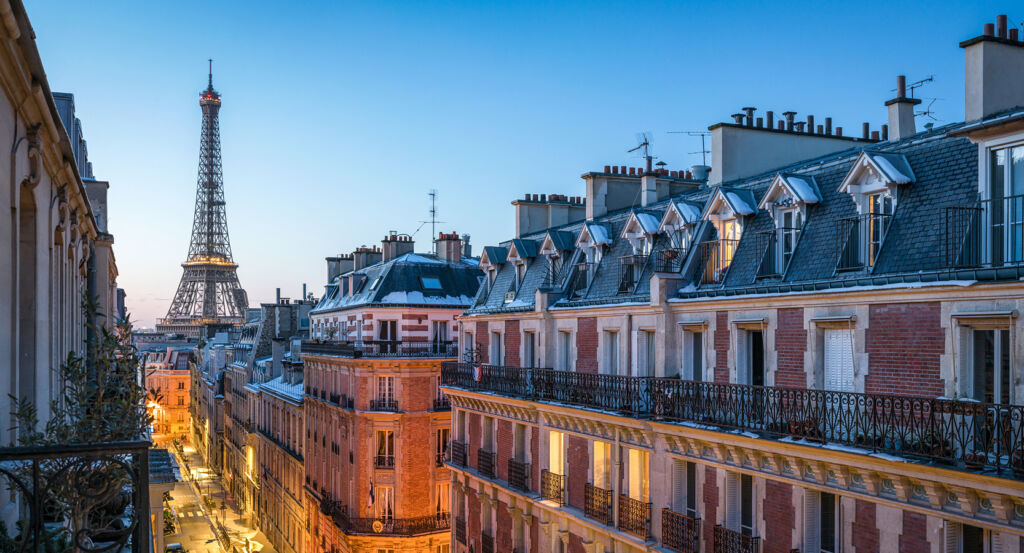
Why Boulevard Poissonnière matters.
Boulevard Poissonnière is a distinguished Faubourg-Montmartre corridor where theatrical heritage, Belle Époque elegance, commercial innovation, and energetic Parisian culture converge along one of the capital's historic Grands Boulevards.
Running through Faubourg-Montmartre between Boulevard Montmartre and Boulevard de Bonne-Nouvelle, this elegant boulevard unfolds through celebrated theaters, grand cafés, historic cinemas, refined Haussmann architecture, lively restaurants, and beautifully preserved streetscapes that embody the enduring character of Central Paris. Broad sidewalks, mature rows of plane trees, richly ornamented façades, and constant pedestrian activity create an atmosphere where entertainment, commerce, and neighborhood life have flourished for more than two centuries. Every section of the boulevard reveals another chapter in the remarkable evolution of Paris' historic entertainment district. The result is a corridor defined by architectural refinement, cultural prestige, and one of the city's most enduring urban avenues.
What defines Boulevard Poissonnière.
Boulevard Poissonnière is best known as one of the original Grands Boulevards created after the demolition of the medieval Wall of Charles V, taking its name from the nearby Porte Poissonnière, where fishmongers from the Channel ports entered Paris along the historic Route des Poissonniers supplying the city's central markets. Completed during the late seventeenth century under the direction of Louis XIV's administration, the boulevard rapidly evolved into one of Europe's foremost promenades before becoming a centerpiece of nineteenth-century Parisian entertainment during the reign of Napoleon III. The avenue is home to the Théâtre des Variétés, inaugurated in 1807 by Napoleon I and designed by architect Jacques Cellerier, where Jacques Offenbach premiered many of his celebrated operettas and playwrights including Eugène Labiche, Georges Feydeau, and Marcel Pagnol helped define the history of French comedy. The boulevard also became synonymous with the Belle Époque through renowned cafés, panoramic entertainment venues, early cinemas, and the nearby Passage Jouffroy and Passage des Panoramas, whose pioneering iron-and-glass shopping arcades transformed retail architecture while reinforcing the Grands Boulevards as the commercial and cultural heart of nineteenth-century Paris. Together, these architectural, theatrical, commercial, and urban achievements established Boulevard Poissonnière as one of the defining corridors in the evolution of modern Parisian public life.
Historic theaters, beautifully preserved Haussmannian façades, celebrated covered passages, and generations of cultural institutions continue illustrating how the boulevard has remained one of Paris' great centers of entertainment for more than three centuries. The enduring relationship between royal urban planning, Belle Époque creativity, theatrical innovation, and commercial enterprise demonstrates why Boulevard Poissonnière continues occupying a unique place within the historic Grands Boulevards. Few Parisian corridors combine royal planning, performing arts, architectural elegance, and commercial innovation with such extraordinary continuity.
How Boulevard Poissonnière fits.
Boulevard Poissonnière works as an exploration through Faubourg-Montmartre's celebrated theaters, covered passages, and historic boulevards.
Begin at the Théâtre des Variétés, where more than two centuries of theatrical history introduce the extraordinary cultural legacy of the boulevard before strolling beneath its elegant tree-lined sidewalks. Continue through Passage Jouffroy, whose pioneering iron-and-glass architecture reveals one of Europe's finest surviving nineteenth-century shopping arcades. Conclude at the Musée Grévin, where France's celebrated wax museum provides a memorable finale celebrating the remarkable relationship between entertainment, architecture, and Parisian cultural life. The progression moves naturally from theatrical heritage to commercial innovation before culminating in one of the capital's most beloved museums, revealing why Boulevard Poissonnière remains one of Paris' most distinguished historic corridors.
Where your story begins.
Foresyte Travel reveals places that feel extraordinary long before you arrive.
Experience premium editorial crafted for luxury travelers.
Foresyte Travel may earn a commission when you book through the link on this page.














































































































