
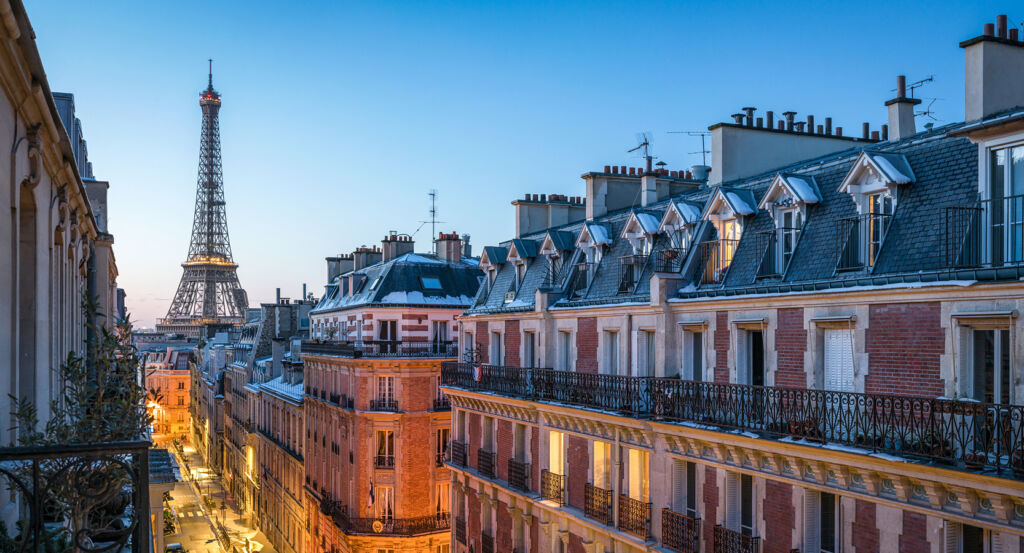
Why Boulevard Saint-Michel matters.
Boulevard Saint-Michel is a renowned Sorbonne corridor where intellectual tradition, revolutionary history, academic excellence, and energetic Left Bank culture converge along one of the capital's most celebrated boulevards.
Running through Sorbonne between Place Saint-Michel and Port-Royal, this grand boulevard unfolds through prestigious universities, historic bookshops, elegant Haussmann architecture, celebrated cafés, independent cinemas, and lively public squares that have defined the intellectual life of Paris for more than a century. Broad tree-lined sidewalks, thriving student terraces, distinguished academic institutions, and beautifully proportioned façades create an atmosphere where scholars, writers, philosophers, and artists have shaped generations of cultural and political thought. Every section of the boulevard reflects another chapter in the remarkable evolution of the Latin Quarter as one of Europe's great centers of learning. The result is a corridor defined by academic prestige, historical significance, and one of Paris' most influential urban avenues.
What defines Boulevard Saint-Michel.
Boulevard Saint-Michel is best known as the grand spine of the Latin Quarter, created by Baron Haussmann between 1855 and 1859 to modernize the medieval Left Bank while linking the Seine with the Paris Observatory through one of the capital's most ambitious urban projects. Named after Place Saint-Michel at its northern end, the boulevard rapidly became the symbolic heart of French academic life, passing institutions including the Sorbonne, founded in 1257 by Robert de Sorbon, and the University of Paris, whose medieval faculties helped establish Paris as Europe's foremost center of higher learning. Throughout the twentieth century the avenue repeatedly became the epicenter of political and intellectual movements, most famously during the May 1968 student protests, when barricades erected along Boulevard Saint-Michel and the surrounding Latin Quarter ignited demonstrations that evolved into a nationwide strike involving nearly ten million workers and fundamentally reshaped French politics, education, labor relations, and social culture. The boulevard also preserves landmark institutions including the Lycée Saint-Louis, the École des Mines de Paris, and generations of historic bookstores, publishers, and cafés that have welcomed figures ranging from Jean-Paul Sartre and Simone de Beauvoir to Ernest Hemingway and James Baldwin. Together, these extraordinary academic, political, literary, and architectural legacies establish Boulevard Saint-Michel as one of the defining intellectual corridors of modern Europe.
Monumental academic buildings, carefully preserved Haussmannian architecture, internationally renowned educational institutions, and a spirited culture of bookselling, debate, and scholarship continue expressing the boulevard's enduring character as the intellectual heart of Paris. The remarkable continuity between medieval universities, nineteenth-century urban planning, and twentieth-century democratic movements demonstrates how successive generations transformed the avenue into a global symbol of education, free inquiry, and civic engagement. Few boulevards anywhere in the world unite university history, revolutionary change, literary achievement, and architectural coherence with such extraordinary influence.
How Boulevard Saint-Michel fits.
Boulevard Saint-Michel works as an exploration through Sorbonne's celebrated academic landmarks and historic Left Bank institutions.
Begin at Place Saint-Michel, where Gabriel Davioud's grand fountain introduces the historic gateway to the Latin Quarter before strolling south along Boulevard Saint-Michel beneath its elegant rows of plane trees. Continue to the Sorbonne, whose nearly eight centuries of academic excellence reveal why Paris became one of the world's foremost university cities. Conclude at the Jardin du Luxembourg, where grand gardens, statuary, and the Palais du Luxembourg provide a memorable finale celebrating the remarkable relationship between scholarship, civic life, and architectural beauty that continues defining the Left Bank. The progression moves naturally from grand urban design to medieval academic heritage before culminating in one of Paris' greatest public gardens, revealing why Boulevard Saint-Michel remains one of the capital's most iconic intellectual corridors.
Where your story begins.
Foresyte Travel reveals places that feel extraordinary long before you arrive.
Experience premium editorial crafted for luxury travelers.
Foresyte Travel may earn a commission when you book through the link on this page.














































































































