
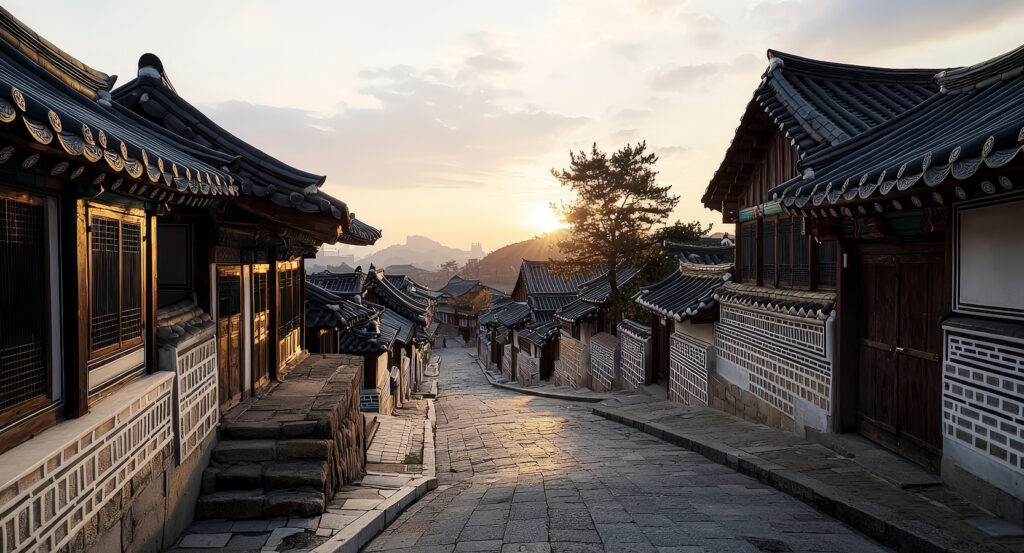
Why you should experience Bukchon Hanok Path in Seoul, South Korea.
Bukchon Hanok Path in Seoul is a quiet masterpiece, a narrow, stone-paved passage where the past breathes softly between the walls.
Winding through a hillside lined with traditional hanok homes, it feels less like a street and more like a living time capsule. Tiled roofs slope gracefully toward the sky, wooden lattice doors cast patterned shadows, and the scent of pine and soy from nearby kitchens lingers in the air. Every turn reveals another layer of Seoul's soul, a grandmother sweeping her stoop, an artist sketching the skyline, a child's laughter echoing through the stillness. The alley's rhythm is slower, deliberate; it asks you to listen. From the top, the view opens to a panorama of tiled eaves descending into the city below, framed by the modern skyline in the distance. The contrast is breathtaking, a seamless discussion between what was and what continues.
What you should know about Bukchon Hanok Path.
Gaho-dong, among the eight historical neighborhoods that make up Bukchon Hanok Village, has roots reaching back over 600 years to the early Joseon Dynasty.
Its name, translating to “Village of Beautiful Goodness”, once referred to the aristocratic district where royal scholars and court officials built their family homes. The narrow alleyways, including this one, were designed according to Confucian spatial harmony: south-facing roofs for sunlight, gently curving paths for the flow of wind and gi (life energy). Unlike the grand palaces nearby, Bukchon's hanoks reflected intimacy and restraint, inner courtyards for reflection, stone foundations for stability, and paper-lined doors that blurred the line between inside and out. During the 20th century, as Seoul modernized, many hanoks were demolished; but Gaho-dong endured, thanks to a small group of residents who resisted redevelopment and restored their homes by hand. When the area was designated a preservation district in the 1980s, Gaho-dong became a model for heritage revival, among the few places in Seoul where you can still walk an unbroken pattern of Joseon-era lanes. Few realize that beneath its cobblestones run original drainage channels from the 15th century, still functioning today. The neighborhood's rooflines were rebuilt using traditional joinery without nails, and each home's ridge ornament (chimi) carries unique family motifs, cranes, clouds, and lotus flowers representing peace, fortune, and enlightenment.
How to fold Bukchon Hanok Path into your trip.
Bukchon Hanok Path is best experienced in stillness, not as a photo stop, but as a living conversation with Seoul's memory.
Arrive early, just after sunrise, when the alleys are empty and the light paints soft gold across the roof tiles. Begin your walk near Bukchon-ro 11-gil, following the gentle slope upward until you reach the higher terrace overlooking Jongno. The climb is gradual, but every few steps, pause to breathe it in, the hush of footsteps on stone, the rustle of wind through wooden rafters, the view of the city stretching like a modern echo beyond the hanok rooftops. Visit one of the small artisan studios tucked between homes, potters, calligraphers, and paper-makers who continue crafts passed down through generations. If you linger until dusk, lanterns begin to glow behind wooden screens, filling the alley with warmth and quiet life. For the perfect pairing, stop at one of the nearby teahouses or cultural centers where you can learn hanji paper folding or traditional etiquette, experiences that bring the alley's history into your hands. Bukchon Hanok Path in Seoul isn't just a street, it's Seoul distilled to its essence: graceful, resilient, and alive with the whisper of centuries.
Where your story begins.
Foresyte Travel reveals places that feel extraordinary long before you arrive.
Experience premium editorial crafted for luxury travelers.

















































































































