Why Saladin Citadel matters.
Saladin Citadel is a twelfth-century fortified complex where Islamic Cairo's military history meets the Ayyubid consolidation of Egypt, the architectural patronage of successive ruling dynasties and the transformation of a medieval stronghold into the seat of Egyptian government.
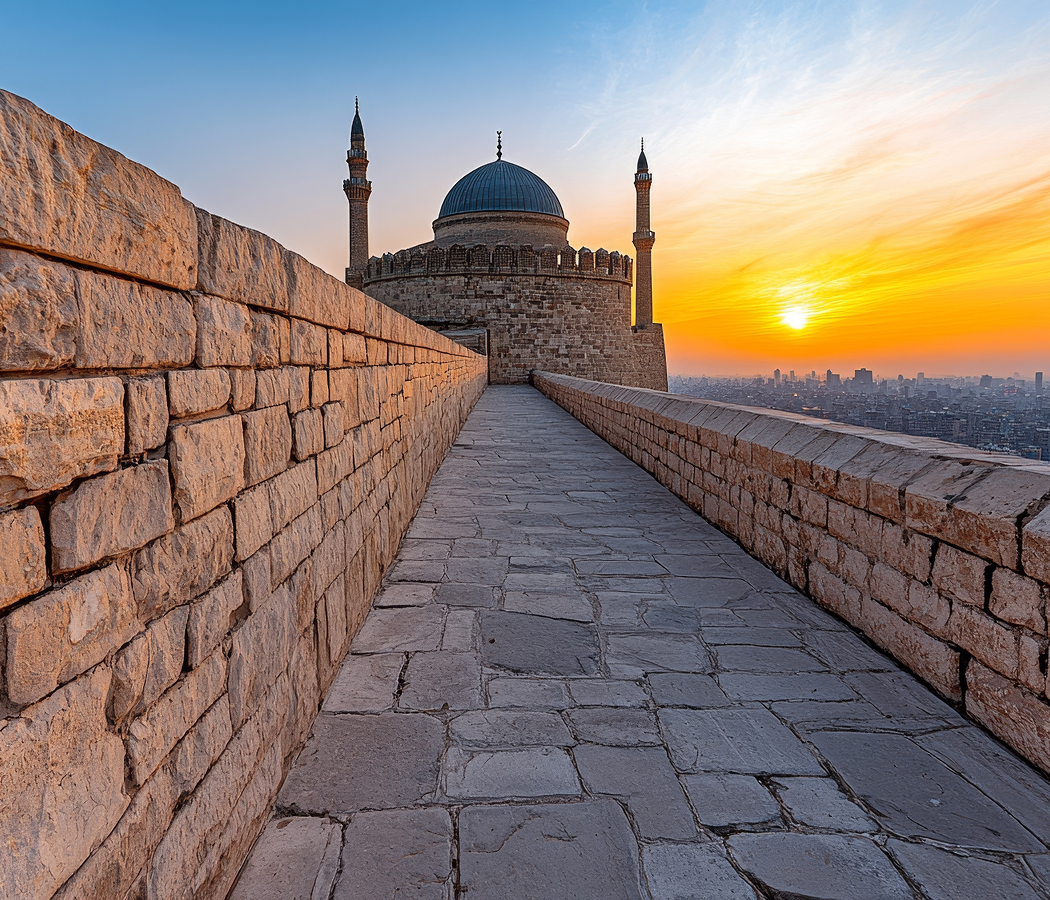
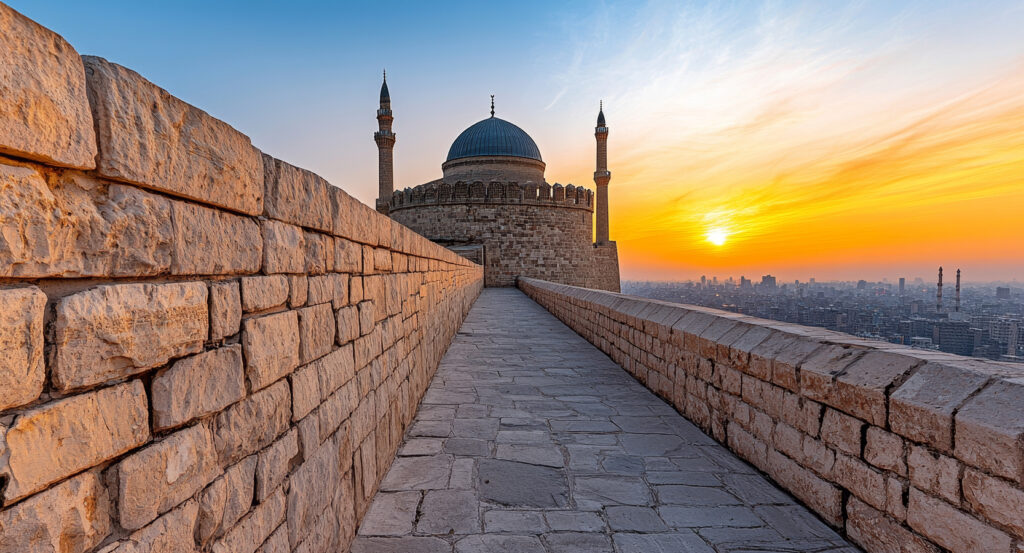
Set atop the Muqattam foothills near Salah Salem Road and a short drive from Al-Sayeda Aisha Square, the citadel occupies a limestone promontory above Cairo's historic southern districts, overlooking the mosques of Al-Darb al-Ahmar, the former royal precincts below and the Nile Valley extending westward. Defensive walls and towers follow the irregular contours of the elevated terrain. Expansive gateways connect enclosed courtyards, former administrative buildings and religious structures constructed across successive centuries. The principal mosque rises above the surrounding fortifications, establishing the complex's silhouette against the eastern hills. The result is a fortified governmental precinct whose elevated position connects military defense, dynastic authority and Cairo's historical development.
What defines Saladin Citadel.
Saladin Citadel is best known for its foundation by Sultan Salah al-Din, its role as the seat of Egyptian government for nearly seven centuries and its concentration of Ayyubid, Mamluk and Ottoman architecture. Salah al-Din assumed control of Egypt in 1169 and subsequently ended the Fatimid Caliphate in 1171, establishing the foundations of Ayyubid rule. His military campaigns required stronger defenses for Cairo against the threat of Crusader incursions. In 1176, construction began on a fortified complex overlooking the city from the Muqattam foothills. The project formed part of a broader defensive program that included plans for walls connecting Cairo with the older settlement of Fustat. Salah al-Din selected the elevated site for its strategic advantages, including extensive views across the surrounding urban landscape. Construction incorporated substantial limestone masonry, defensive towers and fortified entrances designed to control access to the plateau. The citadel was completed and expanded under subsequent Ayyubid rulers, becoming the principal residence and administrative center of Egypt's ruling elite. Sultan al-Kamil developed the complex during the early thirteenth century, strengthening its residential and governmental functions. The Mamluk Sultanate subsequently transformed the citadel through the construction of palaces, ceremonial halls and religious buildings. Sultan al-Nasir Muhammad undertook major architectural projects during the fourteenth century, reinforcing the fortress's position as the center of Mamluk government. Ottoman rule began in 1517, introducing new administrative arrangements and architectural additions while preserving the citadel's governmental role. Muhammad Ali Pasha assumed control of Egypt in 1805 and initiated extensive reconstruction during the nineteenth century. His building program replaced substantial portions of the earlier palace complex with new military, administrative and religious structures. The citadel remained associated with Egyptian government until the transfer of the principal seat of power to Abdeen Palace during the reign of Khedive Ismail. Its surviving buildings preserve successive phases of military construction and state patronage within a single fortified precinct.
Muhammad Ali Pasha's nineteenth-century reconstruction established the architectural composition that dominates the citadel's upper enclosure. The Mosque of Muhammad Ali, constructed between 1830 and 1848, occupies a commanding position above the older fortifications. Designed by architect Yusuf Bushnak, the mosque draws upon Ottoman imperial architecture through its central dome, surrounding semi-domes and slender minarets. Its exterior incorporates extensive alabaster cladding, contributing to its familiar designation as the Alabaster Mosque. The interior contains a large central prayer hall illuminated through windows distributed around the dome and surrounding architectural elements. Decorative surfaces incorporate painted ornament, gilding and expansive chandeliers associated with nineteenth-century Ottoman religious design. The mosque's courtyard contains an elaborate ablution fountain and a clock tower presented to Muhammad Ali by King Louis Philippe of France. Nearby, the Mosque of al-Nasir Muhammad preserves an earlier phase of the citadel's religious architecture. Completed in 1318, the mosque incorporates a hypostyle prayer hall, a central courtyard and minarets distinguished by decorative tilework. Its architectural arrangement preserves elements associated with Mamluk royal patronage. The National Military Museum occupies former palace buildings within the complex, presenting objects associated with Egypt's military history. The Police Museum contains exhibits concerning the development of Egyptian law enforcement and state security institutions. Defensive towers and surviving sections of the Ayyubid walls preserve the military functions underlying the citadel's original construction. Elevated terraces provide views across the historic city, including dense residential districts and the domes and minarets of medieval Cairo. The combination of fortifications, mosques and former governmental buildings preserves the architectural consequences of successive ruling dynasties.
How Saladin Citadel fits.
Saladin Citadel works as the fortified centerpiece for an Islamic Cairo itinerary connecting Mamluk religious patronage, medieval urban infrastructure and the surviving architecture of Egypt's historic capital.
Begin at Sultan Hassan Mosque and Madrasa, the fourteenth-century religious complex situated immediately below the citadel's western approaches. Sultan al-Nasir Hassan commissioned the building in 1356, establishing one of the largest religious institutions constructed during the Mamluk period. Its expansive entrance leads into a central courtyard surrounded by four vaulted iwans associated with the principal Sunni schools of Islamic jurisprudence. The complex incorporates teaching spaces, residential facilities and a mausoleum intended for the sultan. Its massive stone façades and architectural proportions demonstrate the resources devoted to royal religious patronage during the Mamluk Sultanate. Continue to Al-Rifa'i Mosque, the nineteenth-century religious complex standing beside Sultan Hassan's earlier foundation. Construction began in 1869 under the patronage of Khushyar Hanim, mother of Khedive Ismail, and the building was completed in 1912. Its architectural design incorporates forms associated with medieval Egyptian religious monuments, creating a deliberate relationship with the neighboring Mamluk complex. The mosque contains the tombs of members of Egypt's Muhammad Ali dynasty, including King Farouk. Shah Mohammad Reza Pahlavi of Iran was also buried within the building following his death in 1980. Its funerary associations connect Egyptian royal history with the political changes of the twentieth century. Conclude at Bab Zuweila, the surviving southern gate of medieval Fatimid Cairo. Constructed during the eleventh century, the gateway formed part of the city's defensive walls and controlled movement along the southern commercial approaches. Its two substantial stone towers support the minarets of the adjacent Mosque of al-Mu'ayyad Shaykh, constructed during the early fifteenth century. The gate became associated with public ceremonies, processions and punishments under successive medieval rulers. Its surviving masonry preserves the scale and defensive organization of the Fatimid city's fortifications. The progression moves from Mamluk religious architecture through nineteenth-century royal commemoration and culminates at a Fatimid city gate, connecting Saladin Citadel with Cairo's medieval political and architectural development.
Where your story begins.
Foresyte Travel reveals places that feel extraordinary long before you arrive.
Enjoy editorial crafted for luxury travelers.
Foresyte may earn a commission when you book.