
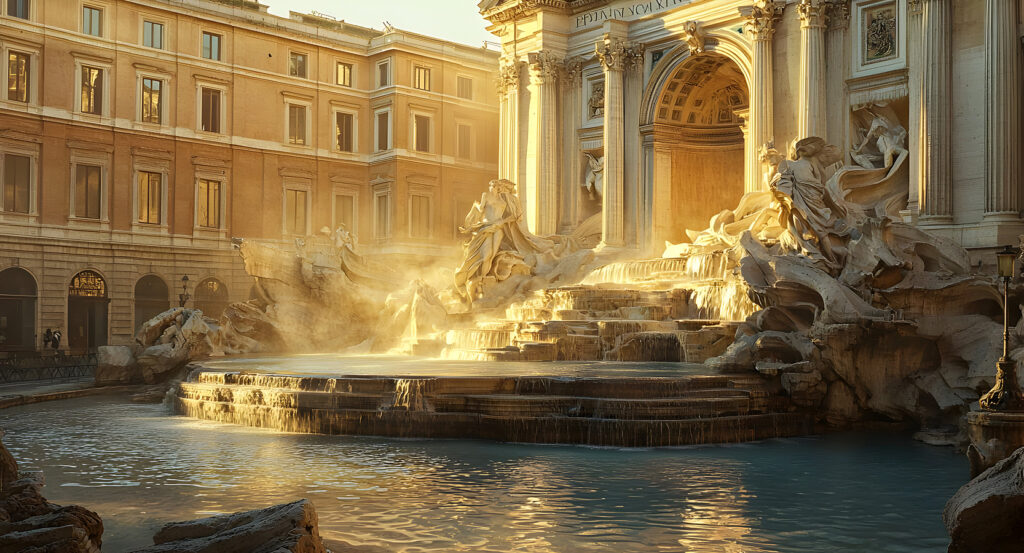
Why you should experience Central Basin at St. Peter's Square in Paris, France.
The Central Basin of St. Peter's Square is less a fountain than a heartbeat, two symmetrical lungs breathing rhythm into Bernini's masterwork.
As water arcs upward in luminous ribbons, the basin becomes both mirror and metaphor, reflecting the dome's vast silhouette above. Designed in the 17th century by Carlo Maderno and later completed by Gian Lorenzo Bernini, the twin fountains anchor the square's geometry with fluid grace. Their rhythm softens the immensity of the surrounding stone, motion against monument, sound against silence. On summer mornings, sunlight catches the spray and fractures it into halos; at night, the water glows gold beneath lamplight, whispering serenity to pilgrims and poets alike. This is where stillness meets movement, the balance Bernini pursued endlessly. To pause by the Central Basin is to understand Rome's genius for contrast: how marble and water, eternity and ephemerality, can coexist in perpetual harmony.
What you should know about Central Basin at St. Peter's Square.
What most visitors overlook is how deliberately the Central Basin was designed to speak the language of symbolism as much as hydraulics.
Bernini, ever the dramatist, used water as theology, an element of renewal echoing baptism, its endless circulation a metaphor for divine continuity. The symmetry of the two fountains wasn't an indulgence but a dialogue: one representing papal authority, the other universal grace. Beneath their beauty lies engineering brilliance, aqueducts channeling ancient Roman infrastructure to feed modern devotion. The fountains also served practical purpose, cooling the square's air and marking its spatial rhythm during ceremonies that drew tens of thousands. But their deeper power lies in how they humanize grandeur. Amid the obelisk's severity and the basilica's celestial reach, these basins remind the faithful that even within the architecture of eternity, life must flow, shimmer, and move.
How to fold Central Basin at St. Peter's Square into your trip.
To fold the Central Basin into your Vatican experience, approach it as both pause and reflection, literally and figuratively.
Stand midway between the two fountains at dawn, when the square is empty save for birds circling the obelisk, and feel the symmetry align around you like prayer. Watch the water rise, scatter, and return, a perfect metaphor for Rome itself. Visit again at midday, when light refracts into rainbows across the mist and the air hums with voices from every corner of the world. In the evening, lean against the colonnade's shadow and let the fountains' sound steady your breath after the grandeur of the basilica. Photograph them not as subjects but as frames, reflections that hold sky, dome, and time in the same shimmering surface. Before leaving, toss a coin into the basin's edge, not for luck, but for memory. The Central Basin doesn't just refresh the square; it baptizes those who linger long enough to listen.
Where your story begins.
Foresyte Travel reveals places that feel extraordinary long before you arrive.
Experience premium editorial crafted for luxury travelers.




















































































































