Why Cloud Gate matters.
Cloud Gate is an expansive reflective sculpture where the Loop's vertical architectural density meets Anish Kapoor's liquid-mercury form, seamless stainless-steel engineering and a concave underside that folds Chicago's skyline, sky and human movement into continuously changing reflections.
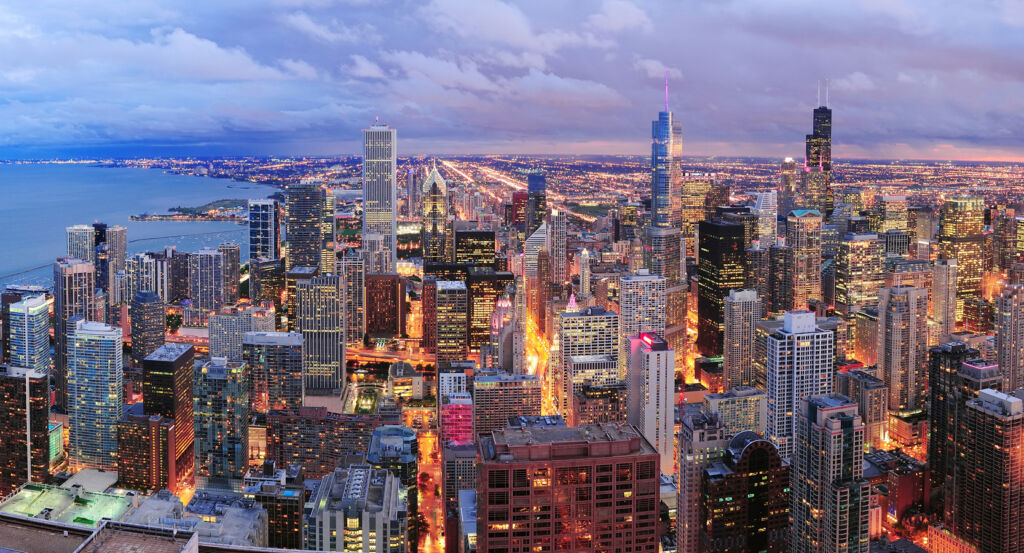
Set within Millennium Park near East Randolph Street and just steps from Michigan Avenue, the sculpture occupies the park's western edge between the historic Michigan Avenue streetwall, Grant Park extending south and the high-rise corridor rising north toward the Chicago River. The 66-foot-long elliptical body rises 33 feet above the plaza and spreads 42 feet across, concentrating a 110-ton mass onto two base points beneath an uninterrupted mirrored shell. A 12-foot arch cuts through the lower body and opens into a concave chamber, allowing movement beneath the sculpture as reflections multiply across its curved ceiling. Polished steel captures buildings, clouds and people at radically different scales as convex exterior surfaces stretch the surrounding city and the underside compresses figures toward its central apex. The result is a public sculpture whose physical mass nearly disappears behind reflection, curvature and pedestrian access, converting Chicago itself into the image carried across its surface.
What defines Cloud Gate.
Cloud Gate is best known for turning Anish Kapoor's interest in reflective form into his first permanent public outdoor work in the United States and one of the most technically demanding sculptures created for Millennium Park. Kapoor presented the design in 1998, developing a form inspired by liquid mercury whose smooth exterior required its enormous metal shell to appear visually continuous. Performance Structures Inc. in Oakland worked with engineer Ethan Silva to translate the compound geometry into 168 individual stainless-steel plates shaped through computer-controlled fabrication. Those components were produced in California and transported separately to Chicago after plans to move a completed sculpture proved impractical. MTH Industries handled erection and finishing on site, joining the plates through more than 2,400 linear feet of welding before an intensive grinding and polishing sequence erased the visible joints. Internal engineering suspends the shell from two stainless-steel rings and tethers it at one end, allowing expansion and contraction through Chicago's large temperature swings without transferring distortion into the mirrored exterior. The final exterior panel entered position in June 2004, and the assembled sculpture stood publicly during Millennium Park's July opening even though finishing work remained incomplete. A temporary enclosure went around the sculpture in January 2005 so crews could complete sanding, grinding and polishing before the finished artwork received its dedication on May 15, 2006. The completed project cost $20 million, including $3 million supplied by SBC, and private funding underwrote the commission. Plaza reconstruction restricted access beginning in August 2023 before the surrounding area reopened in June 2024 with accessibility and infrastructure improvements completed.
Kapoor's mirror-polished steel controls the sculpture through reflection, using compound curvature to transform a fixed metal surface into an image that changes with position. The convex exterior receives the skyline across a continuously bending plane, stretching vertical buildings as their reflected light follows the shell away from the observer. Approaching the lower opening changes that optical relationship as the exterior curves inward and the reflected ground begins to rise across the metal. Passing beneath the 12-foot arch places the observer inside the concave chamber Kapoor called the omphalos, where curvature redirects reflected figures across the overhead surface. Multiple images converge, separate and invert as people move through the chamber because different sections of polished steel return light along changing angles. Daylight expands the sculpture's visual field through blue sky and moving cloud cover, and the surrounding towers supply harder vertical lines that bend across the elliptical body. Evening illumination changes the same steel through points of artificial light and darker architectural silhouettes, leaving the physical object unchanged as its visible content shifts. The absence of exposed seams is essential to that optical continuity: weld lines would interrupt reflected buildings and bodies, revealing the shell as an assembly of plates. Performance Structures shaped and trimmed all 168 exterior sections to meet precisely, and MTH Industries' finishing work converted those separate components into the apparent single surface on which the optical effect depends. Cloud Gate derives its power from this union of curvature and extreme surface refinement, making a massive engineered structure visually unstable as Chicago, weather and human movement continually rewrite what appears on the steel.
How Cloud Gate fits.
Cloud Gate works as the opening stop for a Loop route connecting a Gilded Age civic building created for books and Civil War memory, an art museum established in its permanent home during the World's Columbian Exposition and a carriage repository converted into a long-lived community of artists and makers.
Begin at Chicago Cultural Center, completed in 1897 as the first permanent home of the Chicago Public Library and headquarters for the Grand Army of the Republic. Boston architects Shepley, Rutan & Coolidge gave the building a Classical Revival exterior and interiors drawing from Greek, Roman and Italian Renaissance precedents, using marble, bronze, mosaics and stained glass at exceptional civic scale. Preston Bradley Hall contains a Tiffany dome 38 feet in diameter assembled from 30,000 pieces of glass, and another stained-glass dome crowns the Grand Army of the Republic rooms. The library departed after Harold Washington Library Center opened in 1991, when the building became a free municipal cultural center devoted to exhibitions, performances and public programs. Continue to Art Institute of Chicago, whose permanent Michigan Avenue home opened in 1893 in a building created jointly with the city for the World's Columbian Exposition. Shepley, Rutan & Coolidge designed the classical structure, and its Michigan Avenue entrance became the institution's enduring ceremonial front. Sculptor Edward Kemeys's pair of bronze guardian lions arrived the following year, taking their positions on May 10, 1894 and developing into enduring symbols of the museum and Chicago. Conclude at Fine Arts Building, which Solon S. Beman designed for Studebaker in 1885 as a carriage assembly facility and showroom on Michigan Avenue. The Studebaker family converted the property for artists, musicians, architects and craftspeople in 1898, adding three floors during a major remodeling and creating studios that became associated with Chicago's Arts and Crafts and women's suffrage movements. Frank Lloyd Wright, sculptor Lorado Taft and illustrator W. W. Denslow later numbered among occupants of a building that continues to house artists, galleries, instrument makers and performance spaces. The progression moves from civic architecture built around public knowledge through an exposition-era museum that institutionalized Chicago's visual arts ambitions and culminates in an industrial building whose conversion placed artistic production inside the Michigan Avenue corridor itself.
Where your story begins.
Foresyte Travel reveals places that feel extraordinary long before you arrive.
Enjoy editorial crafted for luxury travelers.
Foresyte may earn a commission when you book.