Why Millennium Park matters.
Millennium Park is a transformative civic park where the Loop's architectural innovation, cultural ambition, artistic excellence, and Chicago's global creative character converge.
Positioned between the Chicago Loop and Lake Michigan, this internationally acclaimed urban landscape combines groundbreaking public art, award-winning architecture, striking gardens, outdoor performance venues, interactive fountains, and beautifully designed public spaces that have redefined twenty-first-century urban placemaking. Every pathway reveals another celebrated work of art or architectural achievement, creating a dynamic civic environment where culture, recreation, and design unfold on an extraordinary scale. The result is a destination defined by visionary planning, artistic distinction, and world-renowned public space.
What defines Millennium Park.
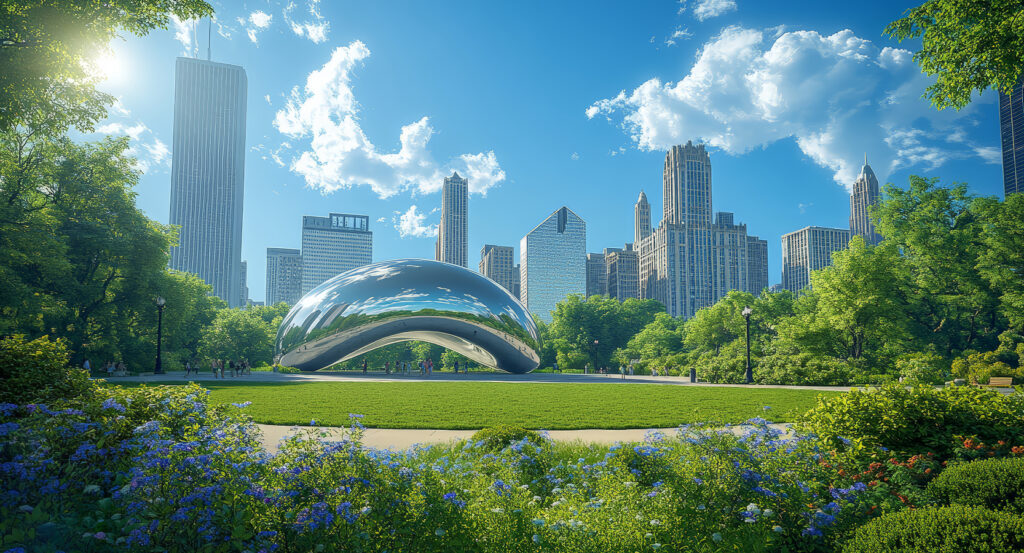
Millennium Park is best known for transforming 24.5 acres of former Illinois Central rail yards and surface parking into one of the world's most influential urban parks, opening in 2004 following a $490 million public-private redevelopment that established a global benchmark for contemporary civic design through internationally acclaimed architecture, engineering, landscape architecture, and public art. Originally envisioned during the late 1990s as part of Chicago's millennium celebrations, the project evolved into one of the most ambitious civic developments in American history through unprecedented collaboration between the City of Chicago, private philanthropists, internationally renowned architects, artists, and engineers. The park's centerpiece, Jay Pritzker Pavilion, was designed by Frank Gehry and features a sweeping stainless-steel bandshell with an advanced trellis-based sound system engineered by Talaske that distributes acoustics across the 4,000-seat pavilion and expansive Great Lawn accommodating 7,000 additional guests. Nearby, Anish Kapoor's Cloud Gate, completed in 2006, weighs 110 tons, consists of 168 precision-polished stainless-steel plates seamlessly welded together, and has become one of the world's most photographed public sculptures. Jaume Plensa's Crown Fountain, completed in 2004, incorporates two 50-foot glass block towers displaying digital portraits of 1,000 Chicago residents through LED technology while water cascades into a shallow reflecting basin inspired by historic gargoyle fountains. Landscape architect Kathryn Gustafson designed Lurie Garden as a 2.5-acre ecological landscape containing more than 240 species and 26,000 perennial plants, symbolizing Chicago's transformation from marshland to global metropolis. The park is further linked to Maggie Daley Park by Frank Gehry's BP Pedestrian Bridge, whose sinuous stainless-steel form simultaneously functions as sculpture, noise barrier, and elevated pedestrian connection across Columbus Drive. Constructed above active commuter rail lines and the Millennium Park Garage, the entire project required exceptionally sophisticated structural engineering, waterproofing systems, and landscape infrastructure while accommodating one of the busiest transportation corridors in the United States. Since opening, Millennium Park has attracted tens of millions of visitors annually, generated billions of dollars in tourism and economic activity, and fundamentally reshaped international thinking about the role of public space in contemporary cities.
The architectural experience unfolds through an extraordinary concentration of internationally recognized works by Frank Gehry, Anish Kapoor, Jaume Plensa, Kathryn Gustafson, Renzo Piano, and SOM, creating one of the world's greatest collections of contemporary civic design within a single public landscape. Advanced engineering, sustainable planting strategies, expansive public art, innovative acoustical design, and seamlessly integrated infrastructure demonstrate how architecture, landscape architecture, engineering, and cultural programming can collectively redefine an urban center. Every element reinforces Millennium Park's position as one of the most influential public spaces of the twenty-first century, where artistic vision, technical innovation, and civic investment combine to create one of the world's defining urban parks.
How Millennium Park fits.
Millennium Park works as part of an exploration through Chicago's celebrated civic core.
Begin at Cloud Gate, where Chicago's most recognizable public artwork introduces the park before exploring Millennium Park's celebrated landscapes and architecture. Continue across the BP Pedestrian Bridge into Maggie Daley Park, whose innovative recreational landscapes complement Millennium Park's artistic vision. Conclude at the Art Institute of Chicago, where one of the world's premier art museums provides a memorable finale celebrating Chicago's extraordinary cultural legacy. The progression moves naturally from internationally acclaimed public art to visionary landscape architecture before concluding with one of America's greatest museum collections, revealing why Millennium Park has become the cultural heart of modern Chicago.
Where your story begins.
Foresyte Travel reveals places that feel extraordinary long before you arrive.
Enjoy editorial crafted for luxury travelers.
Foresyte may earn a commission when you book.