Why you should experience Club Campestre Teotihuacán in Teotihuacán, Mexico.
Club Campestre Teotihuacán is expansive calm shaped by land, horizon, and deliberate distance, a place where Teotihuacán is not approached as a compressed excursion, but as a surrounding presence that unfolds slowly across open space, silence, and scale.
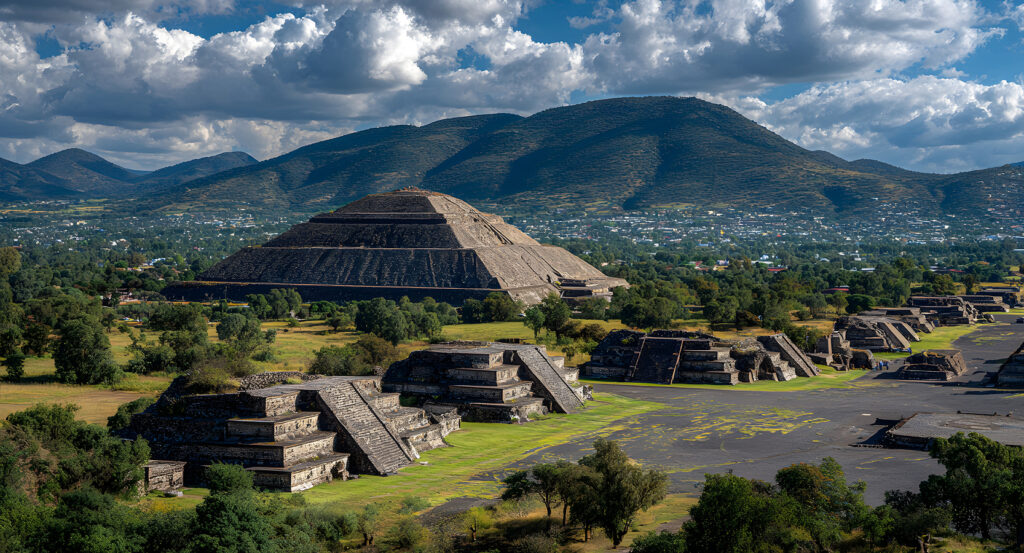
Set beyond the immediate perimeter of the archaeological zone, the property establishes its character through openness rather than proximity, offering a rare sense of breathing room in a region defined by monumentality. Arrival feels like a release from compression: wide skies replace corridors, long sightlines replace walls, and the pace of movement adjusts almost involuntarily. The environment is rural rather than curated, grounded in the logic of land use rather than hospitality theater. Architecture is low and unobtrusive, designed to sit within the terrain rather than rise above it, allowing the surrounding landscape, fields, distant pyramidal silhouettes, volcanic soil, and sky, to remain the dominant visual language. Public spaces feel unforced and utilitarian in the most respectful sense, structured to support gathering, rest, and extended presence. There is no aesthetic performance here; the property communicates confidence through restraint and scale. Guest accommodations reflect this same land-first philosophy. Rooms are straightforward, spacious, and calm, designed to support rest after long days outdoors. Beds are comfortable and grounding, emphasizing recovery over indulgence. Windows open toward open land rather than neighboring structures, allowing light, air, and horizon to shape the interior atmosphere throughout the day. Bathrooms are functional and clean, prioritizing reliability and ease. Sound is best known for distance itself, wind, birds, and open quiet replace urban noise, creating an environment where rest feels natural. Service at Club Campestre Teotihuacán is warm, direct, and grounded. Interactions feel local and sincere, shaped by familiarity with the land rather than hospitality scripting. Staying here feels like choosing space over performance, horizon over highlight, and a relationship with landscape rather than itinerary, making it especially compelling for travelers who want Teotihuacán to be experienced as a geographic and resonant environment, not just an archaeological site.
What you should know about Club Campestre Teotihuacán.
Club Campestre Teotihuacán was shaped around use of land rather than display of heritage, and that distinction defines its character more than any single amenity.
Unlike properties designed to capitalize on immediate adjacency to the pyramids, Club Campestre operates from a broader spatial philosophy: that understanding Teotihuacán requires distance as much as closeness. The surrounding region has long been agricultural and communal, shaped by cycles of cultivation, weather, and seasonal rhythm. The property reflects this lineage by prioritizing openness, horizontal movement, and outdoor presence. Architectural decisions avoid enclosure and visual obstruction, allowing guests to remain oriented to sky, terrain, and horizon. This orientation changes how Teotihuacán is perceived. Rather than appearing as isolated monuments, the pyramids become part of a larger land system, visible from afar, contextualized by geography rather than framed theatrically. Over time, Club Campestre has served as a gathering place for extended stays, retreats, academic groups, families, and travelers who prefer immersion over intensity. Updates and improvements have focused on maintaining usability, comfort, and land stewardship. The property's character has remained stable precisely because it does not attempt to compete with the archaeological site for attention. Staff culture mirrors this grounded continuity. Service is practical, welcoming, and unpretentious, shaped by local knowledge and familiarity. Guidance offered to guests reflects lived understanding of the region, when to visit the site, how weather shifts affect experience, and where stillness matters most. In a tourism landscape increasingly driven by immediacy and visual capture, Club Campestre Teotihuacán stands apart by committing to distance, scale, and patience, offering a way to engage one of Mexico's most significant landscapes without compressing it into a single moment.
How to fold Club Campestre Teotihuacán into your trip.
Club Campestre Teotihuacán works as a spatial counterweight, especially for travelers who want Teotihuacán to be absorbed gradually.
Begin your days with openness. Mornings here unfold under wide skies, with space to orient your body before the itinerary. From the property, approaching the archaeological zone becomes a deliberate act. Arriving after time spent in open land changes perception, the pyramids feel less abrupt, more integrated, their scale easier to process. After visiting the site, returning to Club Campestre feels restorative. The openness allows experiences to settle. Afternoons are well spent outdoors: walking the grounds, sitting with the horizon, or simply allowing the absence of noise to recalibrate attention. There is no pressure to fill time, and that absence becomes part of the experience. Evenings here carry a rare quiet. As the sky darkens and temperatures cool, the lack of urban interference allows reflection to deepen. Meals feel unhurried, conversations slow, and sleep arrives. Over multiple nights, a broader rhythm emerges, one shaped less by attraction density and more by land, light, and distance. By the time you depart, Club Campestre Teotihuacán will not feel like a hotel you stayed at, but like a spatial view through which Teotihuacán became legible, allowing the ancient city to be understood not only through stone and structure, but through its relationship to the land that has held it for centuries. In a world that often demands immediacy, this kind of stay offers something increasingly rare: scale, patience, and the permission to let meaning unfold slowly.
Where your story begins.
Foresyte Travel reveals places that feel extraordinary long before you arrive.
Experience premium editorial crafted for luxury travelers.