Why Congress Parkway matters.
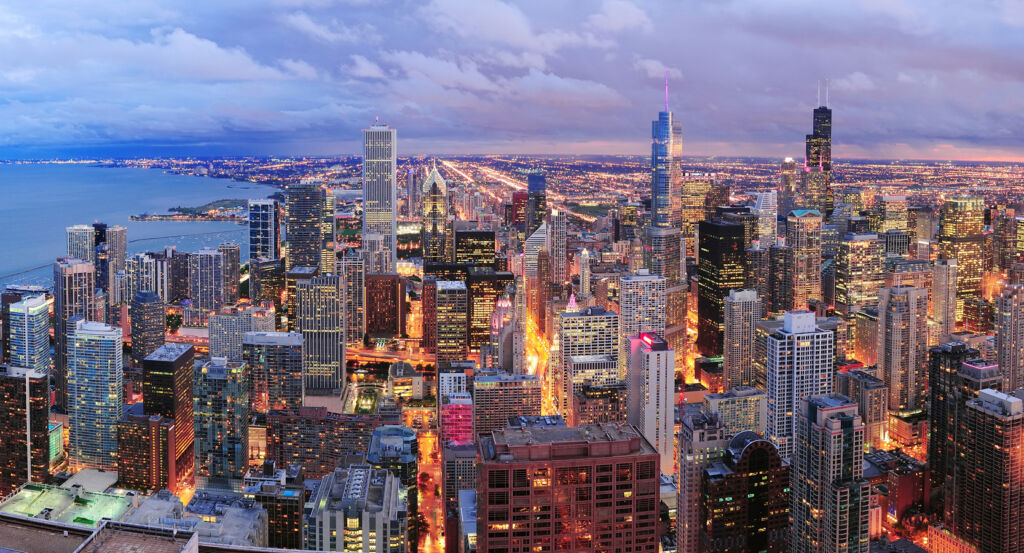
Congress Parkway is an influential corridor where the Loop's civic ambition, architectural innovation, transportation legacy, and Chicago's urba character converge along one of the city's defining east-west avenues.
Running through the Loop between the West Loop and Grant Park, Congress Parkway connects government buildings, university campuses, transportation infrastructure, museums, and nationally significant civic spaces that collectively reflect more than a century of metropolitan planning. The corridor reveals how visionary urban design, expressway engineering, institutional growth, and public investment reshaped Downtown into one of the world's foremost urban centers. Expansive civic architecture, modern office towers, landscaped medians, and carefully integrated transportation infrastructure continue defining the parkway while reinforcing its enduring significance. The result is a corridor distinguished by civic leadership, architectural excellence, and transformative urban planning.
What defines Congress Parkway.
Congress Parkway is best known for realizing architect Daniel Burnham's 1909 Plan of Chicago, which envisioned a grand east-west civic boulevard linking Downtown with the western portions of the city through an expansive transportation corridor. Construction accelerated during the 1950s with development of the Congress Expressway, later incorporated into the Eisenhower Expressway (Interstate 290), under the leadership of the Illinois Department of Transportation and the Chicago Department of Public Works, fundamentally reshaping transportation across metropolitan Chicago. The corridor integrates the CTA Blue Line within the expressway median, creating one of the nation's earliest examples of rapid transit operating within an interstate highway right-of-way while strengthening connections between downtown, the Near West Side, and O'Hare International Airport. Congress Parkway also anchors major civic institutions including the Harold Washington Library Center, The Art Institute of Chicago, University of Illinois Chicago, Old St. Patrick's Church, and the Museum Campus through direct east-west access linking government, education, culture, and transportation. Continued streetscape improvements, transportation modernization, and preservation of Burnham's civic vision have maintained Congress Parkway as one of Chicago's most historically important urban corridors.
Creation of Congress Plaza, restoration of historic bridge structures crossing the South Branch of the Chicago River, and successive investments coordinated by the Chicago Department of Transportation, the Chicago Metropolitan Agency for Planning, and the Chicago Loop Alliance strengthened the parkway's role as both a transportation artery and civic gateway. Engineers working on the Congress Expressway established nationally influential standards for integrating interstate highways, rail transit, grade-separated intersections, and downtown circulation into a single coordinated transportation system. Long-term investment in streetscape improvements, bicycle infrastructure, pedestrian accessibility, public art, and adjacent institutional expansion collectively demonstrates how planning, engineering, architecture, higher education, and civic stewardship continue reinforcing Congress Parkway's importance. Together, Daniel Burnham, the 1909 Plan of Chicago, the Eisenhower Expressway, Interstate 290, the CTA Blue Line, Congress Plaza, the Chicago Metropolitan Agency for Planning, the Chicago Loop Alliance, the University of Illinois Chicago, the Harold Washington Library Center, and decades of transportation innovation establish Congress Parkway among Chicago's most historically significant civic corridors.
How Congress Parkway fits.
Congress Parkway works as an exploration of Chicago's civic planning, architectural legacy, and downtown cultural institutions.
Begin at Buckingham Fountain, where one of Grant Park's defining civic spaces introduces Daniel Burnham's vision for Chicago's expansive public landscape before naturally expanding into the broader story of Congress Parkway. Continue to Harold Washington Library Center, where one of the world's largest public library buildings reflects the city's enduring investment in education, architecture, and civic life before guiding the experience toward its conclusion. Conclude at The Art Institute of Chicago, where internationally renowned collections and Beaux-Arts architecture provide the historical and cultural payoff, illustrating how Burnham's civic vision, institutional leadership, and public investment continue shaping the Loop. The progression moves naturally from expansive public space to civic learning before concluding with one of Chicago's foremost cultural institutions.
Where your story begins.
Foresyte Travel reveals places that feel extraordinary long before you arrive.
Enjoy editorial crafted for luxury travelers.
Foresyte may earn a commission when you book.