
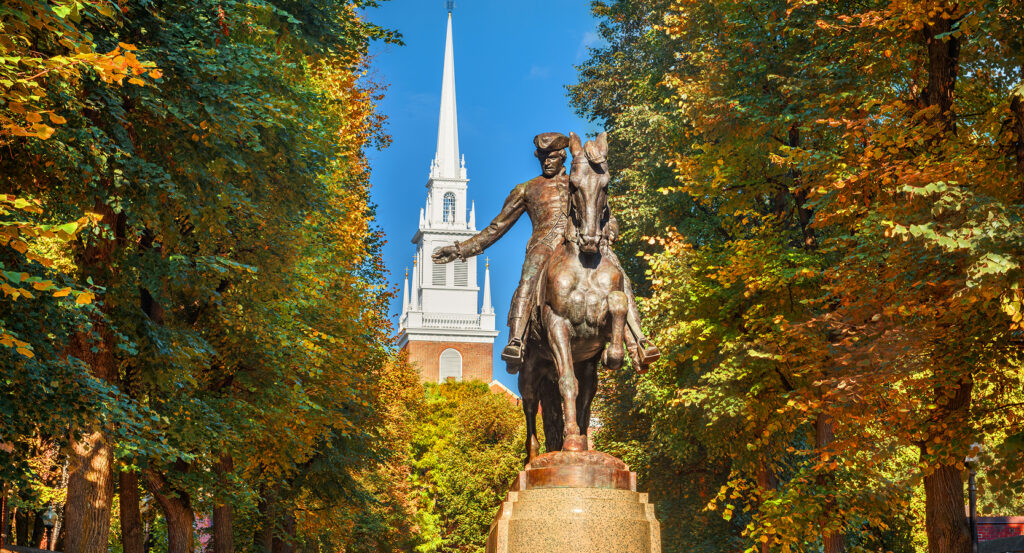
Why Copp's Hill Burying Ground matters.
Copp's Hill Burying Ground is a historic colonial cemetery where North End's Revolutionary heritage, maritime history, enduring craftsmanship, and centuries of remembrance preserve one of Boston's oldest surviving landscapes.
Set along Hull Street near Charter Street and just steps from Old North Church, this peaceful hilltop cemetery surrounds visitors with weathered slate gravestones, family tombs, winding paths, mature shade trees, and sweeping views toward Charlestown and Boston Harbor. Colonial funerary art, remarkable stone carvings, and centuries of preserved history create an atmosphere that vividly connects visitors with Boston's earliest generations. Every monument tells another chapter in the city's colonial past. The result is an experience defined by historical depth, architectural character, and one of Boston's most significant colonial burial grounds.
What defines Copp's Hill Burying Ground.
Copp's Hill Burying Ground is best known for serving as Boston's second oldest burying ground, established in 1659, while preserving the resting places of more than 10,000 people whose lives collectively document the city's evolution from a small colonial settlement into one of Revolutionary America's most influential ports. Originally known as the North Burying Ground, the cemetery occupies two acres atop one of the North End's highest elevations, expanding several times between the seventeenth and nineteenth centuries as Boston's population rapidly increased. During the American Revolution, its commanding position overlooking Boston Harbor gave the site exceptional military importance, prompting British forces to construct the North Battery beside the cemetery, from which artillery directed the bombardment of Bunker Hill and the burning of Charlestown in 1775. Local tradition holds that British soldiers used the gravestone of merchant and outspoken Patriot Captain Daniel Malcolm for target practice, with distinctive circular scars still visible today. The cemetery also contains the family tomb of the influential Mather ministers, Increase, Cotton, and Samuel Mather, alongside the graves of Prince Hall, founder of Black Freemasonry; Robert Newman, who helped display the lantern signals from Old North Church during Paul Revere's famous ride; Edmund Hartt, master shipbuilder of USS Constitution; and numerous merchants, artisans, sailors, and members of Boston's early African American community. Listed on the National Register of Historic Places in 1974 and incorporated into Boston's Freedom Trail, Copp's Hill Burying Ground remains one of New England's finest surviving collections of seventeenth- and eighteenth-century funerary art, preserving extraordinary examples of carved slate gravestones, table tombs, and colonial memorial symbolism. Together, Revolutionary history, remarkable funerary craftsmanship, prominent colonial figures, and more than three centuries of preservation establish Copp's Hill Burying Ground as one of Boston's most important historic cemeteries.
The cemetery continues demonstrating how a historic burial ground can preserve the political, religious, maritime, and social history of an entire city through its monuments and landscapes. Carefully maintained pathways, exceptional colonial stone carving, nationally significant historic preservation, and uninterrupted public access reinforce Copp's Hill Burying Ground's standing among America's finest colonial cemeteries while illustrating the extraordinary historical legacy of Boston's North End.
How Copp's Hill Burying Ground fits.
Copp's Hill Burying Ground works as part of an exploration through Boston's historic North End.
Begin at Old North Church, where the famous lantern signal of Paul Revere's ride introduces the Revolutionary history surrounding Copp's Hill Burying Ground before exploring its remarkable gravestones. Continue to Paul Revere House, where the preserved colonial home of Boston's most celebrated patriot provides an intimate glimpse into eighteenth-century life. Conclude at Langone Park, where waterfront views across Boston Harbor and Charlestown provide a memorable finale celebrating the maritime landscape that shaped the neighborhood's remarkable history. The progression moves naturally from Revolutionary history to colonial domestic life before concluding along the harbor that defined Boston's rise, revealing why Copp's Hill Burying Ground remains one of the North End's most compelling historic sites.
Where your story begins.
Foresyte Travel reveals places that feel extraordinary long before you arrive.
Enjoy editorial crafted for luxury travelers.
Foresyte may earn a commission when you book.







































































































