Why Dearborn Street matters.
Dearborn Street is a distinguished corridor where the Loop's civic heritage, architectural innovation, commercial influence, and Chicago's urba character converge along one of the city's defining downtown streets.
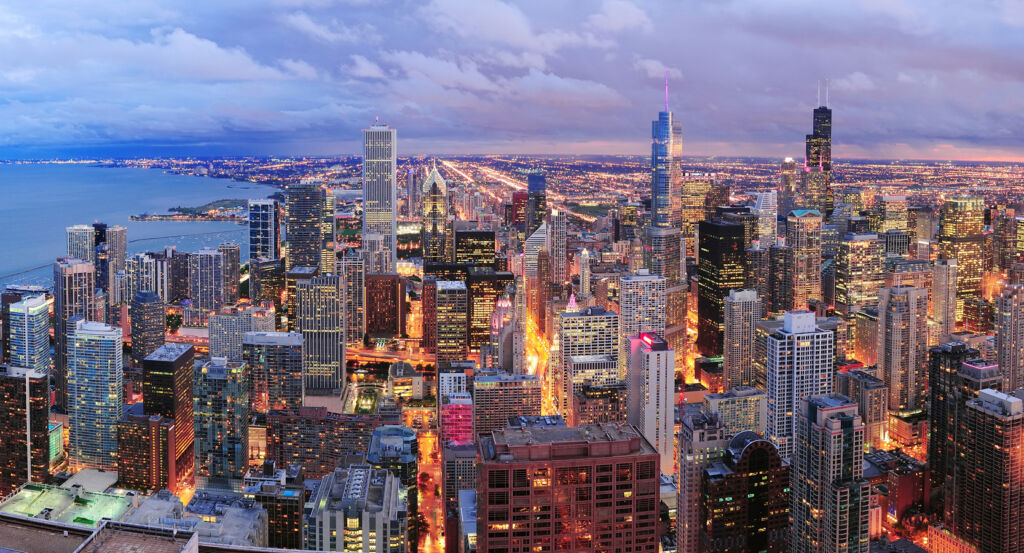
Running through the Loop between the Chicago River and the Near South Side, Dearborn Street connects celebrated office buildings, historic theaters, financial institutions, university campuses, government centers, libraries, and public plazas that collectively reflect more than 180 years of metropolitan development. The corridor reveals how transportation investment, commercial expansion, architectural experimentation, and civic leadership established one of America's most influential business districts. Historic skyscrapers, Beaux-Arts civic buildings, Art Deco towers, and contemporary office architecture continue defining the streetscape while reinforcing its enduring metropolitan character. The result is a corridor distinguished by architectural continuity, institutional prominence, and sustained economic vitality.
What defines Dearborn Street.
Dearborn Street is best known for extending through the Loop, where incorporation of the Town of Chicago in 1837, reconstruction following the Great Chicago Fire of 1871, and expansion of the city's street grid established the corridor as one of downtown's principal commercial and civic thoroughfares. Development between the 1880s and the 1930s introduced pioneering steel-frame skyscrapers including the Monadnock Building, Fisher Building, Marquette Building, Old Colony Building, and Chicago Temple Building, many designed by architects Burnham and Root, Holabird & Roche, Daniel Burnham, William Le Baron Jenney, and Graham, Anderson, Probst & White, helping define the evolution of modern high-rise architecture. Construction of the Chicago “L” Loop beginning in 1897, growth of the Chicago Board of Trade district, expansion of nearby financial institutions, and establishment of major legal, publishing, and insurance offices reinforced Dearborn Street's importance within one of the nation's leading business centers. Designation of the Loop Retail Historic District and preservation of numerous individually designated Chicago Landmarks and National Historic Landmarks, together with continued investment by the City of Chicago and the Chicago Department of Transportation, have preserved the corridor's architectural legacy while supporting modern office, educational, cultural, and commercial activity.
Formation of the Chicago Loop Alliance strengthened downtown stewardship through streetscape improvements, public programming, business advocacy, economic development, and preservation initiatives benefiting Dearborn Street and the surrounding district. Architects including Louis Sullivan, John Wellborn Root, Dankmar Adler, Helmut Jahn, and Skidmore, Owings & Merrill contributed successive generations of office buildings, institutional architecture, and urban design that expanded the corridor's architectural significance across more than a century. Development of protected bicycle infrastructure along Dearborn Street, continued restoration of historic skyscrapers, investment by DePaul University, expansion of the Harold Washington Library Center district, and long-range planning by the Chicago Department of Planning and Development collectively demonstrate how architecture, transportation, higher education, preservation, and civic investment continue shaping the corridor. Together, Daniel Burnham, William Le Baron Jenney, Louis Sullivan, John Wellborn Root, Dankmar Adler, Helmut Jahn, Burnham and Root, Holabird & Roche, the Chicago Loop Alliance, the Chicago “L”, the Loop Retail Historic District, and more than a century of architectural and commercial development establish Dearborn Street among Chicago's most historically significant urban corridors.
How Dearborn Street fits.
Dearborn Street works as an exploration of the Loop's architectural heritage, civic institutions, and commercial history.
Begin at Harold Washington Library Center, where one of the world's largest public library buildings introduces Chicago's commitment to education, civic investment, and distinguished architecture before naturally expanding into the broader story surrounding Dearborn Street. Continue to Monadnock Building, where pioneering load-bearing masonry construction demonstrates a pivotal chapter in skyscraper engineering before guiding the experience toward its conclusion. Conclude at Chicago Cultural Center, where acclaimed interiors, historic civic architecture, and year-round arts programming provide the historical and cultural payoff, demonstrating how architecture, education, and public life continue defining Dearborn Street. The progression moves naturally from civic learning to engineering innovation before concluding within one of Downtown's most celebrated public buildings.
Where your story begins.
Foresyte Travel reveals places that feel extraordinary long before you arrive.
Enjoy editorial crafted for luxury travelers.
Foresyte may earn a commission when you book.