
Why Tokyo Dome City Attractions matters.
Tokyo Dome City Attractions is a kinetic urban amusement park where Korakuen's entertainment history meets high-speed engineering, elevated rides and an unusual amusement landscape threaded directly through Central Tokyo.
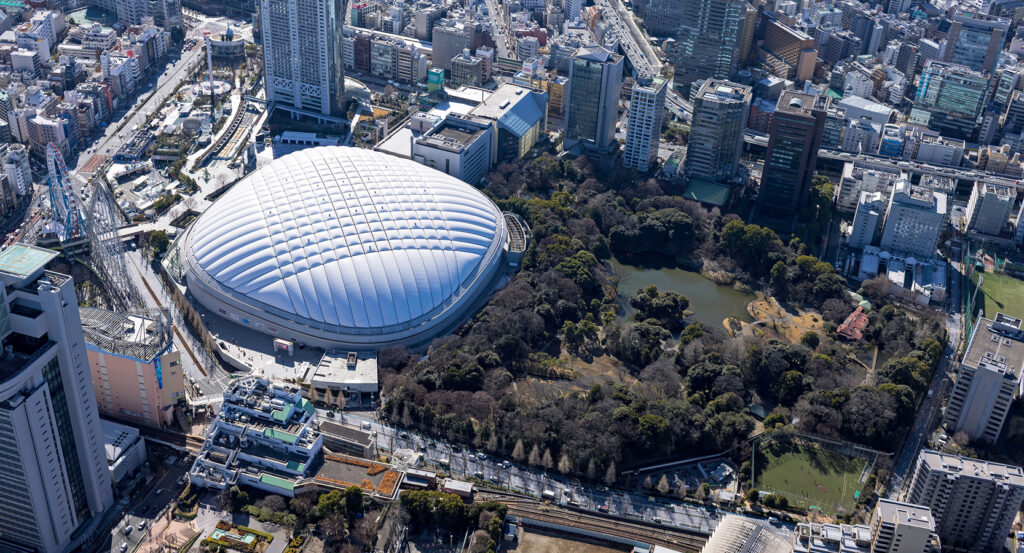
Set along Hakusan-dori near Sotobori-dori and just steps from Tokyo Dome, the amusement park occupies close to 30,000 square meters woven among stadium structures, commercial buildings, pedestrian decks and the railway approaches of Suidobashi and Korakuen. Its free-gate layout dissolves the conventional amusement-park perimeter, allowing rides and public circulation to occupy the same dense metropolitan precinct. Thunder Dolphin climbs through the surrounding architecture before plunging at a maximum angle of 80 degrees and reaching 130 kilometers per hour, sending its track through the open center of Big O and through an opening in the LaQua building. Big O carries its gondolas to a height of 80 meters around a 60-meter-diameter ring with no central axle, placing the skyline, coaster and surrounding towers within the same rotating view. The result is an amusement park whose defining thrill comes from embedding major ride engineering inside the compressed architecture and pedestrian movement of Central Tokyo.
What defines Tokyo Dome City Attractions.
Tokyo Dome City Attractions is best known for developing the former Korakuen Amusement Park across seven decades of experimentation with the possibilities of a dense urban amusement park. Korakuen Amusement Park opened on July 9, 1955 across 26,614 square meters with a Double Ferris Wheel, Octopus, Merry-Go-Round, Great Flying Tower and a roller coaster explicitly named Jet Coaster, helping establish that term in Japanese popular usage. Coaster Land added another 6,900 square meters in 1961 and expanded the ride count to 32, establishing a scale of amusement operation unusual within the center of the city. Another rebuilding in 1968 introduced the 1,500-meter Giants Coaster, Astro Jet and ten new rides alongside the 70-meter Korakuen Tower, whose rotating observation deck became the centerpiece of Tower Land. Parachute Land followed in 1979 with the looping Boomerang coaster and Sky Flower parachute tower, dividing the park among three distinct amusement zones. Geopolis opened underground in 1992, converting the constraints of the site into an asset through a subterranean amusement district whose name combined geo with polis and whose attractions included Hyper Illusion, Geopanic and Zombie Paradise. The decisive reinvention came on April 17, 2003, when the park adopted the Tokyo Dome City Attractions name and eliminated its entrance gate as the surrounding district prepared for the arrival of LaQua. The LaQua Zone followed on May 1 with five new rides led by Thunder Dolphin and Big O, whose centerless structure Mitsubishi Heavy Industries developed by applying engineering principles used to move immense structures through tires and rails. The 60-meter rotating ring contains 40 cabins, reaches 80 meters at its summit and takes 15 minutes to complete a circuit, with the coaster passing directly through its empty center. Thunder Dolphin surpassed 10 million cumulative riders before receiving new trains in April 2023 with redesigned seats, backrests and restraint bars plus LED illumination for nighttime operation. Seventy years after the 1955 debut, July 9 was formally registered as Jet Coaster Day in 2025, connecting the current park directly to the ride whose name became one of Korakuen's most enduring contributions to Japanese amusement culture.
Kamen Rider 2 launched a separate entertainment lineage at Korakuen on January 10, 1971 when the park placed the television hero before children on its outdoor stage. Himitsu Sentai Gorenger brought the Super Sentai series into that tradition in 1976, establishing a live-performance format that continued through successive generations of televised heroes. Expansion of the outdoor stage into a 3,000-person outdoor theater in 1973 increased the physical possibilities of those productions, and later performances incorporated coaster entrances and elaborate special effects into the action. Horror producer Hirofumi Gomi introduced another form of participatory entertainment at Geopolis in 1992, developing haunted attractions around stories that placed the audience inside the dramatic premise and beginning a creative relationship that continued through later incarnations of the park. Redevelopment removed the outdoor theater and produced the 1,500-person Sky Theater in 2000, preserving large-scale live action as the surrounding amusement infrastructure changed. Theatre G-Rosso replaced that stage in 2009 with a three-level performance system designed for integrated sound, lighting, video and wire action, turning decades of outdoor hero performance into a purpose-built theatrical operation. The park's performance history runs alongside its mechanical history as a continuous experiment in bringing television characters, stunt performers, horror direction and specialized stage engineering into direct physical contact with an audience.
How Tokyo Dome City Attractions fits.
Tokyo Dome City Attractions works as the anchor for a daytime route through three nearby sites connecting Tokugawa garden culture, Jigoro Kano's creation of judo and the industrial history of printed communication.
Begin at Koishikawa Korakuen Gardens, where Tokugawa Yorifusa, founder of the Mito branch of the Tokugawa family, established an Edo residence in 1629 and his son Mitsukuni completed its garden. Ming scholar Zhu Shunshui influenced Mitsukuni's design through Chinese references including Engetsu-kyo and Seiko-no-tsutsumi, and the garden's name derives from Fan Zhongyan's Memorial to Yueyang Tower and its principle of placing public responsibility before personal enjoyment. Engetsu-kyo survives from the early Edo period, its arch and reflection forming the full moon that gives the bridge its name. Continue to Kodokan Judo Institute, founded by Jigoro Kano in May 1882 after he synthesized his study of jujutsu into the discipline he named judo. Kano began Kodokan in a rented space at Eishoji temple and developed a system organized around physical technique and broader educational principles; his international influence expanded when he became the first Asian member of the International Olympic Committee in 1909. Kodokan moved repeatedly across Tokyo before settling at its present Kasuga site in 1958, placing the institutional center of Kano's martial art beside the modern Korakuen district. Conclude at Printing Museum, Tokyo, opened in 2000 during TOPPAN's centenary inside the company's Koishikawa building. Its holdings span printed objects, movable type, tools and machinery, and the collection includes the Suruga Edition copper type designated an Important Cultural Property, connecting the mechanics of reproduction with the political, religious and commercial circulation of knowledge. The Printing House extends that history into working practice through letterpress research and preservation, and its specialist library contains close to 70,000 books centered on printing and related fields. The progression moves from Tokugawa Yorifusa and Mitsukuni's seventeenth-century garden through Jigoro Kano's creation of Kodokan judo into TOPPAN's institutional preservation of printing technology, revealing successive forms of cultural production embedded across the districts surrounding Tokyo Dome City Attractions.
Where your story begins.
Foresyte Travel reveals places that feel extraordinary long before you arrive.
Enjoy editorial crafted for luxury travelers.
Foresyte may earn a commission when you book.

















































































































