
Why Tokyo Dome matters.
Tokyo Dome is a colossal indoor stadium where Korakuen's century of mass entertainment meets professional baseball, stadium-scale music and one of Japan's pioneering feats of membrane architecture.
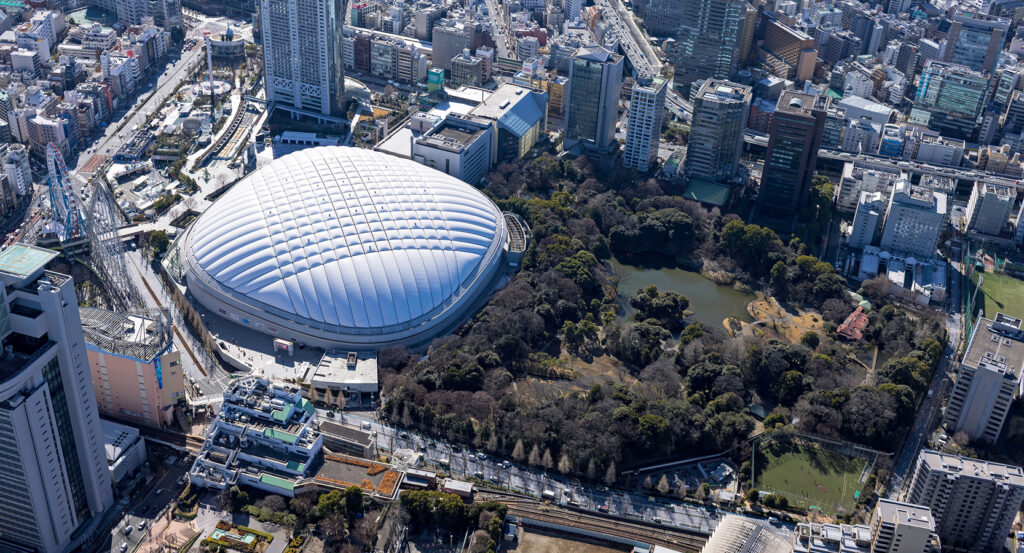
Set along Sotobori-dori near Hakusan-dori and just steps from Suidobashi Station, the stadium dominates a dense entertainment precinct shaped by rail lines, elevated pedestrian routes and the surrounding venues of Tokyo Dome City. Its brilliant white roof rises above the district as a broad elliptical canopy, creating an unmistakable exterior profile without the conventional trusses associated with immense enclosed stadiums. Inside, a 13,000-square-meter field sits beneath a translucent membrane spanning the entire arena, placing baseball and large-scale performances inside an uninterrupted volume capable of holding tens of thousands of people. Seating rises steeply around the field as the roof curves overhead, compressing the immense enclosure into a focused bowl whose proportions remain legible from the upper tiers to the playing surface. The result is a stadium where structural engineering, crowd scale and a tightly packed metropolitan setting turn a familiar sporting format into one of Tokyo's most distinctive large-event environments.
What defines Tokyo Dome.
Tokyo Dome is best known for replacing Korakuen Stadium with Japan's first all-weather multipurpose stadium and introducing air-supported roof engineering to the country's major sporting architecture. Korakuen Stadium had opened in 1937 and became a principal home of professional baseball as the surrounding company expanded into bicycle racing, amusement attractions, bowling and other entertainment businesses. Planning for its successor produced a radically different architectural concept: Nikken Sekkei and Takenaka Corporation designed a stadium whose immense roof would remain aloft through pressurized interior air, eliminating the need for columns across the field. Construction ran from 1985 to 1988, producing a 116,000-square-meter building whose structural system combined reinforced concrete and steel with the air-supported membrane. The stadium opened on March 17, 1988 at a construction cost of ¥35 billion, and the first baseball game followed the next day between the Yomiuri Giants and Hanshin Tigers. Its completion transferred the center of Korakuen baseball into an enclosed stadium able to operate independent of rain, changing the conditions under which major games and events were staged in Tokyo. The Baseball Hall of Fame and Museum simultaneously moved from its 1959 location beside the former stadium into Tokyo Dome and doubled in size, physically carrying the institutional history of Japanese baseball into the new building. Korakuen Stadium subsequently disappeared from the site, and the operating company adopted the Tokyo Dome Corporation name in September 1990 as the stadium increasingly defined the surrounding entertainment district. The building received the 30th BCS Award in 1989 and the JIA 25 Year Award in 2014, recognition spanning both its immediate architectural achievement and its endurance across a quarter century of intensive use. Tokyo Dome joined professional baseball history, corporate transformation and a new structural model in a single project whose 1988 completion reset the physical scale of indoor entertainment in Japan.
Nikken Sekkei and Takenaka Corporation solved the roof's enormous span through a low-rise cable network supporting translucent Teflon-coated fiberglass cloth, creating a membrane thin enough to be held aloft by the pressure of the stadium interior. Indoor air continuously inflates the surface into its characteristic curved form, making atmospheric pressure an active component of the structural system. The roof descends at a 1-in-10 gradient from the infield toward the outfield, an asymmetry introduced to preserve sunlight reaching the neighboring Japanese garden and tying the engineering geometry to conditions outside the stadium. Its translucent fiberglass surface admits daylight across the enclosure, reducing the visual weight of a canopy covering an arena with capacity reaching 55,000 for major configurations. Takenaka's structural work paired the membrane with a reinforced-concrete and steel building extending two levels below ground and six above it, creating the rigid perimeter from which the lightweight roof system operates. A major renovation completed for the 2022 season introduced a new main video display with an area 4.4 times that of its predecessor, followed by a second phase that expanded the combined outfield display system to 1,073 square meters. New gates, concourse interventions, seating configurations and 260 digital displays accompanied that technological overhaul, extending the stadium's engineering history into its fourth decade of operation. The air-supported roof remains the decisive achievement, using cable tension, translucent fabric and controlled interior pressure to cover an immense field with a structural system whose physical lightness belies the scale beneath it.
How Tokyo Dome fits.
Tokyo Dome works as the anchor for a daytime route through three nearby institutions connecting Tokugawa garden culture, the formal preservation of Japanese baseball history and the long development of martial education in Tokyo.
Begin at Koishikawa Korakuen Gardens, established in 1629 when Tokugawa Yorifusa, founder of the Mito branch of the Tokugawa family, began constructing a garden at his Edo residence. His son Mitsukuni completed the landscape with ideas supplied by Ming scholar Zhu Shunshui, whose influence introduced Chinese references including Engetsu-kyo and Seiko-no-tsutsumi alongside Japanese scenic allusions. The Korakuen name derives from Fan Zhongyan's Memorial to Yueyang Tower and its political principle that a ruler should assume concern before the people and enjoyment after them, embedding a theory of government directly into one of Tokyo's oldest surviving daimyo gardens. Continue to Baseball Hall of Fame and Museum, founded beside Korakuen Stadium on June 12, 1959 as Japan's first museum devoted specifically to baseball and transferred into Tokyo Dome when the new stadium opened in 1988. Its Hall of Fame began with six inaugural honorees including Yomiuri Giants founder Shoriki Matsutaro, early baseball organizer Hiraoka Hiroshi and student-baseball pioneer Abe Isoo; by 2026, the institution had inducted 223 people. A specialist library holding 50,000 books, magazines and newspapers extends that commemorative mission into a substantial research collection spanning professional and amateur baseball. Conclude at Kodokan Judo Institute, the institutional home of the martial discipline Jigoro Kano created after synthesizing his study of jujutsu into a new educational system in 1882. Kano began teaching at Eishoji temple before Kodokan expanded through successive Tokyo locations, and his work carried judo from a small school into an international discipline as he developed principles joining physical training with intellectual and moral education. His appointment in 1909 as the first Asian member of the International Olympic Committee connected that educational project with the emerging international sports movement decades before Kodokan established its present Bunkyo headquarters. The progression moves from Tokugawa Yorifusa and Mitsukuni's seventeenth-century political landscape through the institutional preservation of Japanese baseball into Jigoro Kano's creation of modern judo, placing Tokyo Dome within a district where recreation, sport and physical culture have accumulated across radically different periods of Tokyo history.
Where your story begins.
Foresyte Travel reveals places that feel extraordinary long before you arrive.
Enjoy editorial crafted for luxury travelers.
Foresyte may earn a commission when you book.

















































































































