
Why The Baseball Hall of Fame and Museum matters.
The Baseball Hall of Fame and Museum is an absorbing sports institution where Korakuen's deep baseball tradition meets historic equipment, national sporting memory and the figures who shaped the game across Japan.
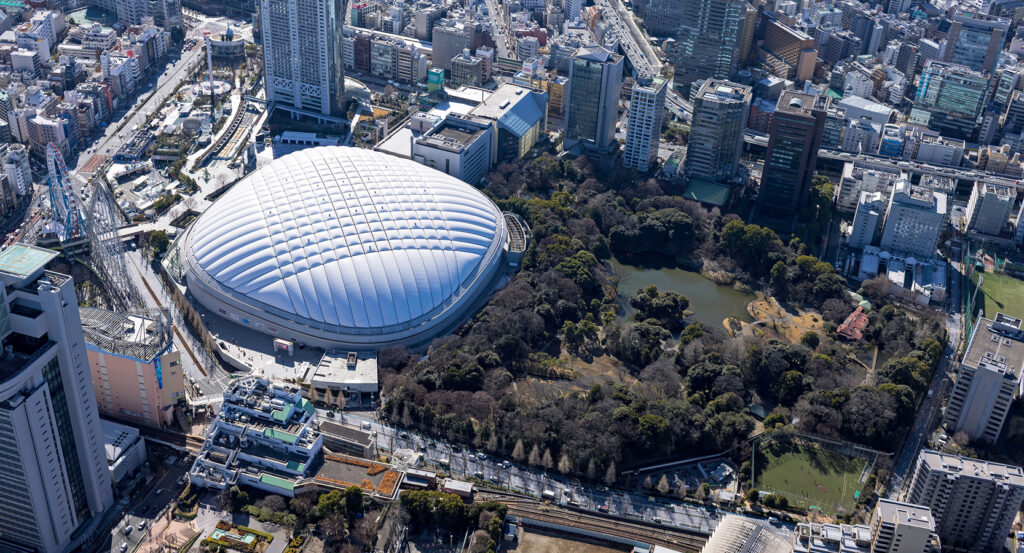
Set within Tokyo Dome near Korakuen-dori and just steps from Korakuen Station, the museum occupies a purpose-built interior directly inside the stadium that succeeded the ground beside its original home. Bronze portrait reliefs fill the Hall of Fame, turning generations of players, managers, umpires, executives and other contributors into a chronological procession through Japanese baseball. Exhibition rooms move outward into professional, amateur and national-team history through uniforms, bats, gloves, trophies, photographs and objects connected with decisive games and individual achievements. A theater and changing exhibition areas add moving images and tightly focused historical subjects to the permanent collection, allowing famous moments to be encountered through both physical objects and surviving footage. The result is a museum where the immediate presence of Tokyo Dome intensifies a collection devoted to preserving the people, competitions and physical objects through which baseball became one of Japan's major sporting traditions.
What defines The Baseball Hall of Fame and Museum.
The Baseball Hall of Fame and Museum is best known for establishing Japan's first museum devoted specifically to baseball and creating a national Hall of Fame twenty years after its counterpart opened in Cooperstown. The institution opened beside Korakuen Stadium on June 12, 1959, placing its commemorative mission directly beside one of the principal grounds of Japanese professional baseball. Six figures entered the inaugural Hall of Fame that year: Sawamura Eiji, Victor Starffin, Shoriki Matsutaro, Hiraoka Hiroshi, Abe Isoo and Hashido Shin. Their careers immediately established the breadth of the institution, spanning celebrated pitching, professional club development, early baseball organization and the growth of the student game. The museum remained beside Korakuen Stadium until construction of Tokyo Dome transformed the surrounding sports precinct three decades later. March 17, 1988 brought its relocation inside the new stadium, where the museum reopened at twice the size of its original home. The move physically carried the institutional memory of baseball from Korakuen Stadium into its successor on the eve of Tokyo Dome's first game. Its Hall of Fame continued expanding through separate selection systems recognizing competitors and other contributors to the sport, with bronze portrait reliefs permanently installed inside the Hall of Fame gallery. Ichiro, Iwase Hitoki, Kakefu Masayuki and umpire Tomizawa Hiroya joined in 2025, followed by Kuriyama Hideki in 2026 after his managerial career encompassed a Japan Series championship with the Hokkaido Nippon-Ham Fighters and Japan's 2023 World Baseball Classic title. Kuriyama became the 223rd inductee, extending an institution founded with six honorees into a national chronology encompassing professional and amateur baseball, management, umpiring and the international development of the Japanese game.
A separate historical mechanism runs through the museum's preservation of physical evidence from baseball's development in Japan, beginning with Meiji-era equipment and extending into contemporary international competition. Its holdings encompass 50,000 objects and photographs, with changing displays drawing from uniforms, bats, gloves, spikes, posters and printed works spanning the sport's history. One surviving baseball associated with the First Higher School dates to 1896, connecting the collection with the elite educational institutions through which the American game spread during the Meiji period. Later objects fix individual achievements to specific physical artifacts, including the ball from Oh Sadaharu's 756th career home run in 1977 and the spikes Fukumoto Yutaka wore when he reached 939 career stolen bases in 1983. Olympic history enters through the uniform of manager Matsunaga Reiichi from Japan's gold-medal team at the 1984 Los Angeles Games, and national-team displays extend that lineage into the World Baseball Classic and Premier12 eras. A specialist library preserves another 50,000 books, magazines and newspapers, making statistical research, biographies, periodicals and historical baseball literature part of the same preservation program. Wartime memory occupies its own permanent place through a cenotaph erected in April 1981 for baseball players mobilized during World War II who never returned, then transferred to the current museum in March 1988. A second monument unveiled in 2005 commemorates nonprofessional players killed in the war, giving the collection a historical reach that extends from famous sporting achievements into the lives interrupted by twentieth-century conflict.
How The Baseball Hall of Fame and Museum fits.
The Baseball Hall of Fame and Museum works as the anchor for a daytime route through three nearby sites connecting Tokugawa landscape design, Jigoro Kano's creation of judo and Bunkyo's long history as a center of education, industry and literary culture.
Begin at Koishikawa Korakuen Gardens, where Tokugawa Yorifusa established a Mito family residence in 1629 and his son Mitsukuni completed a circuit garden organized around a central pond and artificial hills. Ming scholar Zhu Shunshui contributed Chinese ideas including Seiko-no-tsutsumi and Engetsu-kyo, whose surviving arch joins its reflection to form a complete circle; Fan Zhongyan's Memorial to Yueyang Tower supplied the philosophical source for the Korakuen name. The garden now holds the dual national designations of Special Historic Site and Special Place of Scenic Beauty. Continue to Kodokan Judo Institute, founded by Kano Jigoro in May 1882 inside a 12-tatami room at Eishoji Temple after his study of established jujutsu schools led him toward a new system of physical and moral education. Kodokan moved through several Tokyo locations before settling at its present Kasuga site in 1958, decades after Kano became the first Japanese member of the International Olympic Committee in 1909 and helped organize Japan's first Olympic participation at Stockholm in 1912. Judo entered the Olympic program at the 1964 Tokyo Games, carrying Kano's nineteenth-century educational project onto an international competitive stage. Conclude at Bunkyo Museum, opened in 1991 to interpret a district whose historical layers range from Edo samurai estates and merchant communities to Meiji educational institutions and modern publishing, printing and medical industries. Its permanent galleries connect the formation of Edo with domestic life, craft production, popular entertainment and the scholarly culture that later drew figures including Mori Ogai and Higuchi Ichiyo into Bunkyo. The progression moves from Tokugawa Yorifusa and Mitsukuni's seventeenth-century garden through Kano Jigoro's transformation of martial education into modern judo and into Bunkyo Museum's preservation of the district's wider cultural history, placing The Baseball Hall of Fame and Museum within a neighborhood shaped by successive institutions devoted to preserving and transmitting Japanese culture.
Where your story begins.
Foresyte Travel reveals places that feel extraordinary long before you arrive.
Enjoy editorial crafted for luxury travelers.
Foresyte may earn a commission when you book.

















































































































