
Why Dupont Circle matters.
Dupont Circle in Washington, D.C. is the city's pulse dressed in sophistication, a neighborhood where historic elegance meets urban edge, and where intellect, art, and activism intertwine effortlessly.
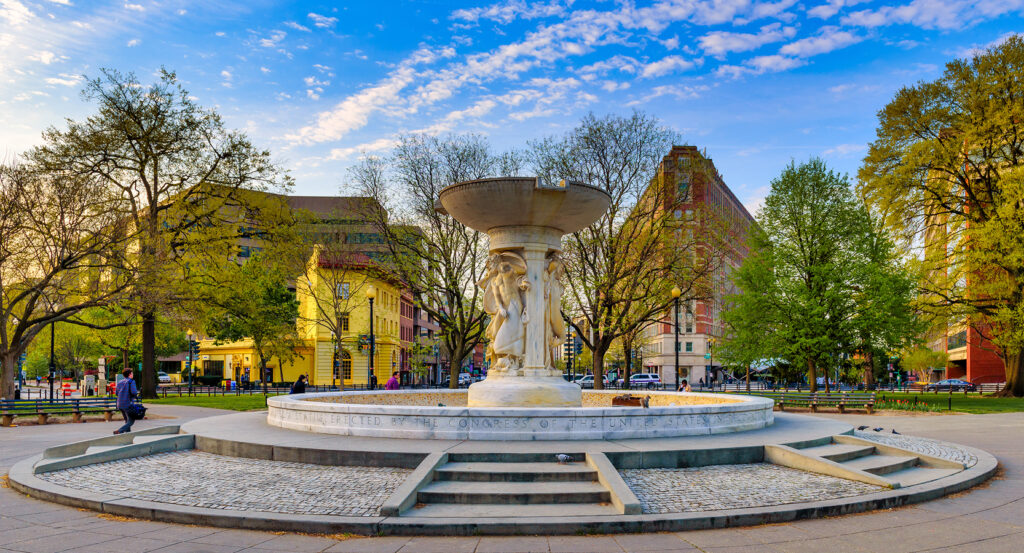
Anchored by its namesake traffic circle, the area radiates outward in a blend of stately architecture, shaded parks, and cosmopolitan rhythm. On any given afternoon, the central fountain, carved in white marble and encircled by benches, hums with life: chess players bent over their boards, commuters sipping coffee, and street musicians weaving jazz through the breeze. Once home to Gilded Age mansions and embassies, Dupont Circle still feels like a gathering place for ideas, the kind of neighborhood where you can attend a literary talk, visit an art gallery, and end the day sipping wine at a sidewalk café beneath gaslit globes. Its avenues, lined with row houses and embassies, give way to bookstores, indie cinemas, and bakeries that feel like fixtures of a more deliberate era. Dupont Circle captures everything that makes D.C. more than a seat of power, it's a neighborhood with soul, intellect, and enduring charm, where the world's conversations unfold block by block.
What defines Dupont Circle.
Beneath Dupont's effortless polish lies a layered story of transformation, from marshland to one of Washington's most dynamic cultural enclaves.
The area was first developed in the late 19th century, its elegant mansions designed for the city's political and social elite. Named after Rear Admiral Samuel Francis Du Pont, the circle's centerpiece, a striking marble fountain sculpted by Daniel Chester French and Henry Bacon, the duo behind the Lincoln Memorial, replaced an earlier bronze statue in 1921, symbolizing the city's transition from postwar austerity to artistic ambition. By the mid-20th century, Dupont Circle evolved again, becoming a stronghold for artists, activists, and LGBTQ+ communities who infused the neighborhood with creativity and defiance. Its brownstones turned into galleries and cafes; its streets became stages for protests and parades. During the 1970s, Dupont emerged as a hub for the gay rights movement, its inclusive energy shaping D.C.'s social fabric for decades to come. The area's underground streetcar tunnels, long abandoned after the 1960s, have found new life as exhibition spaces for avant-garde art under the project known as Dupont Underground, transforming forgotten infrastructure into cultural renaissance. Despite gentrification and modernization, Dupont has preserved its soul: a place where embassies coexist with bookstores, and where diversity isn't just tolerated, it's celebrated. Few realize how meticulously its architecture has been preserved under historic protection, with everything from window trims to cornices maintained in accordance with strict restoration codes. The result is a neighborhood that feels timeless, alive, and deeply human, a microcosm of the capital's ever-evolving identity.
How Dupont Circle fits.
To experience Dupont Circle properly is to surrender to its rhythm, slow, intellectual, and endlessly curious.
Begin at the park at the circle's center, where the Dupont Fountain gleams in the sunlight and the benches fill with locals reading or chatting. From there, stroll along Massachusetts Avenue's Embassy Row, where grand residences now house diplomats from around the world, each marked by their nation's flag fluttering in the breeze. Detour onto Connecticut Avenue for a mix of independent shops, vintage bookstores, and D.C.'s classic Kramerbooks & Afterwords Café, an institution beloved by writers, insomniacs, and thinkers alike. The Phillips Collection, America's first museum of modern art, awaits just a few blocks away, its collection of Renoirs, Rothkos, and Van Goghs displayed in an intimate mansion setting. When hunger strikes, find your way to one of Dupont's globally inspired eateries, Ethiopian, Thai, Italian, or vegan, each echoing the neighborhood's international flavor. After dark, the energy shifts: wine bars and speakeasies glow beneath row house facades, and live jazz spills into the sidewalks. If you visit on a Sunday, Dupont Circle Farmers Market transforms the streets into a celebration of local color and produce, with fresh flowers and homemade pastries adding fragrance to the morning. For a deeper dive, descend into the Dupont Underground and explore rotating art installations in the repurposed trolley tunnels, a literal undercurrent of creativity running beneath the city's feet. Whether you come to think, to wander, or to simply sit beneath the fountain and watch the world turn, Dupont Circle offers what few neighborhoods can: an atmosphere that feels both deeply historical and completely of the moment. It's D.C. at its most human, elegant but unpretentious, learned but alive, and once you feel its heartbeat, it's hard to imagine the city.
Where your story begins.
Foresyte Travel reveals places that feel extraordinary long before you arrive.
Enjoy editorial crafted for luxury travelers.
Foresyte may earn a commission when you book.







































































































