
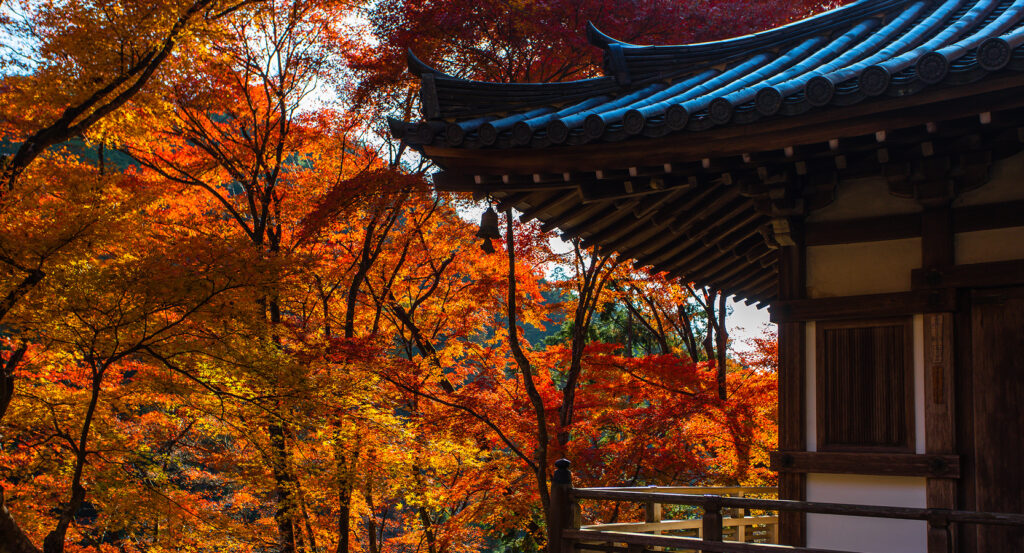
Why you should experience Amida-dō Hall in Kyoto, Japan.
Amida-dō Hall is the still point of Kyoto's Eikando, the moment where faith turns its head and meets your gaze.
Tucked deep within the temple's hillside complex, the hall glows softly with the warmth of aged wood and candlelight. Sunlight filters through shoji screens, touching the golden statue at its center, the Mikaeri Amida, or “Amida Looking Back.” Unlike any other Buddha in Japan, this one does not face forward. His head is turned gently over his shoulder, as if caught mid-motion, eyes meeting yours with compassion that feels human. Around him, incense swirls upward like breath, catching the light in slow spirals. The air is dense but gentle, alive with the echo of centuries of prayer. Standing in that hush, you feel what Kyoto has always promised: not transcendence, but presence.
What you should know about Amida-dō Hall.
The Mikaeri Amida statue dates to the Heian period and is one of Japan's most mysterious devotional works.
According to temple legend, the priest Eikan, from whom Eikando takes its name, was reciting sutras before the statue when it suddenly turned and spoke, saying, “Eikan, you are slow.” The moment symbolized enlightenment through compassion, a deity willing to look back for the sake of those still finding their way. The hall that houses the statue was built to honor this miracle, its dimensions calculated according to ken proportions used in Heian temple design. The floorboards, polished smooth by centuries of pilgrims, creak softly with each step, echoing like a heartbeat beneath the rafters. The statue itself is carved from single-block cypress wood and gilded with layers of lacquer and gold leaf, its delicate features preserved with almost impossible detail, the faint arch of a brow, the quiet curve of a smile. Few realize that the statue's orientation, facing slightly north, allows morning light to strike the turned face first, illuminating the eyes as the temple awakens. Surrounding the main figure are smaller Amida images arranged in symmetrical balance, each representing an aspect of infinite compassion. The hall's ceiling beams still bear faint traces of 15th-century pigment from earlier restorations, while the altar's lotus carvings retain the touch of Edo artisans who recrafted them by hand. To stand before the Mikaeri Amida is to witness devotion expressed through anatomy, a god rendered with empathy, not distance.
How to fold Amida-dō Hall into your trip.
Amida-dō Hall rewards patience and quiet observation, the kind of attention that feels like prayer.
Begin your visit by entering through the lower gardens of Eikando, letting the winding corridors lead you naturally upward toward the hall. Remove your shoes before crossing the threshold; the wood underfoot is cool and smooth, grounding you in the moment. Inside, move slowly along the right-hand aisle until the statue comes into full view, don't rush. Let your eyes adjust to the light, and you'll see the subtle glint of gold within shadow. Stand directly to the left of the altar to meet the Buddha's turned gaze, the angle where legend says Eikan once knelt. If you visit in the morning, the light will fall across the statue's shoulder; in the afternoon, the face softens into amber glow. Offer a bow, a breath, or silence, whatever reverence feels true. Afterward, step outside to the veranda overlooking the pond. The sound of water and wind filtering through maple leaves feels like a continuation of the hall's prayer. Whether or not you believe in miracles, Amida-dō Hall makes one simple truth clear: enlightenment isn't something ahead of you, it's the moment you finally look back.
Where your story begins.
Foresyte Travel reveals places that feel extraordinary long before you arrive.
Experience premium editorial crafted for luxury travelers.

















































































































