
Why Eikandō matters.
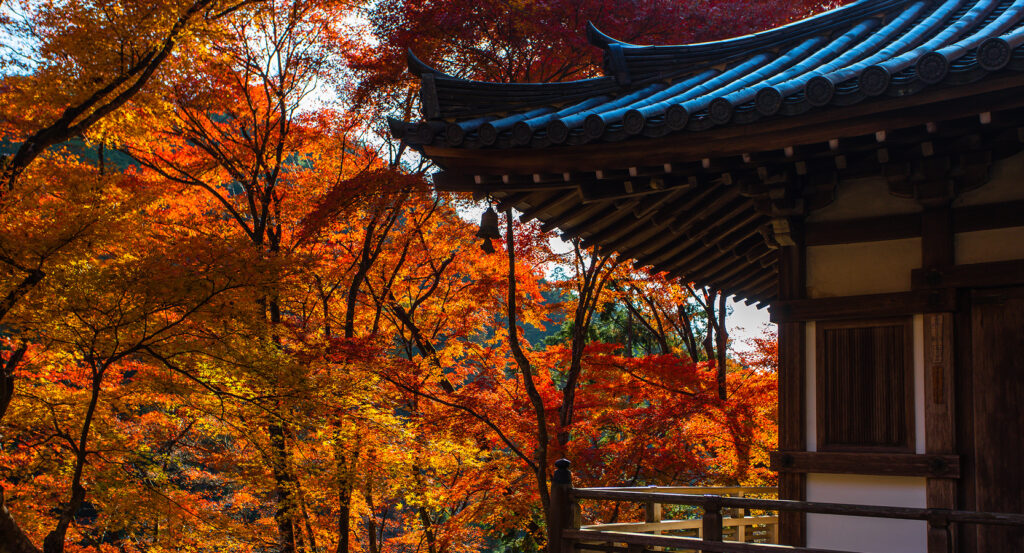
Eikandō Temple, or Zenrinji Temple, in Kyoto is where the spirit of Japan's autumn finds its most breathtaking expression, a hillside sanctuary of light, color, and calm.
Tucked at the foot of the Higashiyama mountains, this ancient temple has been a place of reflection for over 1,000 years, its name translating to “Temple of Good View.” Yet even that poetic understatement hardly captures the beauty waiting within its gates. As you step through the entrance, the world softens, maple trees arch overhead, their leaves glowing in every shade from gold to crimson, mirrored perfectly in koi-filled ponds below. The temple's architecture unfolds with serene balance: wooden walkways creak softly underfoot, stone lanterns line moss-covered paths, and gentle breezes carry the scent of incense from hidden altars. Inside, the main hall houses the famed Mikaeri Amida, or “Looking Back Buddha,” a rare depiction of Amida Buddha glancing over his shoulder, a gesture said to symbolize compassion that waits for all souls. When sunlight filters through the latticed windows and touches this statue, the scene feels almost divine. Eikandō isn't just another temple in Kyoto; it's an experience of stillness wrapped in beauty, a place where nature and faith merge into one living work of art.
What defines Eikandō.
Eikandō's story is one of quiet transformation, of how a small mountain temple became one of Japan's most beloved spiritual and cultural landmarks.
Founded in 853 by Shinsho, a disciple of the renowned monk Kobo Daishi, the temple originally served as a Shingon sect monastery before aligning with the Jodo school of Pure Land Buddhism. Its name, “Eikandō,” honors the priest Yōkan, who revitalized the temple in the 11th century through acts of charity and teaching, earning it the nickname “Eikandō” after him. The Mikaeri Amida statue, now central to its identity, is believed to have turned its head toward Yōkan mid-ceremony, as if acknowledging his devotion, a miracle immortalized in temple lore. Over the centuries, Eikandō has been rebuilt and expanded, its pavilions rising in harmony with the sloping terrain. The Hojo Pond and Tahoto Pagoda were designed with perfect symmetry to reflect the temple's philosophy of peace through proportion. The pagoda itself offers one of Kyoto's most revered views, a panorama that frames the city through fiery autumn foliage. While fall brings thousands of visitors to witness its maple performance, few realize that Eikandō is equally captivating in spring, when cherry blossoms scatter across the temple grounds, or in winter, when snow dusts its rooftops like powdered sugar. The temple also houses rare sutras, scrolls, and artworks that chronicle Japan's spiritual evolution. Every stone, bridge, and hall here tells a story of patience, of beauty earned slowly, through centuries of reverence.
How Eikandō fits.
To experience Eikandō in Kyoto at its fullest, visit in the morning or late afternoon when the light turns golden and the crowds thin.
The temple is located along the southern end of the Philosopher's Walk, making it a natural continuation of that meditative journey. As you approach, the sound of the canal fades, replaced by the rustle of maple leaves and the faint ring of temple bells. Begin at the Sanmon Gate, whose sweeping roofline frames the hillside beyond, then follow the ascending paths through the complex's layered courtyards. Don't rush, this is a place to wander, to breathe, and to listen. The Hojo Pond reflects the trees and sky like a perfect mirror; pause there to watch koi ripple through the reflection. Climb toward the Tahoto Pagoda for a panoramic view that reveals Kyoto's skyline wrapped in green and gold, among the city's most breathtaking outlooks. Inside the halls, take a quiet moment with the Mikaeri Amida; even in silence, its gaze feels profoundly alive. In autumn, the temple opens for special evening illuminations, a performance where the trees glow from below and the pond turns to liquid fire. After sunset, descend back toward the Philosopher's Walk as lanterns flicker along the path, guiding you home through Kyoto's most poetic light. Whether you come seeking faith, art, or beauty itself, Eikandō reminds you that the sacred isn't distant, it's already here, in the way the world glows when you stop to see it.
Where your story begins.
Foresyte Travel reveals places that feel extraordinary long before you arrive.
Enjoy editorial crafted for luxury travelers.
Foresyte may earn a commission when you book.

















































































































