
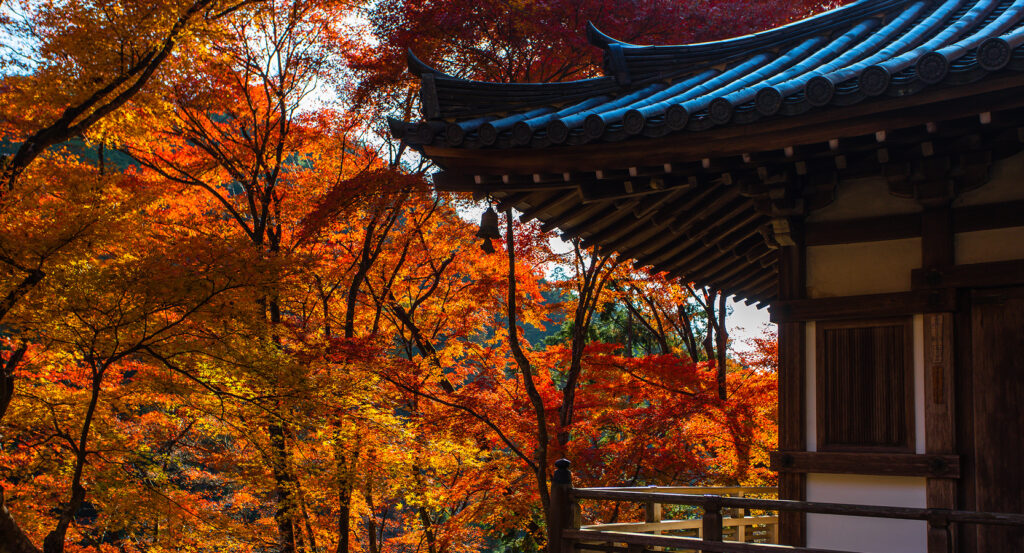
Why you should experience Tahōtō Pagoda at Eikandō in Kyoto, Japan.
Tahōtō Pagoda is Eikandō's quiet pinnacle, a sanctuary above the trees where Kyoto unfolds like a dream.
Rising from the upper slopes of the temple grounds, it stands halfway between earth and sky, surrounded by maples that ignite into crimson flame each autumn. The path to it winds upward through wooden corridors and moss-covered steps, each turn revealing a new glimpse of light through the leaves. When you finally emerge at the clearing, the view stops you: Kyoto stretched out below, the Higashiyama hills cradling the city in morning haze. The pagoda itself, a perfect balance of circle and square, radiates calm. Its vermilion pillars contrast against dark tiled eaves, while the white plaster walls seem to glow from within. The air is thinner here, the sounds of the city distant and softened. Standing before the Tahōtō, you feel both above and within Kyoto, as if the temple itself has carried you into its breath.
What you should know about Tahōtō Pagoda at Eikandō.
Tahōtō Pagoda was originally constructed in the Kamakura period and later rebuilt in 1912, faithfully preserving its ancient proportions.
Unlike the multi-tiered pagodas of other temples, the tahōtō form is unique to Japan, a two-story structure that merges Buddhist symbolism with architectural grace. Its square base represents the physical world, while its circular upper chamber symbolizes enlightenment, the union of matter and spirit. Eikando's pagoda exemplifies this balance perfectly: its proportions follow the in-yo (yin-yang) principle, designed so that light and shadow always coexist across its façade. The finial at its peak, a bronze sorin spire, catches the sun from every angle, making the pagoda seem to shimmer even on overcast days. Few visitors realize that the interior houses a small seated Amida Buddha facing east, toward the rising sun, in silent harmony with the Mikaeri Amida below, who looks back in compassion. Together, they form a discussion between ascent and return, awareness and empathy. The surrounding maples were planted during the Edo period to frame the pagoda as a seasonal axis, in spring, the view opens to pale blossoms; in autumn, it burns with red fire; in winter, the structure stands alone against bare branches and sky. Each season rewrites the same composition with new emotion. The pagoda has survived fires, earthquakes, and centuries of change, yet remains untouched in spirit, the still eye of Eikando's living landscape.
How to fold Tahōtō Pagoda at Eikandō into your trip.
Visiting Tahōtō Pagoda is both ascent and meditation.
Begin from Eikando's main courtyard and follow the upward path that winds through the temple's maple forest. The climb takes only a few minutes, but every step carries you deeper into quiet. Pause along the wooden corridor overlooking the pond below, the reflection of the pagoda often appears there in the water, inverted and wavering. As you near the summit, the sound of the city fades completely, replaced by wind through leaves and the soft groan of wood beneath your feet. At the clearing, remove your shoes before stepping onto the small veranda that circles the structure. From here, Kyoto expands before you: rooftops glinting in the distance, temple spires rising from a sea of green. Visit in the early morning for pale gold light, or at sunset when the pagoda glows like a lantern against the hills. In autumn, it becomes a flame suspended above the city, a vision so serene it feels painted by hand. Before descending, turn back once more toward the Amida Hall far below; the path that connects them is not just physical, but spiritual, a journey from reflection to revelation. Tahōtō Pagoda at Eikandō is Kyoto distilled to its essence: balance, humility, and the beauty of stillness at the summit.
Where your story begins.
Foresyte Travel reveals places that feel extraordinary long before you arrive.
Experience premium editorial crafted for luxury travelers.

















































































































