
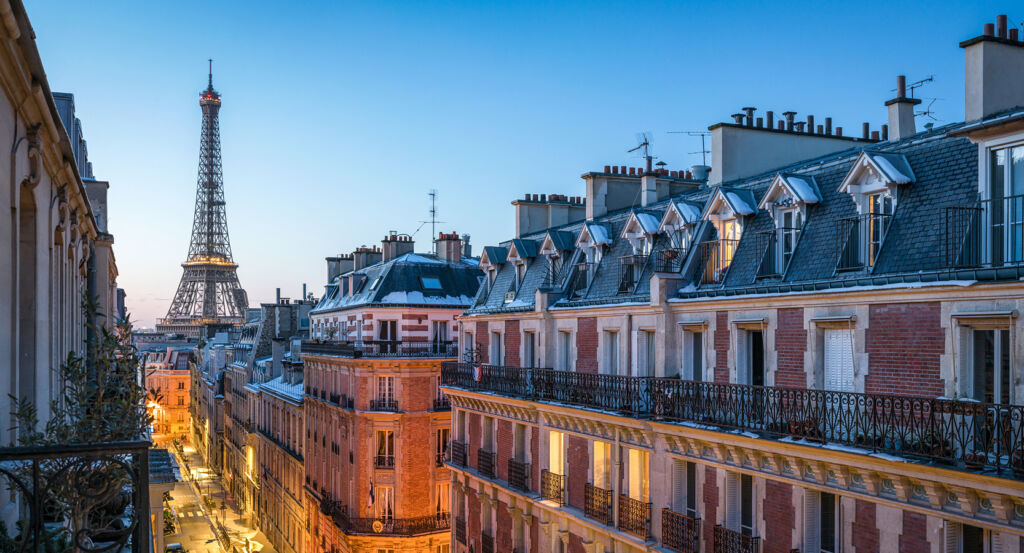
Why you should experience ELSA Hôtel Paris in Paris, France.
ELSA Hôtel Paris is a literary four-star hotel where Ternes's Belle Époque elegance, Surrealist inheritance, poetic romance and enduring culture of artistic reinvention converge within a house named for writer and Resistance figure Elsa Triolet.
Set along Avenue Carnot near Rue des Acacias and just steps from Arc de Triomphe, the hotel occupies an 1872 Haussmannian building on the same avenue where Louis Aragon lived as a child while his mother, Marguerite Toucas-Massillon, operated a boarding house at No. 20 between 1899 and 1904. Decorator Marie-Agnès Louboutin completely reworked the property in 2021 around a 1930s Parisian vocabulary, combining noble materials, floral motifs and touches of Japanese art within the bathrooms and shower rooms. The rebirth also replaced the Hôtel Astrid name with ELSA, deliberately connecting the building with Aragon's lifelong relationship with Triolet, whom he met in 1928 and married in 1939. The result is a hotel where an 1872 address, Louboutin's interwar aesthetic and the Aragon-Triolet story turn Avenue Carnot's polished Parisian character into an unusually personal literary narrative.
What you should know about ELSA Hôtel Paris.
ELSA Hôtel Paris is best known for reopening under its current character in November 2021 after the former Hôtel Astrid underwent a complete renovation by decorator Marie-Agnès Louboutin, creating a new chapter for an Avenue Carnot building constructed in 1872 and used as a hotel since Hôtel Astrid was established there in 1936. The Guillet family purchased Hôtel Astrid in 1937 and retained the property through decades that included its three-star classification in 1990, complete closure during the 2020 pandemic and transfer into management by The Hotels Agency in June 2021, an operator renamed Collection Vesper in 2024. Louboutin's renovation introduced an interior concept explicitly inspired by 1930s Paris, using noble materials and floral compositions throughout the house while incorporating subtle references to Japanese art within guest bathrooms. The reinvention culminated in Atout France awarding the property four-star status in 2022, followed in September 2024 by the Clef Verte environmental certification assessed against 120 criteria. The contemporary hotel contains 40 rooms facing either Avenue Carnot or Rue des Acacias, with much of the inventory oriented toward views across Parisian rooftops and Arc de Triomphe 200 metres away.
Elsa Triolet gives that reinvention considerably greater depth because the hotel's chosen namesake connects directly with Louis Aragon's childhood on Avenue Carnot and with one of twentieth-century France's most consequential literary partnerships. Aragon met Russian-born Triolet in 1928, during the period when she designed jewelry for Parisian haute couture between 1929 and 1932 and he was developing the literary career that followed his participation with André Breton in launching Surrealism in 1924. The couple married on February 28, 1939 and later used their writing as intellectual resistance under the German occupation, while Aragon published Les Martyrs in 1942 and Triolet's Le Premier Accroc coûte deux cents francs made her the first woman to receive the Prix Goncourt in 1945. Triolet attended the Nuremberg trial in 1946 and reported on it for Les Lettres Françaises, extending a life that joined literature, fashion, political engagement and wartime resistance until her death in 1970. Naming the former Hôtel Astrid for Elsa transformed more than the sign above the door, connecting Marie-Agnès Louboutin's 1930s interiors with a writer whose relationship with Aragon began during precisely the cultural period the redesign evokes.
How to fold ELSA Hôtel Paris into your trip.
ELSA Hôtel Paris works as the anchor for an afternoon tracing the intimate artistic houses, architectural experimentation and performance culture that developed through the western seventeenth Arrondissement.
Begin at Musée national Jean-Jacques Henner, where Marie Henner purchased painter Guillaume Dubufe's former home and studio in 1922, commissioned Marcel Legendre to transform it, donated the building and collections to France in 1923 and opened the museum in 1924, preserving one of the Third Republic's rare artist houses accessible to the public. Continue to Église Saint-Ferdinand-des-Ternes, where Paul Théodon, Frédéric Bertrand and Pierre Durand began replacing an earlier church in 1937, completing the present Neo-Byzantine structure in 1957 with a nave articulated beneath three domes after construction had been interrupted by World War II. Conclude at Fondation Louis Vuitton, where Frank Gehry translated Bernard Arnault's cultural ambitions into a contemporary art institution whose billowing glass architecture rises from the Bois de Boulogne, carrying the afternoon from intimate nineteenth-century artistic patronage into twenty-first-century experimentation. The progression moves from Marie Henner turning a painter's private house into a national museum through the prolonged creation of Saint-Ferdinand-des-Ternes and finally into Gehry's architectural imagination, revealing western Paris as a place where private creative conviction repeatedly acquires ambitious physical form.
Where your story begins.
Foresyte Travel reveals places that feel extraordinary long before you arrive.
Experience premium editorial crafted for luxury travelers.














































































































