
Why Eonyang Bulgogi Busanjip matters.
Eonyang Bulgogi Busanjip is a longstanding Korean barbecue restaurant where Namcheon-dong's coastal dining culture meets the charcoal-grilled beef traditions of southeastern Korea, generations of family dining, and MICHELIN-recognized regional cooking.
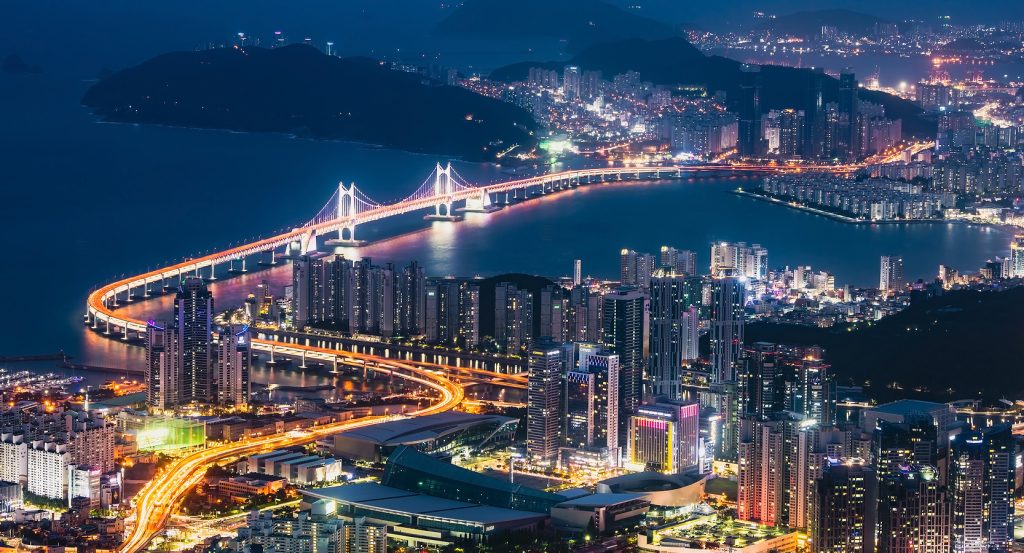
Occupying an upper-floor dining space near the southern end of Gwangalli Beach, Eonyang Bulgogi Busanjip stands between Namcheon-dong's residential streets and the waterfront boulevard, with the beach promenade, Gwangan Bay, and the illuminated span of Gwangandaegyo Bridge extending northward along the coast. The restaurant's elevated position creates a visual connection with the surrounding shoreline, placing its dining rooms above the neighborhood's commercial frontage. Large windows frame sections of the bay and bridge, introducing Busan's coastal geography into an interior organized around Korean barbecue tables. Rows of dining tables accommodate family gatherings and group meals, with private rooms providing additional separation for larger parties. Tabletop grills establish the physical center of the meal, bringing the preparation and serving of beef directly into the dining area. The interior retains the practical character of a longstanding Korean beef restaurant, with the focus concentrated on communal tables, carefully prepared meat, and the sequence of dishes accompanying a traditional meal. The result is an established coastal dining destination whose straightforward interior arrangement places regional beef cookery within sight of Busan's celebrated waterfront.
What defines Eonyang Bulgogi Busanjip.
Eonyang Bulgogi Busanjip is best known for preserving a regional style of Korean beef preparation associated with Eonyang, a historic settlement in the western part of Ulsan whose cattle trade helped establish one of southeastern Korea's most distinctive barbecue traditions. Eonyang developed as an important commercial center for cattle moving through the region, with its livestock market connecting agricultural communities, traders, and the surrounding transportation network. The town's beef culture became closely associated with bulgogi prepared from finely cut or chopped meat, seasoned and shaped into broad portions before grilling over charcoal. The preparation established a distinctive local interpretation of a dish whose name literally refers to fire-cooked meat. Eonyang-style bulgogi gained particular prominence during South Korea's postwar economic development, when improved transportation and rising household incomes expanded the market for restaurant dining and premium domestic beef. Its association with Hanwoo, Korea's indigenous cattle breed, connected the regional specialty with a broader culinary tradition emphasizing the flavor, fat distribution, and texture of carefully selected beef. Eonyang Bulgogi Busanjip brought that culinary heritage into Busan's Gwangalli district, establishing a restaurant whose reputation developed over several decades of serving the regional specialty. The establishment became widely known by the abbreviated name Busanjip, reflecting its longstanding association with the neighborhood's dining culture. Its original premises stood near the waterfront during an earlier phase of Gwangalli's commercial development, when the surrounding district was becoming an increasingly important destination for seafood restaurants, Korean barbecue establishments, and coastal recreation. The restaurant's sustained popularity contributed to the concentration of Eonyang-style beef restaurants around the southern end of Gwangalli, where several similarly named establishments developed their own followings. Busanjip underwent a significant transition in 2018 when it relocated from its longtime premises to a larger location nearby, continuing its established culinary program within a new dining environment. The move preserved the restaurant's connection to the neighborhood after decades of operation, maintaining its relationship with customers familiar with its earlier premises. International recognition followed through the inaugural MICHELIN Guide Seoul & Busan 2024, which included Eonyang Bulgogi Busanjip among Busan's selected restaurants. The recognition placed the restaurant within the first MICHELIN evaluation of Busan's dining scene, a major development for a city whose culinary reputation had long been associated with seafood, pork soup, traditional markets, and regional Korean specialties. MICHELIN's selection recognized Busanjip's preparation of Eonyang-style bulgogi and its established position within the local restaurant culture. The restaurant's history connects the cattle-trading heritage of southeastern Korea with Busan's coastal commercial development and the international recognition of regional Korean cuisine.
How Eonyang Bulgogi Busanjip fits.
Eonyang Bulgogi Busanjip works as the culinary anchor for a coastal exploration connecting Busan's celebrated urban beach, its contemporary waterfront commercial architecture, and a major public landscape overlooking Suyeong Bay.
Begin at Gwangalli Beach, the crescent-shaped shoreline extending 1.4 kilometers along the southern edge of Suyeong Bay. The beach developed into one of Busan's principal recreational waterfronts as the surrounding districts expanded into a continuous metropolitan coastal corridor. Its defining architectural feature arrived with the completion of Gwangandaegyo Bridge in January 2003, introducing a 7.42-kilometer double-deck marine crossing whose central suspension span extends 900 meters between expansive towers. The bridge transformed the waterfront panorama and subsequently became the visual centerpiece of the Busan Fireworks Festival, which originated during the city's hosting of the 2005 Asia-Pacific Economic Cooperation summit. A further development arrived in April 2022 with the inauguration of the Gwangalli M Drone Light Show, establishing a permanent weekly aerial performance above the bay. The beach combines public recreation with major examples of marine engineering and contemporary outdoor entertainment. Continue to Millac The Market, a contemporary cultural and commercial destination occupying 7,702 square meters near Millak Port. Developed by Kitchen Borie, the complex extends the company's earlier work at The Bay 101 in Haeundae and Old Tree Market in Dadaepo into a larger waterfront setting. Its architectural composition incorporates an expansive commercial interior organized around independent retailers, food establishments, and public gathering areas. Busking Square provides a stepped seating arrangement facing an enormous glazed elevation, framing Gwangandaegyo and the surrounding harbor as part of the building's interior composition. The development received the grand prize at the 2022 Busan Architecture Awards, recognizing its contribution to the city's evolving commercial landscape. Conclude at Millak Waterfront Park, the substantial coastal public space developed between August 1992 and May 1997 along the eastern edge of the bay. Extending 543 meters beside the shoreline, the park occupies 33,000 square meters and incorporates broad paved terraces, landscaped areas, and a stepped platform descending toward the water. Its coastal platform measures 3,040 square meters, establishing a large public gathering surface directly beside the sea. The park became an important recreational destination for residents of Suyeong-gu, connecting the surrounding fishing district with accessible waterfront space. Its open terraces provide uninterrupted views across the bay toward the surrounding mountains, high-rise districts, and illuminated marine crossing. The progression moves from Gwangalli Beach's transformation into a major metropolitan waterfront through Millac The Market's contemporary commercial architecture and culminates at Millak Waterfront Park, where Busan's maritime geography becomes a substantial public coastal landscape.
Where your story begins.
Foresyte Travel reveals places that feel extraordinary long before you arrive.
Enjoy editorial crafted for luxury travelers.

















































































































