
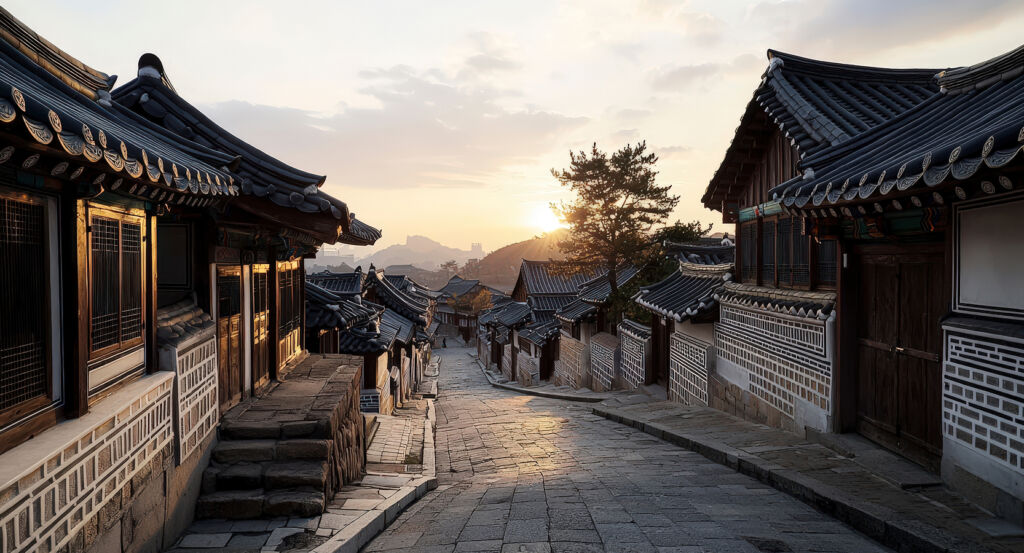
Why you should experience Eunpyeong-gu in Seoul, South Korea.
Eunpyeong-gu is a district of mountains and tradition, where forested landscapes, Buddhist heritage, and contemporary community life converge along the northwestern edge of the capital.
Mountain valleys, historic temples, hanok villages, residential neighborhoods, cultural institutions, hiking trails, and public parks create a district shaped by geography and preservation. Framed by the dramatic peaks of Bukhansan National Park, the area developed differently from many of Seoul's rapidly urbanized districts, with natural landscapes continuing to play a defining role in daily life. Monks, scholars, residents, artisans, and community leaders helped shape a neighborhood defined by reflection, heritage, and connection to nature. Today, Eunpyeong-gu offers one of the capital's strongest combinations of mountain scenery and cultural history, creating an atmosphere distinct from Seoul's commercial core. Its character is rooted in the relationship between landscape and tradition. To the east, Gangdong-gu's celebrated archaeological sites, riverside parks, and residential communities extend naturally from Eunpyeong-gu across one of Seoul's most diverse urban environments, reinforcing the district's role within the broader fabric of the capital.
What you should know about Eunpyeong-gu.
Eunpyeong-gu is best known for being home to Jingwansa Temple, among the four major temples historically responsible for protecting Seoul during the Joseon Dynasty.
Founded more than a thousand years ago, the temple became an important religious institution positioned along the approaches to the capital. During the Joseon era, Jingwansa formed part of a network of strategically significant temples that helped safeguard the city while serving as centers of Buddhist practice and scholarship. The temple is also renowned for preserving traditional Korean temple cuisine, a culinary tradition recognized for its cultural and historical significance. Its location within the foothills of Bukhansan further strengthened its role as a place of retreat and spiritual reflection. Few districts possess a landmark so closely connected to both the protection and cultural preservation of the Korean capital.
How to fold Eunpyeong-gu into your trip.
Eunpyeong-gu is best experienced through the landmarks that reveal its connection to nature, heritage, and traditional Korean culture.
Begin at Jingwansa Temple, where the district's defining connection to Buddhism and Seoul's historical development immediately comes into focus. Continue toward Eunpyeong Hanok Village, whose traditional architecture reveals how Korean heritage continues to shape the district's modern identity. From there, make your way to Bukhansan National Park, where granite peaks, forest trails, and panoramic views provide a broader perspective on the landscapes that continue to define Eunpyeong-gu today. Along the route, you'll encounter temple grounds, traditional homes, mountain scenery, cultural institutions, walking paths, historic sites, and community spaces that reveal the district's distinctive character. The progression moves naturally from spiritual landmark to cultural village to national park, illustrating the forces that continue to shape northwestern Seoul.
Where your story begins.
Foresyte Travel reveals places that feel extraordinary long before you arrive.
Experience premium editorial crafted for luxury travelers.

















































































































