
Why Faubourg-du-Roule matters.
Faubourg-du-Roule is an elegant enclave where the Champs-Élysées meets western Paris through aristocratic estates, broad nineteenth-century avenues and residential streets shaped by the capital's long expansion beyond its historic core.
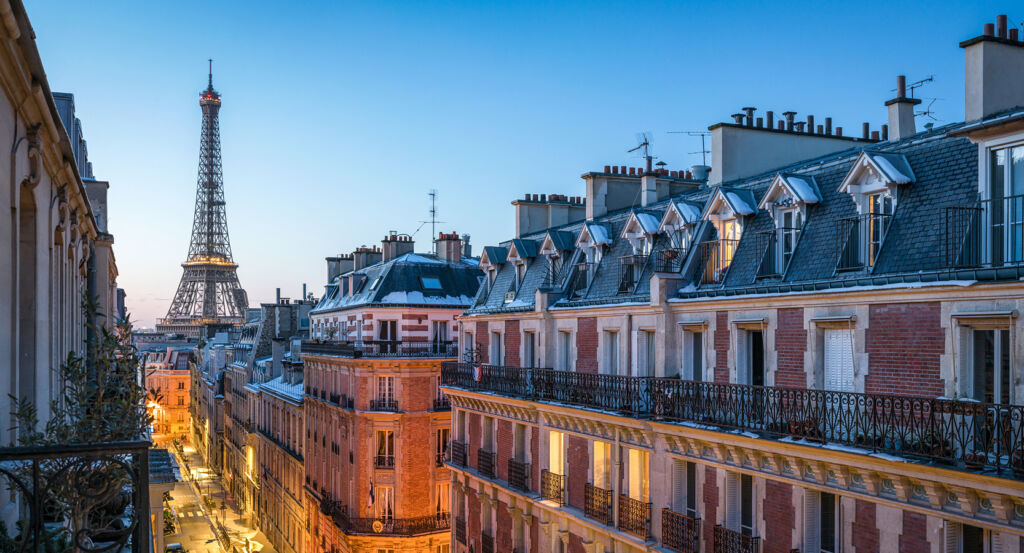
Positioned between Champs-Élysées, Europe, and Plaine-de-Monceaux, the neighborhood occupies a western Right Bank pocket where Rue du Faubourg Saint-Honoré, Avenue de Friedland and Boulevard Haussmann cross territory once extending through fields and suburban properties beyond the city. Broad avenues establish the dominant scale, yet streets toward Rue de Courcelles and Rue de Monceau retain smaller residential blocks whose hôtels particuliers and enclosed gardens preserve traces of the district's earlier estate geography. Rue du Faubourg Saint-Honoré establishes the primary encounter through the old western route that carried settlement outward from Central Paris and gradually accumulated religious houses, private residences and commercial activity. Avenue de Friedland introduces a second spatial mechanism through the sweeping nineteenth-century axis approaching Place Charles de Gaulle, where uniform stone facades and long sightlines recast former suburban ground around metropolitan circulation. Quieter streets toward Courcelles deepen the contrast through remnants of properties subdivided as wealthy residential development advanced across the western edge of Paris. The result is a neighborhood where inherited faubourg geography and nineteenth-century expansion remain visible at adjoining scales, preparing a history rooted in the village of Le Roule and its gradual absorption into the capital.
What defines Faubourg-du-Roule.
Faubourg-du-Roule is best known for developing from the former village of Le Roule, a settlement established west of medieval Paris along the route continuing the Rue Saint-Honoré toward Neuilly. A leper house dedicated to Saint-Jacques and Saint-Philippe occupied the territory during the Middle Ages, tying the sparsely settled district to a religious institution beyond the city walls. The establishment survived after leprosy declined, and its property later passed through institutional changes that accompanied the gradual development of the faubourg. Population growth during the seventeenth and eighteenth centuries intensified settlement along the main road as Parisian expansion pushed westward. The old chapel eventually became inadequate for the enlarging community, leading to plans for a new parish church during the reign of Louis XV. Jean-François-Thérèse Chalgrin developed the architectural project, drawing on early Christian basilicas for a composition dominated by a columned portico and barrel-vaulted nave. Construction began in the 1770s, encountered financial interruptions and continued into the Revolutionary period, leaving Église Saint-Philippe-du-Roule as an architectural marker of the district's transition from peripheral village to urban parish. Incorporation into Paris placed Le Roule inside a rapidly changing western sector, and subsequent nineteenth-century development absorbed its earlier village structure into the avenues and residential blocks of the modern eighth Arrondissement.
The Beaujon estate supplied a separate mechanism for changing the northern portion of Faubourg-du-Roule through private wealth, philanthropy and successive subdivision. Financier Nicolas Beaujon assembled a large property beginning in 1780 that stretched from the old Rue du Faubourg-du-Roule toward the Champs-Élysées. Architect Nicolas-Claude Girardin designed the Folie Beaujon, including the Saint-Nicolas chapel, within a retreat combining residential architecture and extensive grounds. An adjoining hospice dedicated to Beaujon's memory introduced a philanthropic function before the estate fragmented after his death in 1786. The southern portion subsequently became an entertainment garden, then entered residential subdivision under the Restoration through Rue Fortunée, Rue Chateaubriand and Rue Byron, opened in 1825. Another portion underwent subdivision from 1842, and Honoré de Balzac acquired a former building connected with the property in 1846. Rue Fortunée later became Rue Balzac, extending the writer's association into the surrounding geography. Avenue de Friedland, begun from Rue de Tilsitt in 1857, imposed another metropolitan axis across the former estate territory as western Paris moved decisively from suburban retreats toward dense residential development.
How Faubourg-du-Roule fits.
Faubourg-du-Roule works as the anchor for an afternoon connecting an eighteenth-century pleasure garden reworked under the Second Empire, a collector's residence conceived for the new Boulevard Haussmann and a Belle Époque mansion created around an exceptional collection of decorative arts.
Begin at Parc Monceau, where Louis-Philippe-Joseph d'Orléans, duc de Chartres, acquired the Mousseau property in 1769 and commissioned Carmontelle to develop an Anglo-Chinese garden from 1773, filling the grounds with architectural inventions drawn from different periods and cultures. Construction of the Farmers-General wall cut through the estate in 1787 and introduced Claude-Nicolas Ledoux's Barrière de Chartres, whose rotunda survives at the northern entrance; Adolphe Alphand reshaped the remaining garden in 1861 under Napoleon III, carrying the former aristocratic retreat into the network of public landscapes created across Second Empire Paris. Continue to Musée Jacquemart-André, where banker and collector Édouard André purchased ground on the newly opened Boulevard Haussmann and commissioned Henri Parent to design a private mansion beginning in 1869. André married portraitist Nélie Jacquemart in 1881, and their collecting journeys through Italy and the Near East expanded holdings encompassing Italian Renaissance painting, Flemish masters and eighteenth-century French art; Jacquemart bequeathed the mansion and collection to the Institut de France, and President Raymond Poincaré inaugurated the museum on December 8, 1913. Conclude at Musée Nissim de Camondo, where Moïse de Camondo commissioned René Sergent in 1911 to replace his family residence beside Parc Monceau with a mansion conceived around his collection of eighteenth-century French decorative arts. Sergent drew architectural inspiration from the Petit Trianon, creating rooms for furniture, tapestries, porcelain, silver and paintings assembled by Camondo; after his son Nissim died in aerial combat in 1917, Camondo named the future museum for him and bequeathed the house and collection to the French state, establishing a memorial whose family history acquired another devastating chapter when Béatrice de Camondo and her family were murdered during the Holocaust. The progression moves from Carmontelle and Alphand carrying an aristocratic pleasure ground into the public landscape of nineteenth-century Paris through André and Jacquemart building a private collection into a museum into Camondo and Sergent joining architectural patronage, decorative arts and family remembrance, tracing the extraordinary concentration of collecting and residential culture surrounding Faubourg-du-Roule.
Where your story begins.
Foresyte Travel reveals places that feel extraordinary long before you arrive.
Enjoy editorial crafted for luxury travelers.
Foresyte may earn a commission when you book.














































































































