
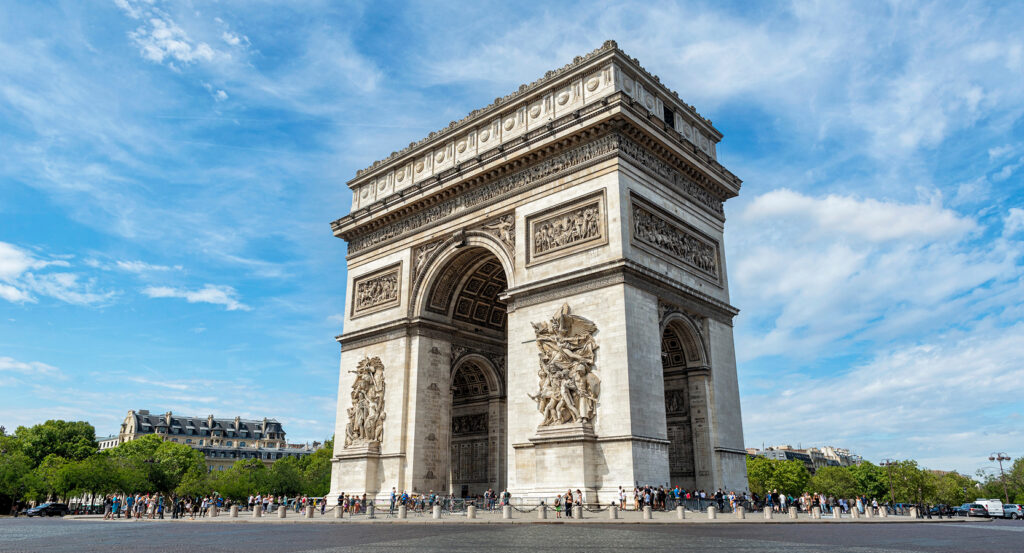
Why Place Charles de Gaulle matters.
Place Charles de Gaulle is a commanding ceremonial square where the Champs-Élysées' grand urban character meets a twelve-avenue star, the Arc de Triomphe and the western reach of Paris's historic axis.
Set along Avenue des Champs-Élysées near Avenue de Friedland and just steps from Avenue Marceau, the square occupies an immense circular junction where twelve radiating avenues, coordinated nineteenth-century façades and broad tree-lined perspectives converge around the Arc de Triomphe. Avenue de la Grande Armée extends the central axis west toward La Défense as Avenue Foch opens through a wider landscaped corridor and Avenue Kléber descends toward Chaillot. Twelve near-uniform building ensembles frame the perimeter, giving architectural order to a traffic circle whose avenues disperse toward three Arrondissements. The Arc rises free of surrounding construction at the center, allowing long perspectives to carry through the square toward the Champs-Élysées and western Paris. The result is a vast urban composition where radial geometry, coordinated architecture and a solitary central monument turn a major road junction into one of Paris's clearest demonstrations of nineteenth-century metropolitan planning.
What defines Place Charles de Gaulle.
Place Charles de Gaulle is best known for the twelve-avenue star developed around the Arc de Triomphe during the Second Empire, when Georges-Eugène Haussmann and Jacques-Ignace Hittorff transformed an older western junction into a rigorously composed entrance to modern Paris. The site had begun acquiring radial form long before Haussmann, with Jean-Rodolphe Perronet developing a star-shaped junction between 1768 and 1774 at the western end of the Champs-Élysées. Napoleon I then selected the site for a triumphal arch honoring the Grande Armée after Austerlitz, commissioning Jean-François-Thérèse Chalgrin in 1806 for a project that would define every subsequent intervention around the junction. Construction stopped amid the political reversals of 1814, resumed during the Restoration and reached completion under Louis-Philippe, with the Arc inaugurated on July 29, 1836. Second Empire reconstruction changed the scale of the surrounding ground after Napoleon III and Haussmann sought to integrate the monument into the enlarged capital created through the 1859 annexation of neighboring communes. Hittorff developed twelve avenues around the Arc and designed coordinated four-story hôtels around their perimeter, giving the star a continuous architectural boundary. The old octroi structures disappeared in 1860 as the expanded road system replaced the earlier edge-of-city arrangement. An imperial decree of May 23, 1863 formally established the name Place de l'Étoile, fixing in language the radial geometry that had become its principal urban characteristic. The square emerged from these successive interventions as a rare Parisian composition in which an eighteenth-century road junction, a Napoleonic monument and Haussmannian metropolitan planning became parts of the same spatial system.
The Arc at the center subsequently turned the square into a setting for national commemoration whose meaning extended far beyond its original imperial commission. Chalgrin's immense structure rises 50 meters above the junction and carries sculptural work by François Rude, Jean-Pierre Cortot, Antoine Étex, James Pradier and other nineteenth-century artists across its piers and reliefs. Rude's Départ des volontaires de 1792 joined revolutionary imagery to a monument conceived under Napoleon, widening the historical scope of the structure as successive regimes adapted it to their own public ceremonies. Napoleon's remains passed beneath the vault on December 15, 1840 during their return from Saint Helena, drawing a crowd exceeding 400,000 along the ceremonial route. The Unknown Soldier was interred beneath the Arc after the First World War, and the memorial flame established there gave the site a continuing role in national remembrance. Charles de Gaulle reached the Arc on August 26, 1944 before proceeding down the Champs-Élysées during the liberation of Paris, connecting the square with one of the defining public ceremonies of his wartime career. After de Gaulle died on November 9, 1970, the Conseil de Paris voted unanimously on November 13 to rename Place de l'Étoile in his memory, and a prefectural order dated November 16 made Place Charles-de-Gaulle official. The older Étoile name survived in common usage and in Charles de Gaulle-Étoile station, preserving both historical names within the geography of the same twelve-rayed square.
How Place Charles de Gaulle fits.
Place Charles de Gaulle works as the anchor for a daytime exploration through western Paris using three nearby sites that move from a philanthropic museum commission through a private collection assembled inside Haussmann's expanding city into a Franco-American commemorative garden.
Begin at Palais Galliera, commissioned in 1879 by Marie Brignole-Sale, Duchess of Galliera, to house an art collection she intended to make publicly accessible. Paul-René-Léon Ginain, Prix de Rome winner in 1852 and later architect of Paris's 6th Arrondissement, developed a Neo-Renaissance museum around a central hall and galleries illuminated through large arched openings. Construction combined dressed-stone façades with an internal metal structure produced by Gustave Eiffel's company, whose workshops also supplied railings, glazed openings and staircase components. Giandomenico Facchina executed mosaic floors and painted ceilings, extending the architectural commission into the decorative arts. A legal error naming the City of Paris as recipient of the building led the duchess to redirect her collection to Palazzo Rosso in Genoa, leaving the completed Parisian palace without the works it had been created to contain. The building opened in 1895 and became Paris's fashion museum in 1977. Continue to Musée Jacquemart-André, commissioned by Édouard André from Henri Parent in 1868 on newly created Boulevard Haussmann. André came from a prosperous Protestant banking family and commissioned portraitist Nélie Jacquemart to paint him in 1872; their marriage in 1881 created a collecting partnership that pursued French eighteenth-century art and Italian Renaissance works through repeated journeys abroad. Parent's residence provided ceremonial rooms for the growing collection, including an elaborate double-revolution staircase and spaces subsequently adapted for works acquired by the couple. Nélie continued collecting after Édouard's death in 1894, acquired the Abbaye de Chaalis in 1902 and left the Paris house and its contents to the Institut de France before her death in 1912. President Raymond Poincaré inaugurated the museum on December 8, 1913, preserving the residence and collection under conditions established by Jacquemart herself. Conclude at Square Thomas Jefferson, where the former Chaillot reservoir site became a garden whose commemorative works developed a sustained connection between France and the United States. Joseph Pulitzer donated Auguste Bartholdi's Lafayette and Washington group, joining the creator of the Statue of Liberty with two figures central to the Franco-American alliance during the American Revolution. Jean Boucher's 1923 memorial honors American volunteers who died for France, and later monuments commemorate Horace Wells and diplomat Myron T. Herrick. A plane tree brought from Liberty Island was planted there in 1987 in the presence of the American ambassador, extending the garden's transatlantic associations into the late twentieth century. The progression moves from the Duchess of Galliera's museum commission through André and Jacquemart's private collecting project into a garden built around Franco-American commemoration, developing three distinct forms of cultural patronage across the western quarters surrounding Place Charles de Gaulle.
Where your story begins.
Foresyte Travel reveals places that feel extraordinary long before you arrive.
Experience premium editorial crafted for luxury travelers.
Foresyte Travel may earn a commission when you book through the link on this page.














































































































