
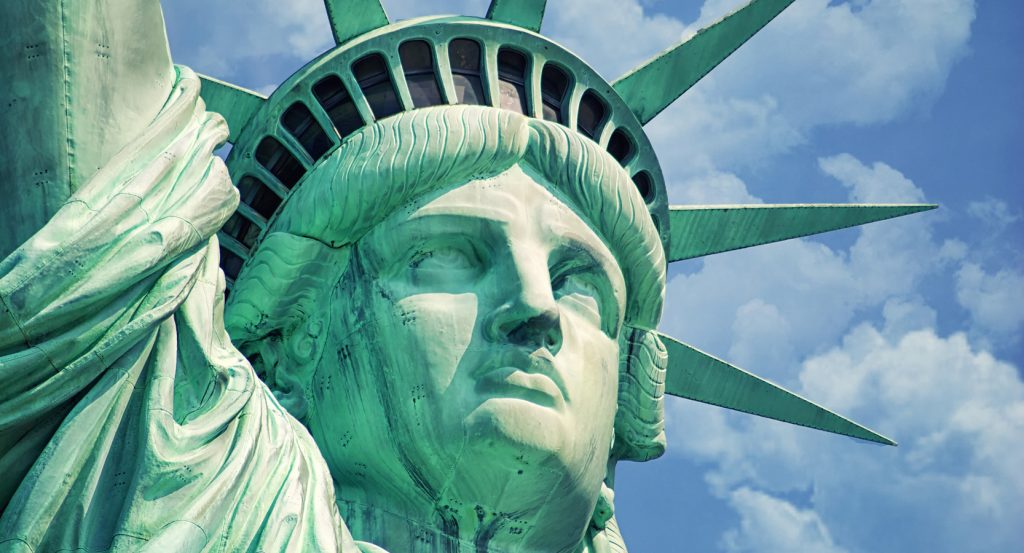
Why Fort Wood matters.
Fort Wood is a formidable harbor fortification where Liberty Island's military past meets early American coastal defense and the architectural foundation beneath the Statue of Liberty.
Set on the southern half of Liberty Island near the Main Mall and just steps from Flag Plaza, the fort occupies elevated ground facing the shipping channels of New York Harbor with Manhattan, Brooklyn, New Jersey and Governors Island spread across the surrounding water. Grey-blue granite from Blue Hill, Maine covers rubble-masonry exterior walls averaging 24 feet high and 30 feet thick, giving the surviving defensive perimeter exceptional physical weight beneath the later monument. The broad terreplein forms a 50,000-square-foot pedestrian platform between the exterior walls and the central pedestal, preserving a substantial horizontal layer of the military structure around the monument. Exterior staircases rise through this masonry enclosure toward the pedestal, allowing the defensive architecture to remain legible beneath the colossal copper figure above. The result is a massive granite fort whose walls, elevated platform, stairways and commanding harbor position preserve Liberty Island's earlier military architecture directly beneath its internationally recognized monument.
What defines Fort Wood.
Fort Wood is best known for beginning as a United States harbor-defense installation constructed between 1808 and 1811, decades before the Statue of Liberty transformed Bedloe's Island into an international symbol. The United States Army assumed administration of the island as a military post in 1808 and began the defensive work as tensions with Britain increased during the years preceding the War of 1812. Its eleven-point configuration belonged to a fortification tradition brought to North America by French military engineers during the seventeenth century, with artillery and infantry assigned to protect approaches through New York Harbor. New York Governor Daniel D. Tompkins renamed the installation Fort Wood in 1814 for Lieutenant Colonel Eleazer Derby Wood, a West Point graduate and Army engineer killed during the siege of Fort Erie on the Canadian front. Fort Wood belonged to a wider defensive network that included Castle Williams and Fort Jay on Governors Island, Castle Clinton at Manhattan's southern tip and Fort Gibson on Ellis Island, forming part of the Second American System developed to protect the nation's major ports. Artillery and infantry remained associated with the post until the Civil War, when Fort Wood operated as a recruiting station and ordnance depot with a small garrison. The garrison was disbanded in 1877 as preparations advanced for the French statue, although the Army retained an active ordnance presence on Bedloe's Island until 1937. Fort Wood carries a military chronology extending from the young republic's coastal-defense campaign through the War of 1812 era, Civil War mobilization and the eventual conversion of its island setting for a radically different national purpose.
Major alterations during 1844 through 1847 gave the fort another architectural chapter, adding a three-foot-deep granite facing to the scarp along with musketry slots and deep parapet coping. President Ulysses S. Grant approved Bedloe's Island for the Statue of Liberty in 1877, placing the future French monument inside an existing American military site. Architect Richard Morris Hunt received the American Committee for the Statue of Liberty's pedestal commission and spent two years refining proposals after Frédéric Auguste Bartholdi had explored concepts including a “Fortress of Liberty,” a stepped pyramid and other supporting forms. Hunt's 1884 final scheme reduced an earlier 114-foot proposal to 87 feet under financial pressure, and the architect donated his $1,000 fee to the American Committee's fundraising campaign. Construction placed Hunt's pedestal inside the old fortification, permanently joining nineteenth-century monument architecture with an early federal defensive work when Liberty Enlightening the World was dedicated on October 28, 1886. President Calvin Coolidge's 1924 proclamation designated the Statue of Liberty and Fort Wood as a national monument with the boundary fixed at the fort's outer edge, and federal administration transferred to the National Park Service in 1933. A later public-private restoration campaign launched under Lee Iacocca in 1982 raised funds toward an $86 million restoration of the monument complex, culminating around the Statue's 1986 centennial. Preservation continued into the twenty-first century with a project completed in 2023 that rehabilitated 35,000 square feet of Fort Wood granite through masonry repairs, block resetting, mortar replacement and selective stone replacement. Those successive interventions preserved the fort as an architectural component of the Statue of Liberty National Monument long after its original defensive purpose disappeared.
How Fort Wood fits.
Fort Wood works as the anchor for a New York Harbor outing connecting the interpretation of Liberty, the federal immigration station at Ellis Island and a pioneering American fortification on Governors Island.
Begin at Statue of Liberty Museum, the 26,000-square-foot institution opened on Liberty Island on May 16, 2019, with architecture by FXCollaborative and exhibitions by ESI Design. The project emerged from a 2012 commission and was conceived as an extension of the island landscape, lifting planted terrain across an angular building whose roof becomes accessible park space. Flood resilience placed the museum above the 500-year flood level, and bird-safe glass, a green roof and hurricane-resistant construction addressed the exposed harbor setting. Exhibition space substantially expanded access to objects and interpretation associated with the Statue's conception, construction and 1986 restoration, placing the original torch within a purpose-built museum separate from the pedestal. Continue to Ellis Island National Museum of Immigration, housed in the Beaux-Arts Main Immigration Building designed by Edward Lippincott Tilton and William Alciphron Boring after fire destroyed the first wooden federal station in 1897. Their firm won a federal architectural competition, and the fireproof replacement opened on December 17, 1900, processing 2,251 immigrants on its first day. Copper-domed corner towers, limestone quoins and immense arched windows gave the federal station a commanding harbor presence during the period when immigration through Ellis Island reached its historic peak. 12 million immigrants passed through the station between 1892 and its 1954 closure, linking the island with one of the largest movements of people in United States history. Conclude at Castle Williams, Lieutenant Colonel Jonathan Williams's circular red-sandstone fort erected on Governors Island between 1807 and 1811 as an experimental coastal-defense design. Williams, Chief Engineer of the Army Corps of Engineers and the first superintendent of the United States Military Academy, developed the work as a prototype for a new generation of American fortifications. Defensive obsolescence shifted its purpose toward barracks and military confinement; Confederate enlisted soldiers and Union deserters occupied its casemates during the Civil War, and the Army later converted the structure into a modernized military prison. Secretary of War Elihu Root intervened in 1901 when Army leaders sought demolition, preserving a structure that subsequently remained part of Governors Island's long military history. The progression moves from a modern museum devoted to Liberty through the federal gateway that processed millions of immigrants and culminates at Williams's pioneering harbor fort, connecting symbolism, migration and military engineering across three islands.
Where your story begins.
Foresyte Travel reveals places that feel extraordinary long before you arrive.
Enjoy editorial crafted for luxury travelers.
Foresyte may earn a commission when you book.







































































































