Why Four Seasons Hotel Mexico City matters.
Four Seasons Hotel Mexico City is a hacienda-style hotel where Colonia Juárez's grand boulevard setting meets an enclosed garden, successive generations of commissioned design and the Mexican cocktail experimentation that carried Fifty Mils onto the world stage.
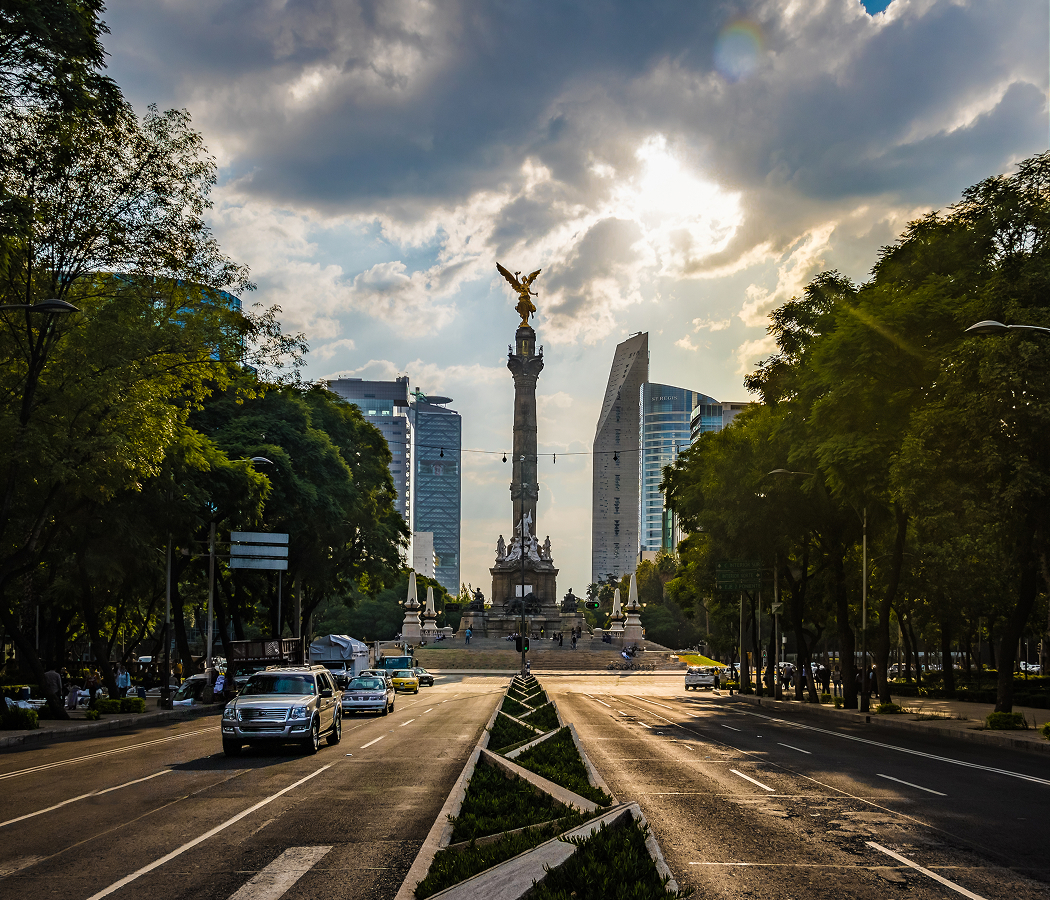
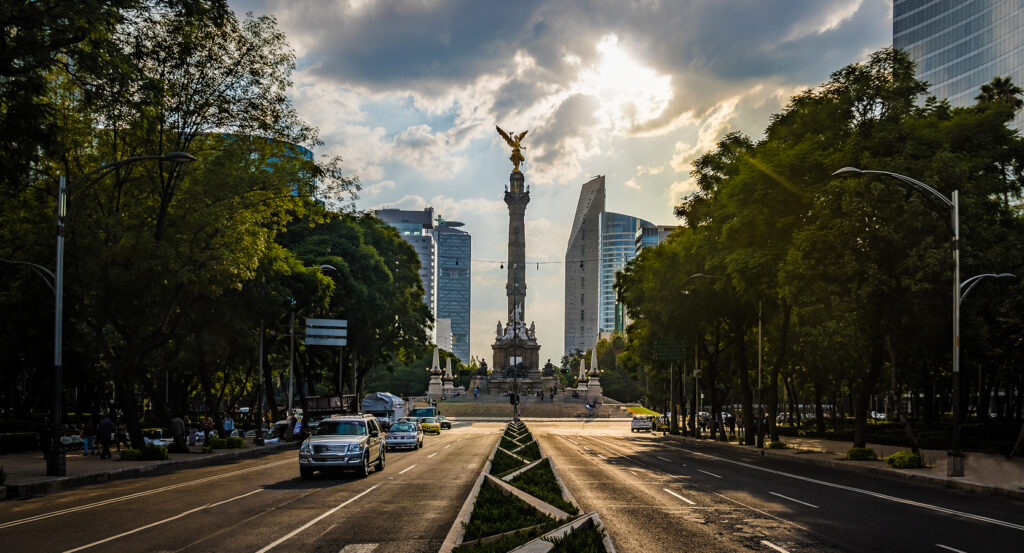
Set along Paseo de la Reforma near Burdeos and just steps from Bosque de Chapultepec, the hotel occupies Colonia Juárez's western edge, with Lieja marking the approach to the park and the boulevard extending northeast toward the Diana Cazadora fountain. Arched windows and a pale façade enclose a formal garden planted with fruit trees and tropical vegetation, placing a substantial planted interior behind the avenue's frontage. Arrival moves through the lobby toward the central fountain, where surrounding colonnades frame the garden as the building's principal gathering place. Mexican folk art and evening strings of light add a second layer of detail along the courtyard, encouraging attention to sculpture, foliage and the changing illumination beneath the arches. The result is a hotel whose inward-facing garden and Reforma position give a stay in the capital a distinct physical center between boulevard exploration and time spent within its planted enclosure.
What defines Four Seasons Hotel Mexico City.
Four Seasons Hotel Mexico City is best known for developing a purpose-built interpretation of the Mexican hacienda through a sequence of international design commissions and Mexican artisanal collaborations. Wimberly, Allison, Tong & Goo supplied the architecture for the property, which opened in March 1994. The building's colonial references belong to that modern commission, giving its architectural history a clear starting point within late twentieth-century hospitality. A renewal begun during the hotel's twentieth-anniversary celebrations in 2014 brought Parisian designers Gilles & Boissier into the interiors. Their intervention changed the façade's colours and recast the lobby as a sequence of smaller salons with fireplaces, communal seating and a library area. Completion was announced in March 2016, establishing the redesigned public rooms as another substantial chapter in the building's development. Martin Brudnizki's London firm, MBDS, separately designed Zanaya and Fifty Mils, bringing another author into the same renovation campaign. Mexican designer Bibiana Huber led the next major interior reinterpretation, whose first phase debuted in April 2026. Huber's commissions extended to hand-painted ceramics associated with José Noé Suro, lighting by ULA Light and decorative pineapples by Marva Studio drawn from Michoacán craft traditions. Fernanda Mereles, Pedro Arturo and Arozarena de la Fuente contributed art and textile work, extending the commission across several creative disciplines. Red marble from Durango placed Mexican stone alongside the commissioned objects, anchoring the redesign in a specific regional resource. Fashion designer Kris Goyri developed new hotel uniforms within the same renewal, carrying Mexican authorship from the interiors into the clothing worn throughout the property. Those successive commissions connect the hotel's 1994 architecture with a continuing investment in designers, workshops and artists whose work gives the building distinct creative chapters.
Fifty Mils developed the hotel's cocktail reputation after opening in 2015 under a team that included French mixologist Mica Rousseau. Mexican ingredients became central to its drinks, with Ant Man combining mezcal, avocado and ants with hoja santa bitters, lemongrass syrup, egg white and soda. Bugs Bunny carried that ingredient-led approach into gin through carrot juice, fresh cactus and three-chile bitters, with fernet supplying an additional aromatic accent. The bar's experimentation also reached the production of the spirit itself through Four Fifty, an exclusive mezcal developed with Casa Wahaka in 2016. Rousseau, Axel Pimentel and Jimmy Morales collaborated with mezcal maker Beto Morales on the inaugural edition of 100 numbered bottles. Espadín agave supplied the foundation, followed by whole mango and ripe banana during the third distillation. Moroccan mint and cardamom added another botanical layer to the finished spirit, which entered the bar through straight pours and a tonic preparation garnished with banana. The collaboration placed the bartenders inside mezcal production, connecting their cocktail work with decisions made during distillation. International recognition followed in 2018, when Fifty Mils entered The World's 50 Best Bars at position 45. The award joined an established body of drinks and a dedicated mezcal commission, giving the hotel's bar a distinction grounded in creations developed within its own cocktail program.
How Four Seasons Hotel Mexico City fits.
Four Seasons Hotel Mexico City works as the garden-centered base for a Chapultepec outing connecting a former imperial residence, Mexico's twentieth-century artistic reinvention and the national museum that gives pre-Hispanic civilizations an architectural stage.
Begin at Castillo de Chapultepec, where construction initiated under Viceroy Bernardo de Gálvez in 1785 created the foundation for a residence repeatedly reshaped by changes in Mexican power. Maximilian of Habsburg and Carlota later occupied the castle during the Second Mexican Empire, adding an imperial chapter to the hilltop building's history. President Lázaro Cárdenas designated the property for the Museo Nacional de Historia in 1939, and the museum opened in September 1944. The conversion placed a former seat of privileged residence into public cultural use, making the castle an appropriate opening for an outing examining how Mexico preserves and presents its past. Continue to Museo de Arte Moderno, inaugurated on September 20, 1964 within the same wooded district. Pedro Ramírez Vázquez and Rafael Mijares designed its curving galleries, using glass, steel and aluminium alongside five domes of fiberglass-reinforced polyester. The building's continuous exhibition rooms gave twentieth-century painting a distinctly modern enclosure after the castle's sequence of former residential spaces. Frida Kahlo's Las dos Fridas, painted in 1939 during her separation from Diego Rivera, belongs to the collection and brings the discussion of national culture into the scale of an individual artist's double self-portrait. Conclude at Museo Nacional de Antropología, whose September 17, 1964 inauguration preceded the modern-art museum by three days. Pedro Ramírez Vázquez directed a building completed in nineteen months, coordinating architecture with archaeological collections transferred from the former museum on Moneda. The central courtyard's El Paraguas gathers the complex beneath its immense suspended canopy, giving the approach to the galleries a commanding architectural focus. The Piedra del Sol, uncovered in Mexico City's Plaza Mayor in 1790, supplies a culminating encounter with Mexica cosmology through the carved imagery of the five suns. The progression moves from a former imperial residence converted into public history through the architecture and painting of Mexican modernity and culminates in the national presentation of ancient civilizations, revealing Chapultepec as a concentrated setting for Mexico's changing representations of its past.
Where your story begins.
Foresyte Travel reveals places that feel extraordinary long before you arrive.
Enjoy editorial crafted for luxury travelers.
Foresyte may earn a commission when you book.