Why Four Seasons Hotel The Westcliff matters.
Four Seasons Hotel The Westcliff is a hillside hotel where Johannesburg's mining-era suburban grandeur meets contemporary African design, open-flame cuisine, and expansive views across the city's northern forest.
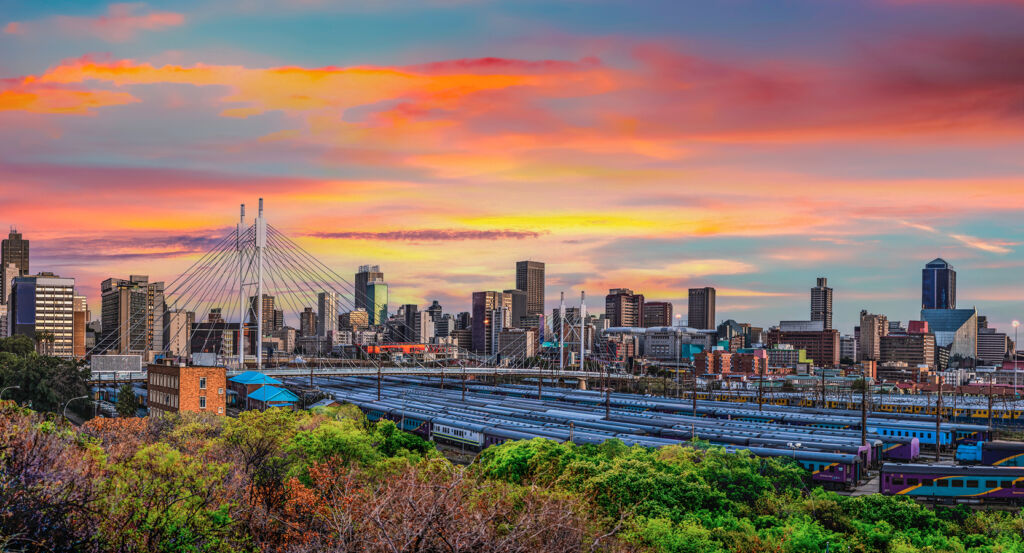
Perched above Jan Smuts Avenue in Westcliff, Four Seasons Hotel The Westcliff occupies a steep ridge between Parktown, Saxonwold and the tree-lined districts extending north toward Rosebank and Sandton. The property unfolds across a series of low-rise buildings, gardens and courtyards that follow the hillside instead of imposing a single expansive block on the landscape. Panoramic terraces and elevated paths orient the hotel toward Johannesburg's urban canopy, with the city appearing as a broad field beyond the surrounding gardens. The hillside plan makes movement through the property part of the stay, linking rooms, restaurants, spa spaces and terraces through changing levels and views. The result is a distinctive Johannesburg hotel whose character depends on topography, cultivated landscape and a precise sense of place.
What defines Four Seasons Hotel The Westcliff.
Four Seasons Hotel The Westcliff originated in 1997 as The Westcliff, a luxury hillside hotel conceived around the architectural character of Johannesburg's affluent northern suburbs. Its original development established an unusual residential model for metropolitan hospitality, arranging low-rise buildings across the steep terrain of the Witwatersrand Ridge through interconnected courtyards, landscaped gardens and private terraces. The property became one of Johannesburg's established luxury addresses during the city's emergence as South Africa's principal corporate and financial center following the end of apartheid. Its original hospitality character combined the discretion of an exclusive residential enclave with the formal service traditions of an international luxury hotel. Hotel Properties Limited, the Singapore-based hospitality investment group associated with the property, subsequently undertook a major transformation that brought the historic Westcliff into the Four Seasons portfolio. The hotel closed in 2012 for an extensive redevelopment, beginning a reconstruction that redefined its architecture, interiors, restaurants and public facilities. South African practice RSL Architects directed the architectural renovation, preserving the property's distinctive hillside arrangement and introducing contemporary elements into its established residential composition. Jacket Interiors developed the principal interior redesign, integrating modern furnishings, regional craftsmanship and an extensive collection of contemporary African art. London-based design practice Blacksheep contributed the interiors of the signature restaurants, establishing a contemporary hospitality character within the property's historic architectural setting. The reconstruction introduced exterior glass elevators that transformed movement through the steeply terraced grounds into a defining architectural feature. Johannesburg artist Hannelie Coetzee created expansive concrete face sculptures for the arrival area using mining core waste associated with South Africa's gold and platinum industries. The redevelopment also commissioned 375 original artworks from local artists, extending the city's creative culture throughout the hotel's interiors. Four Seasons Hotel The Westcliff opened in December 2014 under its new international management, completing two years of reconstruction and establishing a significant new chapter in Johannesburg's luxury hospitality industry. The property's transformation preserved the character of the original Westcliff while introducing a distinctly South African interpretation of contemporary international luxury, with architectural authorship, artistic patronage and hospitality development united through the hotel's longstanding relationship with Johannesburg.
How Four Seasons Hotel The Westcliff fits.
Four Seasons Hotel The Westcliff works as the opening point for a daytime itinerary connecting Johannesburg's designed landscapes, national memory and early twentieth-century architectural culture.
Begin at Johannesburg Botanical Garden, a large urban landscape whose creation answered decades of civic pressure for a dedicated botanical institution in Johannesburg. City officials began formal consideration in 1968, and a resolution passed in 1969 authorized the garden on land at Jan van Riebeeck Park. The site developed around Emmarentia Dam and eventually incorporated collections including a rose garden, arboretum, succulent garden, cycad garden, geological garden and water garden. Its scale gives the city a public landscape in which cultivated plant collections, aquatic habitats and recreational grounds operate together. Continue to DITSONG: National Museum of Military History, which shifts the itinerary from civic landscape into the preservation of South Africa's military record. The museum originated during the Second World War after historians and collectors began gathering documents, weapons and memorabilia connected with the country's military participation. The South African National War Museum opened on 29 August 1947 under Prime Minister and Field Marshal J.C. Smuts, and its scope expanded in 1975 to include all military conflicts involving South Africans. Its original Bellman aircraft hangars still hold much of the collection, giving the institution a direct architectural connection to its founding purpose. Conclude at Glenshiel, the Westcliff estate designed by Sir Herbert Baker and Frank Fleming in 1910 for mining magnate Sir William Dalrymple and Lady Isabel Dalrymple. The house uses an H-shaped plan with wings splayed at 45 degrees, deep verandahs, stone terraces and gardens shaped from material quarried on the property. Its twenty-seven-acre grounds once employed twenty-seven full-time gardeners and extended down toward Jan Smuts Avenue. The progression moves from Johannesburg Botanical Garden's civic cultivation through DITSONG: National Museum of Military History's national memory and culminates in Glenshiel's mining-era architecture, connecting the city's landscape, institutions and private wealth within the elevated world surrounding Westcliff.
Where your story begins.
Foresyte Travel reveals places that feel extraordinary long before you arrive.
Enjoy editorial crafted for luxury travelers.