
Why Tokyo Garden Terrace Kioicho matters.
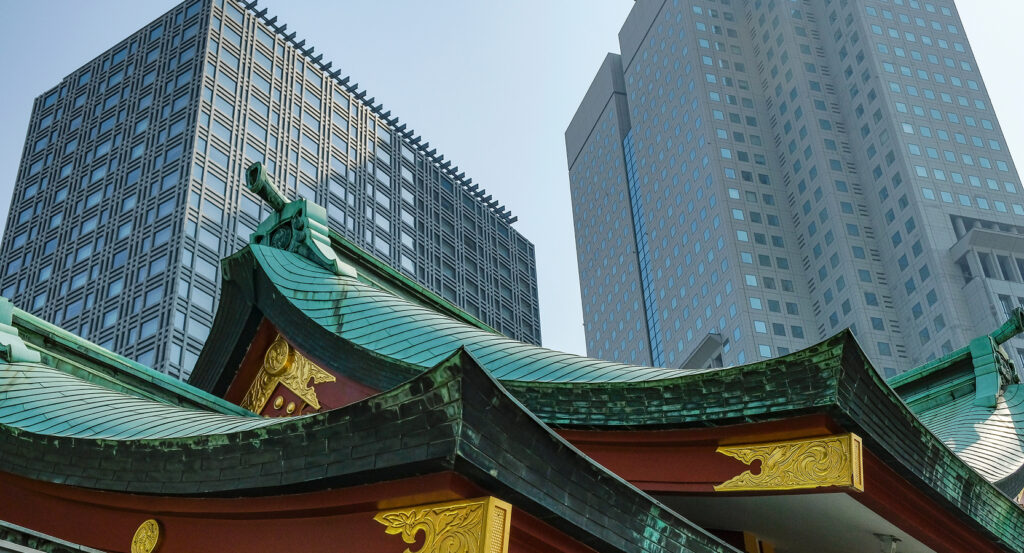
Tokyo Garden Terrace Kioicho is a sweeping urban complex where Kioicho's legacy of daimyo estates meets contemporary architecture, terraced greenery and the dramatic topography surrounding Benkeibori.
Set along Kioicho-dori near Prince-dori and just steps from Benkeibori, the complex occupies a 30,360-square-meter site descending across an 18-meter change in elevation between the historic streets of Kioicho and the moat below. Kioi Tower and Kioi Residence rise above layered terraces, planted passages and open ground created by concentrating much of the development vertically and placing supporting infrastructure beneath the site. A commercial passage runs parallel to Benkeibori, using openings and multi-storey voids to pull views of water and greenery deep into the lower architecture as pedestrians move through the precinct. Exterior paths extend that encounter toward Shimizudani Park and surrounding streets, turning the steep terrain into a sequence of stairs, terraces, gardens and changing elevations. The result is a contemporary district whose towers and terraced public realm make Kioicho's unusual combination of topography, moat landscape and inherited greenery physically legible across the entire site.
What defines Tokyo Garden Terrace Kioicho.
Tokyo Garden Terrace Kioicho is best known for transforming the former Grand Prince Hotel Akasaka property while preserving an architectural survivor whose history connects the site with Japan's imperial and Korean royal families. The building now known as Akasaka Prince Classic House originated as the Tokyo residence of Yi Un, the final crown prince of Korea's Joseon dynasty, and his Japanese wife, Princess Masako of Nashimoto. Architect Gondo Yoji completed the residence in 1930 through a Western composition of half-timbering, steep roofs and ornamental interiors that subsequently received designation as a Tokyo Tangible Cultural Property. Seibu Railway acquired the property after World War II and opened the residence as the Akasaka Prince Hotel in 1955, beginning a hotel history that expanded dramatically when Tange Kenzo designed the adjoining New Building. Tange's 1983 tower became one of the district's most recognizable late twentieth-century structures before the hotel ceased operation in March 2011. The Great East Japan Earthquake struck only weeks before closure, and the former hotel subsequently accommodated evacuees from Fukushima Prefecture during the months preceding redevelopment. Demolition of Tange's 138.9-meter tower required Taisei Corporation to develop its Tekorep system, enclosing the upper demolition floor and lowering the building incrementally as dismantling advanced downward. Seibu then commissioned Nikken Sekkei to design the new 227,200-square-meter development, with Kohn Pedersen Fox Associates contributing exterior design to the principal towers. The 1930 residence presented a different construction problem: the protected building was temporarily moved from its original position, restored and seismically upgraded before returning as Akasaka Prince Classic House within the completed complex. Tokyo Garden Terrace Kioicho reached completion in 2016, carrying the site from royal residence through two generations of hotel architecture and an unusually complex demolition into a new district that retained its oldest building as an active part of the redevelopment.
Kohn Pedersen Fox Associates developed another major strand of the project through an exterior concept derived from jubako, the stacked lacquer boxes associated with Japanese food presentation. The tower composition translates that reference into stacked volumes, giving the high-rise silhouette a series of setbacks and projecting sections that break down its immense vertical mass. Nikken Sekkei extended the architectural strategy across two principal towers with sharply different programs: the 177.65-meter Kioi Tower combines offices, commercial functions and hotel space, and the 88.35-meter Kioi Residence contains 135 rental homes across 21 above-ground floors. Lighting Planners Associates shaped the residential exterior illumination, ILYA Corporation handled its shared interiors and PLACEMEDIA developed exterior areas, expanding the project's authorship beyond the two principal architectural firms. Structural engineering responded to the site's scale through seismic isolation, a strategy subsequently recognized with the 2018 Japan Seismic Isolation Structure Association Award. The completed development also received the 2016 Japan Society of Architecture, Art, and Crafts Award, placing architectural recognition alongside its structural achievement. Kohn Pedersen Fox Associates' jubako-derived massing, Nikken Sekkei's coordination of two distinct towers and the project's seismic engineering gave the former hotel property a new architectural order whose authorship extends from skyline composition into residential design and structural performance.
How Tokyo Garden Terrace Kioicho fits.
Tokyo Garden Terrace Kioicho works as the anchor for a daytime route through three nearby sites connecting Tokugawa political geography, a defining assassination of the Meiji state and the surviving defenses of Edo Castle.
Begin at Kishu Tokugawa Residence Site, which preserves the memory of the Kii branch of the Tokugawa Gosanke on the same Kioicho ground where the contemporary development now stands. Tokugawa Yorinobu, the tenth son of Tokugawa Ieyasu, became the first lord of Kii, and the lineage subsequently produced the eighth shogun, Tokugawa Yoshimune, and fourteenth shogun, Tokugawa Iemochi. Surviving stonework from the daimyo residence has been relocated within the present grounds, leaving a physical remnant of the political household that occupied the site during the Edo period. Continue to Shimizudani Park, where the former estates of the Kii Tokugawa, Owari Tokugawa and Ii families once converged around springs that gave Shimizudani its name. The district entered Meiji political history in 1878 when Shimada Ichiro and fellow former samurai assassinated statesman Okubo Toshimichi as he traveled toward the Akasaka imperial residence. A 6.27-meter memorial now commemorates Okubo near Shinji-ike pond, and the surrounding land became a Tokyo municipal park in 1890 before transfer to Chiyoda in 1965. Conclude at Akasaka-Mitsuke Gate Site, part of the outer defensive system of Edo Castle and a surviving marker of the fortified geography that once controlled movement between Akasaka and the shogunal center. Construction of the gate was assigned to Kuroda Tadayuki, lord of Fukuoka, during the seventeenth-century expansion of Edo Castle, embedding daimyo labor obligations directly into the capital's defenses. Its surviving stonework fixes Kioicho within the larger military landscape that structured Edo around moats, gates and controlled approaches to the Tokugawa seat. The progression moves from the Kii Tokugawa household through Okubo Toshimichi's assassination and the political rupture of early Meiji Japan into Akasaka-Mitsuke's surviving fortifications, revealing the concentration of shogunal and imperial history beneath Tokyo Garden Terrace Kioicho's contemporary architecture.
Where your story begins.
Foresyte Travel reveals places that feel extraordinary long before you arrive.
Enjoy editorial crafted for luxury travelers.
Foresyte may earn a commission when you book.

















































































































