
Why George Restaurant matters.
George Restaurant is a two-MICHELIN-starred Chiaia dining destination where Chiaia's nineteenth-century hospitality heritage meets Domenico Candela's French-trained culinary precision, the agricultural traditions of Campania and a contemporary approach to Neapolitan gastronomy.
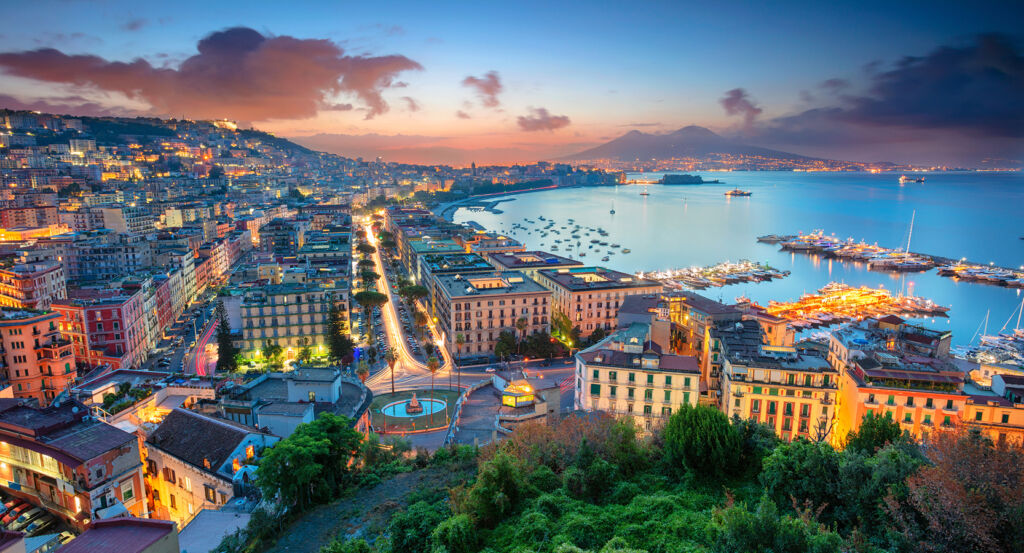
Occupying the panoramic sixth floor of Grand Hotel Parker's, above the hillside stretch of Corso Vittorio Emanuele near Via Tasso and the descending streets toward the Riviera di Chiaia, the restaurant overlooks the Gulf of Naples, Mount Vesuvius and the Sorrentine Peninsula. Its elegant dining room incorporates polished surfaces, carefully arranged tables and decorative furnishings inspired by the hotel's historic association with marine biologist George Parker Bidder III. An open kitchen provides a direct view of the culinary team, connecting the preparation of elaborate tasting menus to the formal arrangement of the dining space. Floor-to-ceiling glazing and an adjoining panoramic terrace establish a continuous visual relationship between the interior and the coastal landscape below. The result is an exceptionally refined rooftop restaurant whose elevated setting, intimate dining arrangements and panoramic architecture provide a distinguished environment for contemporary Campanian cuisine.
What defines George Restaurant.
George Restaurant is best known for the culinary leadership of Neapolitan chef Domenico Candela, whose international training and return to his native city established one of southern Italy's most accomplished contemporary fine-dining establishments. The restaurant occupies a historic hotel whose origins date to 1870, when the property operated as the Hotel Tramontano Beau Rivage and accommodated European travelers visiting Naples during the later nineteenth century. Its subsequent development became closely associated with George Parker Bidder III, an English marine biologist conducting research at the Stazione Zoologica Anton Dohrn. Bidder acquired the property during the late nineteenth century, establishing a relationship between scientific Naples and the city's expanding international hospitality industry. The hotel subsequently attracted prominent literary figures, including Oscar Wilde, Virginia Woolf and George Bernard Shaw, contributing to its reputation among educated European travelers. Severe damage during the Second World War threatened the property's survival, prompting its acquisition in 1948 by Neapolitan lawyer Francesco Paolo Avallone. His restoration established the foundations of the Avallone family's continuing ownership and the hotel's subsequent development as a luxury hospitality institution. The restaurant's modern transformation began in 2018, when a substantial renovation introduced George as a new gastronomic destination under Candela's direction. Born in Naples, Candela developed his professional career through demanding appointments in France, acquiring the classical techniques and organizational discipline associated with some of Europe's most influential kitchens. His experience included Taillevent in Paris, the historic restaurant whose reputation developed through rigorous French haute cuisine and an extensive tradition of formal hospitality. Candela subsequently worked with Anne-Sophie Pic, whose culinary approach emphasizes aromatic precision, carefully controlled acidity and the development of delicate relationships between ingredients. His professional development also included experience with Yannick Alléno, a leading figure in contemporary French gastronomy whose work incorporates advanced extraction techniques, fermentation and the technical refinement of classical sauces. These appointments introduced Candela to different approaches to culinary composition, establishing a foundation in precise cooking, ingredient concentration and the coordinated sequence of tasting menus. His return to Naples brought this technical background into direct contact with the agricultural and maritime products of Campania, creating a culinary program centered on regional ingredients interpreted through contemporary European techniques. The restaurant's initial reception established its position within the city's developing fine-dining sector, and the MICHELIN Guide awarded George its first star in the 2020 edition. The recognition represented an important development for the Avallone family's hospitality enterprise, establishing a direct connection between the historic hotel and the international standards of contemporary gastronomy. Candela continued developing the restaurant through an increasingly ambitious culinary program that combined French classical training with Neapolitan culinary references and carefully selected Mediterranean ingredients. The restaurant's growing reputation brought additional national recognition, including attention from Italian culinary publications examining the development of modern fine dining in southern Italy. MICHELIN's 2024 guide retained George among Italy's starred restaurants, highlighting Candela's treatment of Campanian ingredients and the technical accomplishments of his kitchen. A decisive milestone followed with the MICHELIN Guide Italy 2025, when George received its second star, becoming the first restaurant within the city of Naples to achieve that distinction. The award established a new level of international recognition for Neapolitan fine dining and strengthened the city's position within Italy's highest culinary classifications. The restaurant retained its two-star standing in the 2026 guide, consolidating the achievement through Candela's continued leadership. Its contemporary program includes two principal tasting menus, Since 2018 and Viaggio Goloso, distinguishing the chef's established preparations from a changing sequence developed around seasonal ingredients. The restaurant's development connects nineteenth-century international hospitality, French culinary education, regional agricultural traditions and the emergence of Naples as a destination for MICHELIN's highest levels of contemporary gastronomy.
Domenico Candela's cooking develops the flavors of Campania through a carefully structured progression in which ingredient concentration, contrasting temperatures and classical French sauce-making establish increasingly complex relationships between familiar Neapolitan preparations. His approach begins with the selection of regional products whose natural sweetness, acidity and aromatic characteristics can support several distinct technical treatments within a single composition. The signature POMOD'ORO demonstrates this method through seven varieties of Campanian tomato, each contributing a different balance of acidity, sweetness, water content and concentrated flavor. The kitchen transforms these tomatoes into multiple textures, allowing the same ingredient to develop contrasting sensations through controlled preparation and moisture reduction. A gelatin-based imitation tomato introduces another expression of the fruit's recognizable form, enclosing mozzarella whose lactic richness balances the acidity of the surrounding preparation. Basil contributes aromatic freshness through several treatments, including a delicate frozen preparation that introduces a contrasting temperature and a concentrated herbal fragrance. A steamed basil bread completes the composition, providing a soft structure for collecting the remaining sauce and connecting the elaborate preparation to the Neapolitan custom of scarpetta. The relationship between traditional flavor and technical transformation extends through Candela's treatment of pasta, whose structure becomes a foundation for concentrated sauces and carefully developed aromatic components. Gragnano spaghettone contributes substantial texture and resistance, allowing the pasta to retain its distinctive character alongside ingredients prepared in several forms. Controlled emulsification connects the starch released during cooking with fats and concentrated vegetable liquids, producing a cohesive sauce that adheres closely to the pasta's surface. Candela's French training becomes particularly consequential in the treatment of stocks, reductions and extracted juices, which develop the depth of flavor associated with classical cuisine through prolonged concentration and careful temperature control. These preparations allow small quantities of sauce to carry substantial aromatic intensity, creating a direct relationship between the principal ingredient and the supporting elements of the composition. His treatment of seafood follows the same principle through precise cooking that preserves the delicate texture of Mediterranean fish and crustaceans. Red prawns contribute pronounced natural sweetness, which can be balanced through citrus acidity, herbal oils and concentrated vegetable extracts. A preparation involving Carnaroli rice cooked in an extraction of lemon leaves develops this relationship through the gradual absorption of aromatic liquid, producing a creamy grain structure carrying the fragrance of citrus foliage. Tarragon oil introduces a further herbal component, and fermented raspberry jus contributes acidity whose intensity balances the sweetness of the seafood. Fermentation also provides a controlled method of developing deeper savory characteristics, extending the kitchen's treatment of regional produce through techniques associated with contemporary European and Japanese gastronomy. The process alters the balance of sugars and organic acids within selected ingredients, allowing Candela to introduce additional complexity through relatively restrained quantities. His treatment of meat develops a complementary relationship between classical cooking and Campanian agricultural heritage, including preparations involving Laticauda lamb, a sheep breed associated with southern Italy. The lamb's richness supports concentrated reductions and vegetable accompaniments whose acidity and aromatic intensity create balance across the composition. Papaccella peppers contribute a distinctly Campanian ingredient, bringing sweetness and a concentrated pepper fragrance to preparations developed through careful reduction. Fermented jalapeño introduces sharper acidity and controlled heat, creating a contrasting element within the richer structure of the meat. A light preparation inspired by bagna cauda introduces the savory intensity of anchovies, connecting the composition to the broader Italian tradition of concentrated fish-based sauces. The sequence of these flavors demonstrates Candela's preference for developing recognizable regional ingredients through several interconnected technical operations. His pastry program extends the same approach through classical French preparations whose structures depend on the precise treatment of eggs, butter, sugar and temperature. Soufflé provides a particularly demanding example because its lightness depends on the controlled expansion of air incorporated into an egg-based mixture during baking. Hazelnut contributes the concentrated richness of roasted nuts, and passion fruit introduces pronounced acidity that balances the dessert's sweetness. Caramel ice cream provides a colder, denser component, creating a progression between warm aerated pastry, concentrated fruit and frozen dairy. The wine program develops the culinary sequence through an emphasis on Campania's indigenous grape varieties, including Fiano, Greco and Aglianico, whose contrasting structures accommodate the kitchen's changing levels of acidity, richness and savory concentration. White wines from Fiano di Avellino and Greco di Tufo contribute mineral character, freshness and aromatic complexity, establishing complementary relationships with seafood and citrus-based preparations. Taurasi introduces the substantial tannic structure and aging potential of Aglianico, supporting richer meat preparations and concentrated sauces. The Since 2018 tasting menu preserves the chef's established compositions, and Viaggio Goloso develops the same technical approach through changing seasonal products. George Restaurant's culinary distinction emerges from the sustained relationship between Campanian ingredients, French classical technique and carefully controlled flavor development, establishing a coherent gastronomic progression grounded in the agricultural and maritime traditions of southern Italy.
How George Restaurant fits.
George Restaurant works as the culminating dining destination for an exploration connecting Chiaia's nineteenth-century aristocratic residences, the development of Neapolitan decorative arts and the architectural ambitions of the city's expanding bourgeoisie.
Begin at Villa Pignatelli, the neoclassical residence commissioned in 1826 by British diplomat Sir Ferdinand Richard Acton and designed by architect Pietro Valente. The villa subsequently passed to the Rothschild family, whose ownership introduced further decorative alterations and established the property among Naples' distinguished aristocratic residences. Prince Diego Aragona Pignatelli Cortés acquired the estate in 1867, beginning the period that gave the villa its present name and contributed substantially to its surviving interior decoration. His descendants preserved an extensive collection of furnishings, paintings, porcelain and decorative objects, eventually transferring the property to the Italian state in 1952. The museum's historic rooms preserve the domestic arrangements of an aristocratic household, and its adjoining carriage collection contains vehicles associated with nineteenth-century transportation and ceremonial life. Continue to Museo Duca di Martina, the decorative-arts museum occupying Villa Floridiana, the former royal residence acquired by Ferdinand I of Bourbon in 1817 for Lucia Migliaccio, Duchess of Floridia. Architect Antonio Niccolini transformed the existing building between 1817 and 1819, developing a neoclassical residence surrounded by gardens arranged in the English landscape tradition. The museum's principal collection originated with Placido de Sangro, Duke of Martina, whose extensive acquisitions included European porcelain, Oriental ceramics, glass and decorative objects assembled during his years in Paris. His heirs donated the collection to Naples in 1911, establishing the foundation of a public museum devoted to decorative craftsmanship. Its holdings include exceptional examples of Meissen, Sèvres and Capodimonte porcelain, connecting European ceramic production to the artistic collecting traditions of the Neapolitan aristocracy. Conclude at Palazzo Mannajuolo, the celebrated Art Nouveau residential building designed by architect Giulio Ulisse Arata and constructed between 1909 and 1911. The project developed through collaboration with engineers Gioacchino Luigi Mellucci and Giuseppe Mannajuolo, introducing an ambitious architectural composition associated with Naples' early twentieth-century expansion. Its façade combines elaborate decorative elements, curved balconies and carefully organized window arrangements, demonstrating the influence of European Liberty architecture on the city's emerging residential districts. The building's most celebrated feature is its extraordinary elliptical staircase, constructed through a cantilevered marble arrangement that rises around a central opening. Its complex geometry creates a striking architectural composition whose sculptural form demonstrates the technical ambitions of early twentieth-century Neapolitan construction. The progression moves from Villa Pignatelli's aristocratic domestic architecture through Museo Duca di Martina's international decorative-arts collections and culminates in Palazzo Mannajuolo's extraordinary Liberty design, connecting the social and artistic development of Chiaia across the nineteenth and early twentieth centuries.
Where your story begins.
Foresyte Travel reveals places that feel extraordinary long before you arrive.
Enjoy editorial crafted for luxury travelers.
Foresyte may earn a commission when you book.




















































































































