
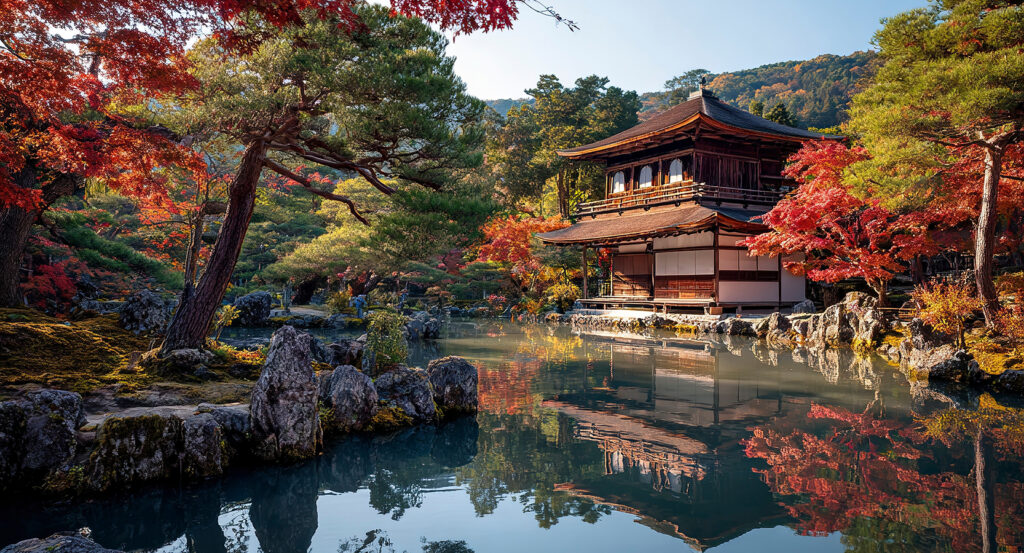
Why you should experience The Moss Garden at Ginkaku-ji in Kyoto, Japan.
The Moss Garden at Ginkaku-ji is Kyoto's green whisper, a world of softness and shadow where time dissolves into texture.
It winds behind the Silver Pavilion and up the temple's hillside like a secret unfolding, a labyrinth of moss, stone, and water that feels both cultivated and eternal. Step into the path and everything slows. The air dampens with the scent of cedar and earth; sunlight drips through the canopy in trembling flecks of gold. Each moss bed glows a different shade of green, jade, emerald, olive, chartreuse, their surfaces rippling like velvet seas. The sound of trickling water accompanies every step, guiding you upward toward quiet reflection points where the temple appears below, its reflection caught in the pond like a dream. Here, imperfection isn't flaw, it's faith. The moss garden reminds you that beauty doesn't resist time; it welcomes it.
What you should know about The Moss Garden at Ginkaku-ji.
The Moss Garden at Ginkaku-ji was designed in the late 15th century by the artist and monk Sōami, under the direction of Ashikaga Yoshimasa.
Its layout captures chisen-kaiyū, the strolling pond garden style that mirrors the flow of thought itself. Unlike the more rigid sand compositions of Zen dry gardens, this landscape was meant to be alive, shifting with the seasons, aging with grace. The pond at its heart, Hakkaku-sen, symbolizes purity and clarity, its reflective surface once used by Yoshimasa for moon-viewing ceremonies. The surrounding mosses, over forty varieties in total, were not originally planted but naturally took hold over centuries as the damp microclimate of the Higashiyama hills nurtured them. Over time, the monks of Ginkaku-ji began to tend them as sacred, seeing in their resilience a living metaphor for mindfulness. The moss represents mono no aware, the beauty of impermanence, and its texture became central to the temple's identity. Even the stepping stones and bamboo fences were placed to slow the visitor's pace, transforming walking into meditation. Few realize that this garden, often mistaken for a single composition, is in fact an evolving ecosystem, each patch of moss responding to light, moisture, and human stillness in its own quiet way.
How to fold The Moss Garden at Ginkaku-ji into your trip.
To experience The Moss Garden at Ginkaku-ji is to surrender your sense of time.
After admiring the Silver Pavilion and its sand garden, follow the winding path upward through the mossy slopes. Move slowly, your footsteps create soft echoes that seem to breathe with the landscape. Pause by the small streams that trickle beneath stone bridges; the sound of water and wind through the pines is Kyoto's original lullaby. As you ascend, the garden opens to small clearings that frame the temple and pond below like painted scrolls. In spring, the moss glows electric beneath the cherry blossoms; in summer, it deepens into cool shadow; in autumn, fallen red leaves scatter like embers across green velvet. Visit in the morning after rain, when the moss shimmers with dew, or at dusk, when the light filters low and golden through the trees. Don't rush the descent, it's designed as a meditation, each turn offering a new balance of stone, water, and shade. Before leaving, look back once more: the garden seems to pulse, alive in its stillness. The Moss Garden at Ginkaku-ji isn't something you observe. It's something you absorb, proof that Kyoto's truest beauty grows quietly, one drop of rain at a time.
Where your story begins.
Foresyte Travel reveals places that feel extraordinary long before you arrive.
Experience premium editorial crafted for luxury travelers.

















































































































