
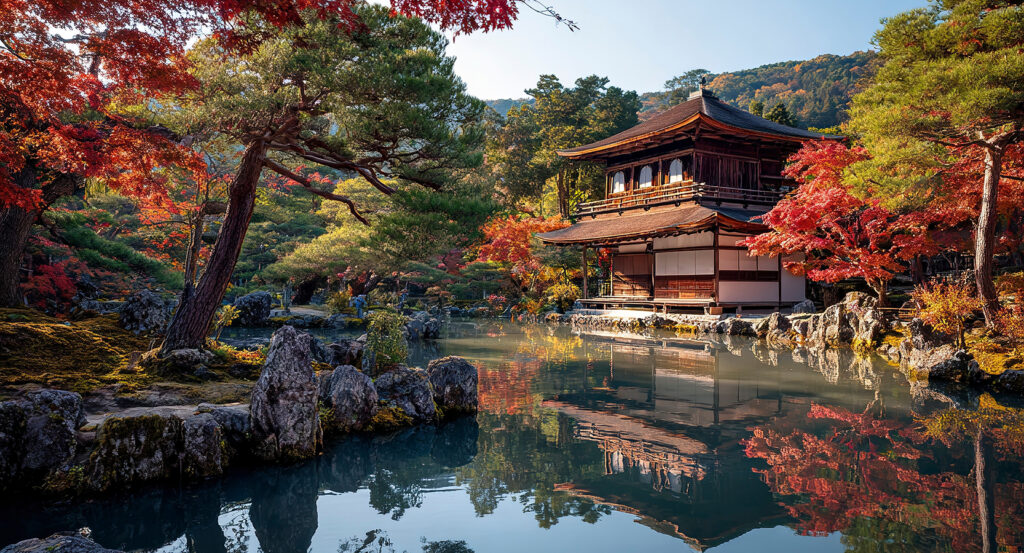
Why Ginkaku-ji matters.
Ginkaku-ji, or Silver Pavilion, is Kyoto's serenity incarnate, a place where restraint becomes art and beauty whispers.
Tucked along the eastern foothills of the Higashiyama district, this 15th-century Zen temple offers a counterpoint to the animated glow of its sibling, the Golden Pavilion. Here, the allure is subtle, the quiet shimmer of moss after rain, the elegance of shadow on wooden eaves, the poetry of imperfection. Built as a retreat for shogun Ashikaga Yoshimasa, Ginkaku-ji, or the Silver Pavilion, was meant to be adorned in silver leaf like its golden predecessor, but the coating was never completed. Instead, the weathered wood and dark patina of its walls became a masterpiece of wabi-sabi, Japan's aesthetic of beauty found in transience and imperfection. As you walk the winding stone paths, the sound of crunching gravel mingles with the murmur of wind through bamboo and the faint trickle of water from unseen streams. Every corner of this temple feels alive with intention: from the refined Kannon-den Pavilion, perched elegantly above its reflecting pond, to the delicate blend between architecture and nature that transforms with each season. Ginkaku-ji doesn't dazzle; it soothes, revealing that silence, too, can shine.
What defines Ginkaku-ji.
Despite its name and legend, Ginkaku-ji's power lies not in silver, but in spirit, in its profound influence on Japan's artistic identity.
Commissioned in 1482, the temple became the heart of the Higashiyama Culture, a movement that shaped the soul of Japanese art and philosophy. It was here that the tea ceremony, flower arranging, Noh theatre, and ink painting matured into forms defined by restraint and depth. Yoshimasa's retreat embodied the belief that simplicity was the truest expression of refinement, that the absence of ornament could reveal the essence of things. The temple's design perfectly reflects this principle: the two-tiered pavilion merges Zen minimalism with Shinden-zukuri, the aristocratic style of Kyoto's Heian period, uniting worlds of power and contemplation. The surrounding gardens, designed by the landscape master Sōami, are themselves a spiritual teaching, the Sea of Silver Sand, with its precisely raked white gravel and the striking Moon Viewing Platform, evoke mountains and water in pure abstraction. When moonlight spills across the sand at night, the entire garden seems to glow, a gentle irony, perhaps, that Ginkaku-ji achieves its silver sheen only through nature's touch. Few know that this understated temple's design directly influenced Kyoto's famed Philosopher's Path, which begins nearby, inviting quiet reflection much like the Zen practices born within its walls.
How Ginkaku-ji fits.
Visiting Ginkaku-ji is less about arrival and more about absorption, letting yourself dissolve into its rhythm of shadow, reflection, and breath.
Begin your journey in the soft light of morning, when mist still clings to the trees and the sound of distant temple bells lingers in the air. Approach through the Maple Avenue, a narrow path lined with shops and tea houses, where the city's pulse begins to fade into calm. Upon entering the temple grounds, slow your steps and follow the circular garden route that ascends gently uphill, designed to reveal Ginkaku-ji from shifting perspectives. Stop first at the Sea of Silver Sand, where raked white gravel catches the sun in rippling patterns, and gaze upon the Moon Viewing Platform rising like a meditative mountain. Then continue to the upper path that winds through mossy groves to a lookout point offering a breathtaking view of Kyoto's tiled rooftops framed by pines. Sit for a moment, breathe deeply, and let the silence take hold, a silence so layered it feels symphonic. Before you leave, take a quiet moment at the pond reflecting the pavilion's weathered façade; its muted tones glow faintly in the water like brushed silk. Pair your visit with a walk along the nearby Philosopher's Path, especially in spring when cherry blossoms line the canal, extending Ginkaku-ji's calm into the city's heart. Ginkaku-ji isn't Kyoto's silver twin, it's its soul. It teaches that radiance doesn't come from gilded surfaces but from grace, humility, and time's quiet hand. To stand here is to understand that beauty, when left unfinished, can become eternal.
Where your story begins.
Foresyte Travel reveals places that feel extraordinary long before you arrive.
Enjoy editorial crafted for luxury travelers.
Foresyte may earn a commission when you book.

















































































































