
Why Governors Island matters.
Governors Island is a harbor enclave where New York Harbor's maritime geography meets preserved military architecture, expansive parkland and commanding views across the waterways surrounding Lower Manhattan.
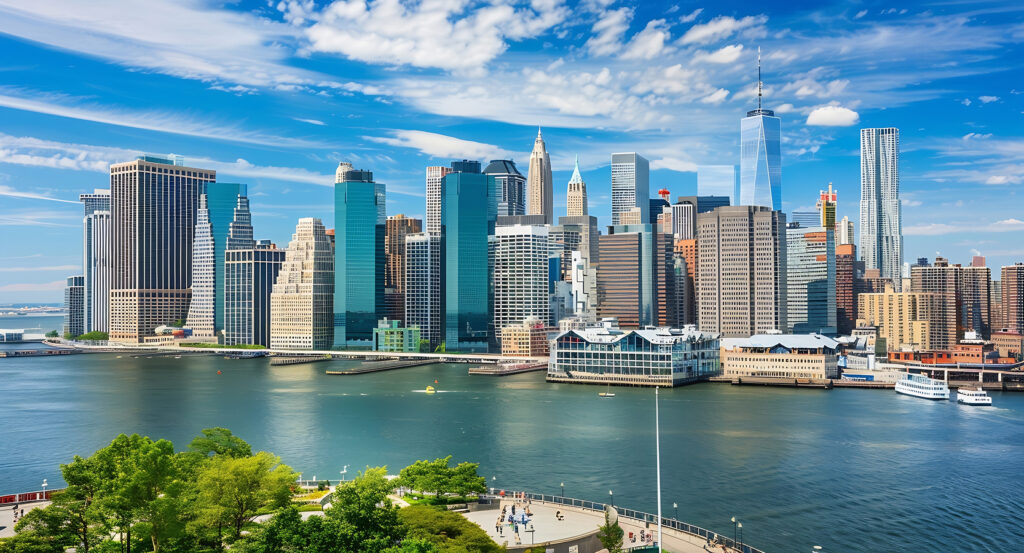
Set in New York Harbor between Lower Manhattan and the Brooklyn waterfront and just south of The Battery, the 172-acre island occupies a strategic position near the meeting of the Hudson and East Rivers, only 800 yards from Manhattan. The northern section retains tree-lined greens, officers' residences and institutional buildings from generations of military occupation, creating a compact architectural district separated physically from the denser city across the water. The southern half opens into broad lawns, planted groves and newly sculpted terrain on land created during the island's twentieth-century expansion. A continuous waterfront places the harbor beside much of the island's circulation, shifting views among Lower Manhattan, Brooklyn, New Jersey, the Statue of Liberty and the Verrazzano-Narrows Bridge as the shoreline turns. The result is an unusually complete harbor landscape where historic military grounds, engineered terrain, extensive open space and uninterrupted water views occupy a single island immediately offshore from Manhattan.
What defines Governors Island.
Governors Island is best known for evolving from a strategically placed harbor outpost into one of New York's longest-serving military installations before returning to civilian public use. The Lenape called the island Paggank, or “Nut Island,” for its hickory, oak and chestnut trees and used the location seasonally for fishing. Dutch West India Company settlers arrived in 1624, established a camp, fort and sawmill on the 70-acre island, and called it Noten Eylandt before shifting much of their settlement to Manhattan. English control followed in 1664, and the property was reserved in 1699 for the benefit and accommodation of royal governors, establishing the name that survives. Continental troops fortified the island during the Revolutionary War, lost it following the Battle of Brooklyn and returned after British withdrawal in 1783. New York transferred the island to the federal government for military purposes in 1800, beginning a federal tenure that extended through most of the next two centuries. The island underwent its greatest physical alteration between 1901 and 1912 when the Army Corps of Engineers deposited 4,787,000 cubic yards of fill, including excavation spoil from the Lexington Avenue subway, adding 103 acres and increasing the landmass to 172 acres. During World War I, the 22nd Infantry Regiment stationed there seized German-owned passenger ships and terminals along the Hudson after the United States entered the conflict. The Army remained until 1966, when the Coast Guard assumed the installation and developed its Atlantic Area headquarters alongside a residential community of 3,000 people and another 1,500 commuters. President Ronald Reagan, Vice President George H. W. Bush and Soviet General Secretary Mikhail Gorbachev met at Quarters One on December 7, 1988, during Reagan and Gorbachev's final meeting before Reagan left office. Coast Guard departure in 1996 closed a military era extending more than two centuries.
Civilian redevelopment accelerated after President Bill Clinton designated 22 acres as Governors Island National Monument in 2001 and the federal government transferred the remaining 150 acres to New York for a nominal price in 2003. Full city control followed in 2010, initiating $400 million in investment across infrastructure and new public landscapes. West 8 won the international park design competition in 2006 and developed an 85-acre public-space master plan released four years later, with Mathews Nielsen Landscape Architects, Magnusson Klemencic Associates, AKRF, Hart Crowser, Pentagram and Tillotson among the specialist collaborators. The first 30 acres opened in 2014, including a six-acre plaza, a ten-acre grove and 14 acres of Play Lawn. The Hills completed the principal park campaign in 2016 through four constructed landforms built from recycled construction debris and clean fill, with 43,000 shrubs and more than 860 trees incorporated across the ten-acre addition. West 8 designed much of the new terrain above projected flood levels and selected native or locally adapted planting for salt tolerance, heat resistance and erosion control; Hurricane Sandy struck only five months after construction began in 2012, yet the unfinished park sustained almost no damage. The transformation created more than 43 acres of new park space and shifted a former military base toward year-round cultural, educational and environmental use.
How Governors Island fits.
Governors Island works as the anchor for an island-wide outing connecting early American coastal defense, nineteenth-century military imprisonment and contemporary artistic production.
Begin at Fort Jay, whose high ground had already supported Continental earthworks during 1775 and 1776 before renewed international tensions brought state and federal funding for new defenses in 1794. French engineer Charles Vincent directed the first federal-era works, and the installation acquired John Jay's name before reconstruction under Colonel Jonathan Williams began in 1806. Williams retained portions of the earlier fort but rebuilt the defensive complex as a pentagonal work with four masonry bastions, brick barracks and capacity planned for 100 guns; extensive alterations during the 1830s produced much of the surviving appearance. Continue to Castle Williams, Jonathan Williams's circular red-sandstone fort erected between 1807 and 1811 on the island's western point. Williams, Chief Engineer of the U.S. Army Corps of Engineers and first superintendent of the United States Military Academy, developed the structure as a prototype whose form influenced American coastal defenses for decades. Military obsolescence shifted its purpose from harbor defense to barracks and imprisonment, with Confederate enlisted prisoners confined there during the Civil War; Secretary of War Elihu Root later blocked Army proposals to demolish the fort, and a 1903 conversion created a modernized military prison that remained active until 1965. Conclude at The Arts Center at Governors Island, where the Lower Manhattan Cultural Council established artist residencies and public programming inside Building 110 before reopening an expanded permanent center in 2019. LMCC itself began in 1973 under founder Flory Barnett with support from David Rockefeller Sr., Chase Manhattan Bank and the New York State Council on the Arts, later developing Workspace residencies, Manhattan arts grants and the River To River Festival. The Governors Island renovation doubled the center to 40,000 square feet, adding studios, galleries and performance areas as LMCC created its first permanent home for artists and audiences. The progression moves from Fort Jay's early federal defensive engineering through Castle Williams's changing military functions and culminates in LMCC's conversion of former military property into a permanent center for artistic production, compressing more than two centuries of island history into three distinct institutions.
Where your story begins.
Foresyte Travel reveals places that feel extraordinary long before you arrive.
Enjoy editorial crafted for luxury travelers.
Foresyte may earn a commission when you book.







































































































