
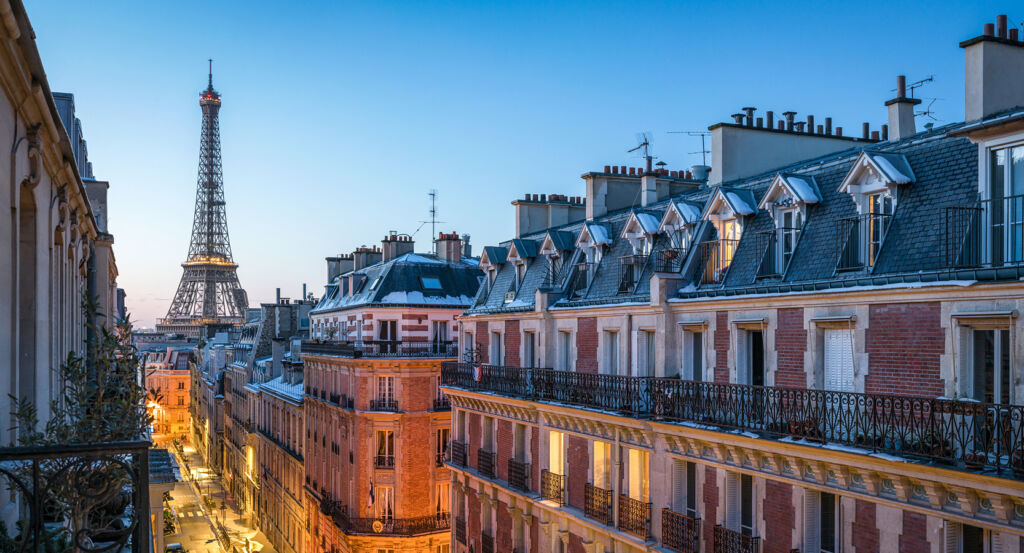
Why you should experience Grands Boulevards Experimental in Paris, France.
Grands Boulevards Experimental is a mischievous four-star hotel where Grands Boulevards' theatrical appetite, revolutionary inheritance, cocktail culture and centuries-old instinct for metropolitan pleasure unfold inside an eighteenth-century building deliberately hidden behind the boulevard.
Set along Boulevard Poissonnière near Rue du Faubourg Poissonnière and just steps from the arcades of Boulevard Montmartre, the 50-room hotel occupies a building erected shortly before the French Revolution on the foundations of a private garden, reached through the long passage that once crossed that concealed green space. The property subsequently served as offices and apartments before becoming a cinema, a conversion that created its courtyard during the 1920s, adding another layer to a building already shaped by changing forms of Parisian entertainment. Dorothée Meilichzon transformed the structure for Experimental Group's January 2018 opening, drawing simultaneously on Louis XVI decorative language and the pastoral simplicity associated with Marie Antoinette's Petit Trianon while allowing the old courtyard to become the architectural heart of the hotel. The result is a hotel where revolutionary-era architecture, cinematic history and Meilichzon's rebellious historicism give Grands Boulevards' long culture of performance a remarkably coherent contemporary expression.
What you should know about Grands Boulevards Experimental.
Grands Boulevards Experimental is best known for opening in January 2018 after Experimental Group transformed a pre-Revolutionary building at 17 Boulevard Poissonnière into a 50-room hotel designed by Dorothée Meilichzon, preserving an unusual chronology that runs from an eighteenth-century private garden through offices and apartments to a twentieth-century cinema whose 1920s conversion created the present courtyard. Meilichzon organized the interiors around a discussion between eighteenth-century aristocratic decoration and lively contemporary design, extending the concept through the guestrooms, restaurant beneath a towering glazed roof and two cocktail bars, including a rooftop overlooking Central Paris. Chef Giovanni Passerini directs the courtyard restaurant, bringing the Roman-born chef behind acclaimed Paris restaurant Passerini into a property whose hospitality program deliberately integrates accommodation, food and drinking instead of treating them as separate amenities. Grands Boulevards Experimental received One MICHELIN Key in the 2024 MICHELIN Guide France hotel selection, giving the six-year-old property international recognition within the first MICHELIN Key awards for French hotels.
Experimental Group gives the hotel a deeper significance within contemporary Parisian hospitality through founders Olivier Bon, Pierre-Charles Cros and Romée De Goriainoff, childhood friends who opened Experimental Cocktail Club in Paris in 2007 before Xavier Padovani joined them as a fourth partner in 2010. The Shell translates that cocktail lineage directly into the property through another Dorothée Meilichzon interior, where Marie Antoinette's fascination with shells and mosaics informs copper tones, shell motifs, rust-colored walls and velvet seating. Experimental's drinks program continues there through cocktails including the Laphroaig-based Peat & Honey and Buffalo Trace Bourbon-based Banana Spleen, while the rooftop extends the group's original bar culture above the eighteenth-century structure. Together, Experimental Group, Dorothée Meilichzon, Giovanni Passerini and The Shell turn Grands Boulevards Experimental into a particularly complete expression of the company's evolution from a three-friend Paris cocktail experiment into an internationally recognized hospitality group.
How to fold Grands Boulevards Experimental into your trip.
Grands Boulevards Experimental works as the anchor for an afternoon tracing the architecture of reading, consumption and performance that turned this part of Paris into a laboratory for increasingly sophisticated forms of public pleasure.
Begin at Bibliothèque nationale de France Richelieu, where Cardinal Mazarin's seventeenth-century palace received the royal library in 1721 before Henri Labrouste created his nine-domed iron reading room between 1861 and 1868 and Jean-Louis Pascal began the 43.7-meter-long Salle Ovale in 1897, ultimately inaugurated under Albert Lebrun in 1936. Continue to Passage des Panoramas, built in 1799 and considered Paris's first covered passage, where a 133-meter glazed commercial corridor preserves historic shopfronts associated with the Marquis chocolate factory and Stern printing works alongside the collecting culture of stamps, postcards, coins and autographs. Conclude at Théâtre des Variétés, constructed in 1807 and enlarged in 1843, where more than two centuries of continuous theatrical life place performance directly inside the boulevard culture that developed alongside the nearby panoramas, passages, cafés and entertainment houses. The progression moves from Labrouste and Pascal monumentalizing intellectual life through the covered passage converting shopping into urban theater and finally into a stage operating since the Napoleonic era, revealing the culture of cultivated pleasure that makes Grands Boulevards Experimental intelligible.
Where your story begins.
Foresyte Travel reveals places that feel extraordinary long before you arrive.
Experience premium editorial crafted for luxury travelers.














































































































