
Why Hachikō Statue matters.
Hachikō Statue is a beloved civic monument where Shibuya's relentless urban energy meets the story of an Akita dog, the memory of Professor Hidesaburo Ueno and a bronze figure that became inseparable from the district's public image.
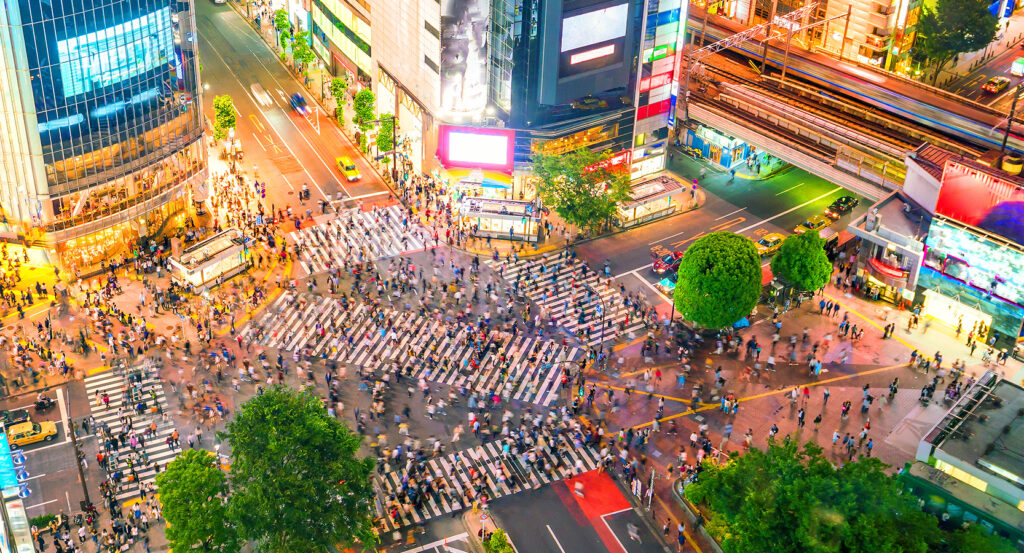
Set outside Shibuya Station near Dogenzaka and just steps from Shibuya Crossing, the bronze occupies a small plaza surrounded by railway entrances, digital façades and some of Tokyo's heaviest pedestrian movement. Sculptor Takeshi Ando depicted Hachiko standing alert on a stone pedestal, facing into the station district where the dog spent years returning after Ueno's death. The statue's modest scale places it directly among pedestrians, turning the surrounding plaza into a meeting point whose human activity continues throughout the day. Station redevelopment has repeatedly altered the architecture around it, yet the bronze remains the fixed center of a public space bearing Hachiko's name. The result is a small memorial whose physical presence carries an intensely personal story into the immense metropolitan scale of contemporary Shibuya.
What defines Hachikō Statue.
Hachikō Statue is best known for commemorating the Akita dog that continued returning to Shibuya Station after the 1925 death of his guardian, Tokyo Imperial University professor Hidesaburo Ueno, eventually becoming one of Japan's most widely recognized stories of devotion. Hachiko was born in Odate, Akita Prefecture, in November 1923 and traveled by rail to Ueno in Tokyo in January 1924 when he was still a young puppy. Ueno was a professor of agricultural engineering whose academic career helped establish agricultural civil engineering as a formal field in Japan, and Hachiko accompanied him to Shibuya Station and the university during their brief life together. Ueno died suddenly at the university on May 21, 1925, only seventeen months after Hachiko entered his household. Hachiko subsequently continued appearing at Shibuya Station for close to ten years, searching among arriving passengers for the professor. Researcher Hirokichi Saito, a central figure in the preservation of the Akita breed, brought Hachiko's behavior to national attention through a Tokyo Asahi Shimbun article published on October 4, 1932. Public interest generated a campaign for a monument during Hachiko's lifetime, and sculptor Teru Ando created the first bronze unveiled outside Shibuya Station on April 21, 1934 with Hachiko present at the ceremony. Hachiko died on March 8, 1935, and his preserved body entered the National Museum of Nature and Science, with a memorial placed beside Ueno's grave in Aoyama Cemetery. Wartime metal collection destroyed Ando's statue in 1944. His son Takeshi Ando created the second bronze, unveiled on August 15, 1948, giving postwar Shibuya the monument that survives at the station. The two statues bind Hachiko's individual history to two radically different moments in Tokyo, with the first created during his lifetime and the second restoring his presence to Shibuya three years after the war.
Hachiko's transformation from a local station dog into a cultural figure accelerated through education, commemoration and later reinterpretations that extended far beyond the original bronze. His story entered elementary-school moral education in 1934 through the lesson On o Wasureruna, carrying the Shibuya episode into classrooms before Hachiko's death. Film subsequently expanded that cultural reach, and the University of Tokyo returned attention to Ueno himself through the Todai Hachiko Monogatari project. Philosopher Masaki Ichinose helped initiate that project ahead of the eightieth anniversary of Hachiko's death, bringing university participants and outside supporters together around a new monument. Sculptor Tsutomu Ueda reversed the familiar Shibuya image of Hachiko waiting alone by portraying the dog joyfully reunited with Ueno, and the bronze was unveiled on the University of Tokyo's Yayoi Campus on March 8, 2015, exactly eighty years after Hachiko died. Shibuya City and Hachiko's birthplace of Odate developed another major commemorative program around the centenary of his 1923 birth, linking the Tokyo station plaza with the Akita community from which the dog came. These successive interpretations expanded the meaning of Hachiko from a station memorial into a cultural figure connecting Shibuya, Odate and the university career of the professor whose death began the story.
How Hachikō Statue fits.
Hachikō Statue works as the anchor for a Shibuya route through three nearby sites that move from the medieval clan associated with the district's name through a surviving Meiji estate landscape and into one of Seiichi Shirai's major late architectural works.
Begin at Konnoh Hachimangu Shrine, whose history reaches to 1092 and the warrior family that established its residence around the sanctuary after receiving the Shibuya name from Emperor Horikawa. The Shibuya clan treated the shrine as its guardian, and a surviving fortress stone within the precinct preserves a physical trace of Shibuya Castle, destroyed during fighting between Hojo Ujitsuna and Uesugi Tomooki in 1524. The present gongen-zukuri sanctuary adds another historical layer through Aoyama Tadatoshi and Lady Kasuga, whose patronage produced the building in 1612 during the rule of Tokugawa Hidetada; carvings of baku and tigers survive within a structure designated a Shibuya cultural property. Continue to Nabeshima Shoto Park, where the Nabeshima family acquired a former suburban residence of the Kishu Tokugawa family and opened a tea plantation in 1876. Tea sold under the Shoto name eventually gave the surrounding district its enduring designation, and after cultivation ended, part of the estate surrounding a natural spring was opened as a children's park. The family donated that ground to Tokyo City in 1932, preserving the spring-fed pond and waterwheel inside a district subsequently transformed into one of Shibuya's residential quarters. Conclude at The Shoto Museum of Art, where Shibuya City commissioned Seiichi Shirai to turn a former civil-engineering office site into the first ward art-museum project of its kind among Tokyo's twenty-three special wards. Shirai had studied Gothic architecture and German philosophy in Heidelberg and Berlin, and the museum completed in 1980 concentrated his late architectural thinking into two floors above ground and two below, wrapped in Korean Kounseki granite. An oval central atrium brings light into a building with few perimeter windows, descending to a fountain pool on the second basement level beneath interiors using onyx, Brazilian rosewood and Venetian velvet; the museum opened on October 1, 1981 after an extended conditioning period for the new building. The progression moves from Konnoh Hachimangu Shrine's connection with the Shibuya clan through Nabeshima Shoto Park's preservation of the estate that supplied Shoto with its name into The Shoto Museum of Art's highly authored municipal architecture, extending Hachikō Statue beyond the station plaza into the deeper historical and cultural development of Shibuya.
Where your story begins.
Foresyte Travel reveals places that feel extraordinary long before you arrive.
Enjoy editorial crafted for luxury travelers.
Foresyte may earn a commission when you book.

















































































































