
Why Shibuya Sky matters.
Shibuya Sky is a mesmerizing observation complex where Shibuya's youth-driven urban character meets open-air architecture, immense metropolitan sightlines and an aerial perspective on one of Tokyo's most intricate transportation and street networks.
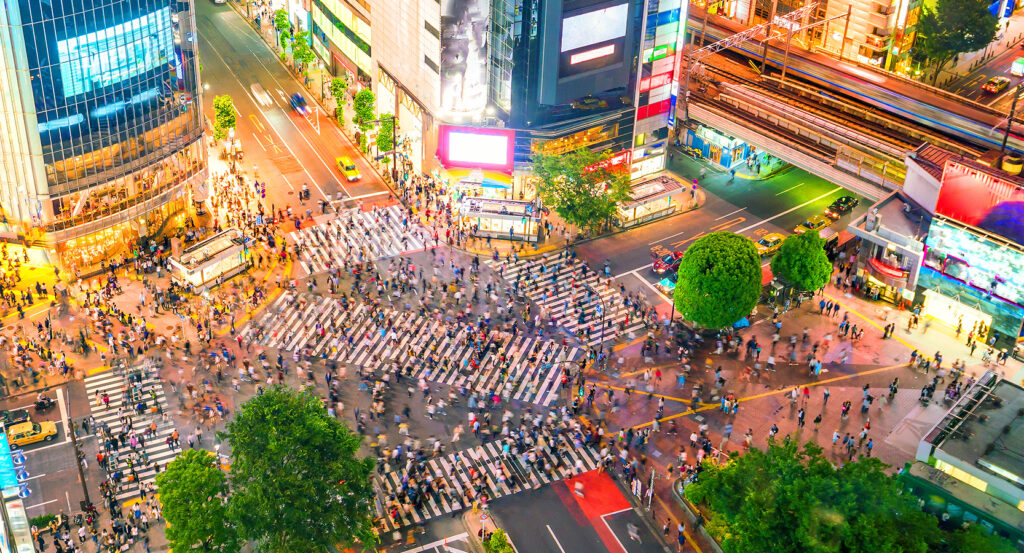
Set above Shibuya Station near Meiji-dori and just steps from Shibuya Crossing, the observation complex occupies the summit of the 229.7-meter Shibuya Scramble Square East Tower, lifting its public spaces directly above the valley from which the surrounding district radiates. The ascent unfolds through SKY GATE between the 14th and 45th floors before opening into the enclosed SKY GALLERY on the 46th floor and the rooftop SKY STAGE, making vertical movement an intentional part of the encounter. More than 2,500 square meters of open roof provide unobstructed views around the tower, with glass perimeter barriers leaving Tokyo Skytree, Shinjuku, Otemachi, Tokyo Bay and Mount Fuji exposed across the horizon. At the roof corners, the city falls away beneath transparent edges and Shibuya Crossing contracts into a moving geometric pattern 230 meters below, turning familiar streets into an intelligible metropolitan system. The result is an observation experience whose height, exposed rooftop and direct position above Shibuya Station reveal both the immense scale of Tokyo and the unusually concentrated urban machinery operating beneath it.
What defines Shibuya Sky.
Shibuya Sky is best known for completing Shibuya Scramble Square East Tower in 2019 as a public rooftop conceived within the enormous reconstruction of Shibuya Station and its surrounding district. Tokyu Corporation, East Japan Railway Company and Tokyo Metro developed the tower above a transportation node where four railway companies and nine lines converge, making the project inseparable from the restructuring of one of Japan's busiest stations. Construction began in June 2014 and concluded in August 2019, producing a 47-storey tower above seven basement levels with 181,000 square meters of floor area. The architectural consortium joined Nikken Sekkei, Tokyu Architects & Engineers, JR-East Design Corporation and Metro Development, with Nikken Sekkei, Kengo Kuma and Associates and SANAA serving as design architects. Kengo Kuma shaped the Lower East Urban Core around pedestrian movement between railways and city streets, using aluminum fins and ceramic-treated glass to give the base a shifting translucent surface. Nikken Sekkei developed the upper tower around Shibuya's valley topography and radial street pattern, breaking the immense glass elevations with vertical slits and drawing the facades toward corners aligned with streets extending from the station. Shibuya Sky completed that vertical logic at the roof, turning the tower's highest level into publicly accessible ground and extending pedestrian movement from underground transportation spaces through the Urban Core to the summit. Shibuya Scramble Square opened on November 1, 2019, establishing its observation facility as the uppermost public component of a redevelopment conceived around reconnecting station, streets and skyline through three-dimensional circulation.
The intellectual model for the observation facility reaches back to a different structure that appeared beside Shibuya Station in 1957. Tokyu Bunka Kaikan opened that year with a rooftop planetarium whose prominent dome became a station-front symbol for 44 years, coupling commercial Shibuya with a public institution devoted to astronomy and curiosity about worlds beyond the city. Its closure in 2001 left the redevelopment team with a historical precedent for treating an observation facility as cultural infrastructure, and Shibuya Sky explicitly revived that ambition through a concept centered on stimulating imagination and intellectual curiosity. Creative company Rhizomatiks developed digital content throughout the 3,000-square-meter indoor observation area, overlaying information and mediated imagery onto the physical panorama. The facility organized those ideas into three sequential zones, SKY GATE, SKY GALLERY and SKY STAGE, moving upward from enclosed transition spaces toward the completely exposed roof. This structure recast the conventional observatory as an authored sequence in which digital interpretation gradually gives way to unmediated city and sky. The connection to the 1957 planetarium gives Shibuya Sky a deeper cultural lineage inside the district, linking two station-centered projects separated by six decades through a shared attempt to make looking outward an instrument for understanding Shibuya and the world beyond it.
How Shibuya Sky fits.
Shibuya Sky works as the anchor for a Shibuya route through three nearby sites that trace the district from a nationally remembered Akita dog through the reuse of abandoned railway infrastructure and into the reinvention of an elevated public park.
Begin at Hachiko Statue, where a modest bronze figure preserves the story that turned Shibuya Station into the setting for one of modern Japan's most enduring popular commemorations. Hachiko belonged to Hidesaburo Ueno, a professor at Tokyo Imperial University, and accompanied him to Shibuya Station before Ueno died suddenly in 1925; the Akita continued returning to the station for nearly a decade. Newspaper attention transformed the dog into a national symbol of loyalty, and sculptor Teru Ando created the first bronze statue erected at Shibuya Station in 1934 with Hachiko present at its unveiling. Wartime metal requisition eliminated that figure, so Takeshi Ando, the sculptor's son, created the present statue in 1948. Its later emergence as one of Tokyo's best-known meeting points gave a deeply personal story a second life inside the enormous pedestrian flows that now define Shibuya. Continue to Shibuya Stream, where another chapter of railway history became the foundation for a new southern extension of the district. Tokyu's Toyoko Line once terminated above ground at Shibuya, but through-running with the Tokyo Metro Fukutoshin Line shifted the tracks underground in 2013 and left the former station platforms and railway corridor available for redevelopment. Shibuya Stream opened in September 2018 across that infrastructure, retaining traces of the former platform geometry as the project extended pedestrian movement south toward Daikanyama. Work associated with the development also restored the Shibuya River as a visible presence beside a new promenade, reconnecting an overlooked watercourse with public space. The project makes the district's transportation history physically legible at ground level before Shibuya Sky reveals the wider rail network from above. Conclude at MIYASHITA PARK, whose history demonstrates that Shibuya's experiments with stacked public space long preceded its newest towers. The original municipal park opened in 1953 and was rebuilt above parking infrastructure during the 1960s, making it an early example of placing civic open space on an elevated structure within land-constrained Central Tokyo. Its latest reconstruction reopened in 2020 as a long multi-level complex extending 330 meters beside the railway, with the public park restored across the roof and spaces for skateboarding, bouldering and recreation embedded above commercial floors. That vertical arrangement carries the same fundamental urban challenge visible across contemporary Shibuya: fitting transportation, commerce, movement and public ground into a district where horizontal space is intensely constrained. The progression moves from Hachiko Statue's intimate connection with the railway station through Shibuya Stream's conversion of obsolete tracks into a new urban corridor and MIYASHITA PARK's decades-long experiment with elevated public ground, revealing the historical mechanisms behind the stacked city that Shibuya Sky makes visible from above.
Where your story begins.
Foresyte Travel reveals places that feel extraordinary long before you arrive.
Enjoy editorial crafted for luxury travelers.
Foresyte may earn a commission when you book.

















































































































