
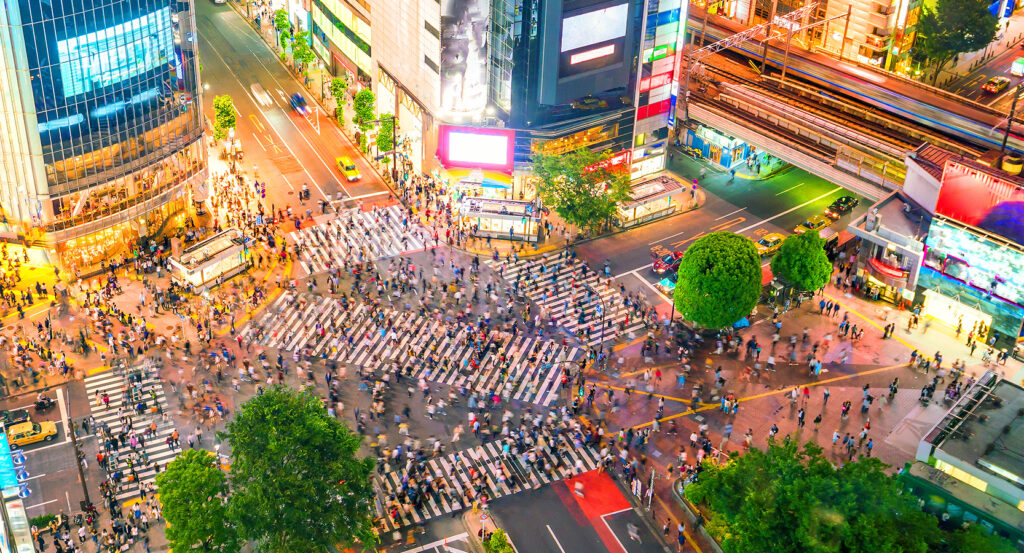
Why Shibuya Crossing matters.
Shibuya Crossing is an electrifying urban intersection where Shibuya's youth-driven character meets immense pedestrian movement, layered commercial architecture and the railway geography that transformed a former valley settlement into one of Tokyo's great metropolitan centers.
Set outside Shibuya Station's Hachiko Exit near Dogenzaka and just steps from Shibuya Center-Gai, the crossing occupies the convergence of several major streets beneath a skyline crowded with screens, signs and buildings shaped around the extraordinary volume of people moving through the station district. When vehicle signals turn red, pedestrians advance simultaneously through straight and diagonal crossings, filling the asphalt from multiple directions before the intersection empties again within a single signal cycle. The surrounding facades function almost like vertical extensions of the street, with illuminated advertising, enormous video displays and windows rising above pedestrian level as railway structures and tower developments frame the wider station complex. Viewing the intersection from ground level reveals the precision inside the apparent disorder: separate crowds converge, divide and clear the roadway before traffic resumes, repeating the transformation of open asphalt into temporary public space throughout the day. The result is a street encounter whose intensity comes from coordinated movement itself, making the accumulated scale of Shibuya's transportation, commerce and pedestrian culture visible in a few recurring moments at the center of the district.
What defines Shibuya Crossing.
Shibuya Crossing is best known for turning the pedestrian flows generated by more than a century of railway expansion into the defining public performance of modern Shibuya. The first Shibuya Station opened in 1885 with the Nippon Railway's Shinagawa Line, now part of the Yamanote Line, when the surrounding valley still retained a markedly different relationship with the Shibuya River. Tamagawa Electric Railway arrived in 1907 and the Tokyo city tram in 1911, beginning the accumulation of transportation systems that would make the station a major interchange. Tokyo-Yokohama Electric Railway opened its Shibuya terminus in 1927 under Keita Goto, connecting the district with suburban growth along the future Tokyu Toyoko Line. Teito Electric Railway, predecessor of the Keio Inokashira Line, followed in 1933, and Tokyo Rapid Railway reached Shibuya in 1938 as part of the lineage leading to the Ginza Line. Commercial development grew directly from that transportation concentration: Toyoko Department Store opened above the terminal in 1934 as the Kanto region's first full-scale terminal department store, tying passenger circulation to retail activity at the station itself. Postwar reconstruction intensified movement through the surrounding streets as new department stores and entertainment complexes expanded the commercial center outward from the railway. By 1973, the station-front intersection had adopted scramble operation, stopping vehicles across all approaches so pedestrians could cross both conventionally and diagonally. Its present form is the visible endpoint of a much longer mechanism: successive railways concentrated people in the valley, station-centered commerce gave those passengers reasons to enter the surrounding streets, and the intersection evolved to absorb the resulting pedestrian movement.
The streets beyond the crossing underwent their own cultural transformation as competing commercial interests pushed Shibuya's center away from the station and into the surrounding hills. Tokyu opened its main department store in 1967, and Seibu Department Store had entered Shibuya by 1968 under Seiji Tsutsumi, extending retail activity deeper into the district. Shibuya Parco followed in June 1973, with Seibu Theater opening the preceding month as part of a strategy that joined shopping with theater, design, advertising and contemporary culture. PARCO treated the surrounding streets as part of the project: the former Kuyakusho-dori became Koen-dori, street furniture and planting were redesigned, and routes toward the new complex acquired names including Spain-zaka and Organ-zaka. Tokyu Hands opened nearby in 1978, followed by Fashion Community 109 in April 1979, further strengthening Shibuya's association with youth-oriented consumption and fashion. Center-Gai underwent a parallel evolution after merchants formed the Shibuya Center Shopping Association in 1961 as younger crowds replaced an earlier concentration of bars and cabarets with restaurants and shops. These developments redirected pedestrian activity into multiple corridors west and northwest of the station, giving the crossing its larger urban role as the hinge between railway arrivals and a commercial district deliberately expanded through streets, fashion, performance and youth culture.
How Shibuya Crossing fits.
Shibuya Crossing works as the anchor for a Shibuya route through three nearby sites that trace the district from a personal story embedded in station history through a postwar cultural institution and into the architecture now reshaping the eastern side of the railway.
Begin at Hachiko Statue, whose subject arrived in Tokyo in 1924 after University of Tokyo professor Hidesaburo Ueno acquired the Akita dog and formed the routine that would bind Hachiko permanently to Shibuya Station. Ueno died suddenly in 1925, yet Hachiko continued appearing at the station for years afterward, attracting national attention after newspaper coverage spread the story beyond Tokyo. Sculptor Teru Ando created the first bronze monument in 1934, and Hachiko attended its unveiling before dying the following year. Wartime metal requisition removed that statue, leaving Ando's son Takeshi to create the present figure in 1948. The monument subsequently became one of Tokyo's most established meeting points, turning the northwest station frontage into a place where a story originating with one commuter and his dog now intersects with enormous daily pedestrian flows. Continue to Shibuya Parco, whose June 1973 opening helped shift the district's commercial gravity toward the slopes leading to Yoyogi Park. PARCO paired retail with cultural production from the outset, opening Seibu Theater in May and using ambitious advertising and environmental design to reshape the surrounding streets as part of the institution's public presence. Koen-dori acquired its current name through that campaign, and the broader network of named slopes helped turn movement through Shibuya into part of the commercial and cultural project. The complex became associated with fashion, theater, art and emerging creators through the following decades before closing for reconstruction in 2016. Its successor opened on November 22, 2019, carrying that lineage into a new building organized around fashion, art, entertainment, food and technology. Conclude at Shibuya Hikarie, which occupies the former site of Tokyu Bunka Kaikan and carries forward an eastern station-front cultural lineage begun in 1956. Tokyu Bunka Kaikan combined four cinemas with a planetarium and other cultural functions, then used an elevated pedestrian bridge to connect across Meiji-dori and help join previously separated parts of the station district. After its closure, construction of the successor development began in 2009, and the 182.5-meter Shibuya Hikarie opened on April 26, 2012 with 34 floors above ground and four below. Nikken Sekkei and Tokyu Architects & Engineers designed the complex around commercial floors, offices and cultural spaces including the 2,000-seat Tokyu Theatre Orb, making it the leading project in the current generation of Shibuya Station redevelopment. Its later pedestrian connections extend the same long-running effort to overcome the railway lines, roads and valley topography that historically divided Shibuya into separate sectors. The progression moves from Hachiko Statue's transformation of station history into shared civic memory through Shibuya Parco's deliberate expansion of youth culture into the surrounding streets and Shibuya Hikarie's reconstruction of the station's eastern cultural gateway, revealing the successive forces that concentrated movement, commerce and cultural production around Shibuya Crossing.
Where your story begins.
Foresyte Travel reveals places that feel extraordinary long before you arrive.
Enjoy editorial crafted for luxury travelers.
Foresyte may earn a commission when you book.

















































































































