
Why Yoyogi Park matters.
Yoyogi Park is an expansive urban park where Shibuya's creative character meets a vast woodland, broad lawns and the open ground left by successive military, residential and Olympic chapters.
Set along Inokashira-dori near Meiji-dori and just steps from Harajuku Station, the park occupies a sweeping green enclosure where mature woodland, open lawns and broad pedestrian paths separate the dense commercial streets of Harajuku and Shibuya from the forested precinct of Meiji Jingu. Tall tree belts define much of the perimeter before opening around the central grass field, creating pronounced shifts between shaded woodland and unobstructed sky. The eastern edge approaches the elevated structures and plazas around the Yoyogi National Gymnasium as the western side reaches quieter residential streets toward Tomigaya and Yoyogi-Hachiman. Long paths and planted clearings spread across more than 54 hectares, giving the park a scale distinct from the tightly built districts surrounding it. The result is an unusually spacious Central Tokyo landscape where forest, lawn and twentieth-century infrastructure preserve the physical consequences of the city's military, occupation-era and Olympic transformations.
What defines Yoyogi Park.
Yoyogi Park is best known for occupying ground that passed through an exceptional sequence of twentieth-century uses before opening as a metropolitan park in 1967. The Japanese Army established the Yoyogi parade ground in 1909, creating the immense open terrain that made the site suitable for experiments in the new technology of powered flight. Army captains Yoshitoshi Tokugawa and Kumazo Hino returned from Europe after studying aircraft and piloting techniques as members of the Provisional Military Balloon Research Association. On December 19, 1910, Tokugawa flew a French-built Henri Farman aircraft from the parade ground, reaching a height of 70 meters, covering close to three kilometers and remaining airborne for four minutes. Hino successfully flew his German Hans Grade aircraft later that day, establishing Yoyogi as the setting for the first officially recognized powered flights by Japanese pilots in Japan. A monument inside the present park commemorates that aviation milestone, preserving the connection between its open landscape and the experiments made possible by the former military ground. The site underwent another profound change after Japan's defeat in 1945, when occupation forces converted the parade ground into Washington Heights, a residential compound for United States military personnel and their families. Houses, schools, churches, shops and recreational facilities replaced much of the military landscape, creating an American residential enclave beside Meiji Jingu. Selection of Tokyo for the 1964 Summer Olympics brought another change, as negotiations secured the return of Washington Heights for development of the principal Olympic Village. The same terrain that had supported military exercises and Japan's first recognized powered flights became the residential center of an international sporting event before Tokyo opened Yoyogi Park there on October 20, 1967.
The 1964 Olympic Village created the most substantial surviving layer within the park itself. Organizers chose Washington Heights as the principal village in October 1961 after negotiations with the United States secured full return of the property, placing athletes close to the main competition venues. Existing American residences were adapted alongside new construction, allowing thousands of competitors and officials to live within a landscape already organized as a residential compound. One building used by the Dutch delegation survived the conversion of the village into Yoyogi Park and remains near the Harajuku entrance as the Olympic Memorial House. The former village athletic field also survived through a different institutional path, becoming the park's track and field facility. Its later association with Mikio Oda commemorates the triple jumper who won at Amsterdam in 1928 and became Japan's first Olympic gold medalist. The stadium carries another distinction from 1964 through its use for the opening ceremony and competitions of the Tokyo Paralympics. Water infrastructure added in May 1991 introduced three fountains rising between 15 and 30 meters and a connecting water corridor, placing a later landscape intervention within ground already transformed repeatedly during the century. Yoyogi Park retains physical fragments of the Olympic Village inside a public landscape whose conversion preserved selected traces of the event that immediately preceded its creation.
How Yoyogi Park fits.
Yoyogi Park works as the anchor for a daytime exploration through Yoyogi and Harajuku using three nearby sites that move from a deliberately constructed sacred forest through a postwar design museum devoted to Japanese craft into Kenzo Tange's structural response to the 1964 Olympics.
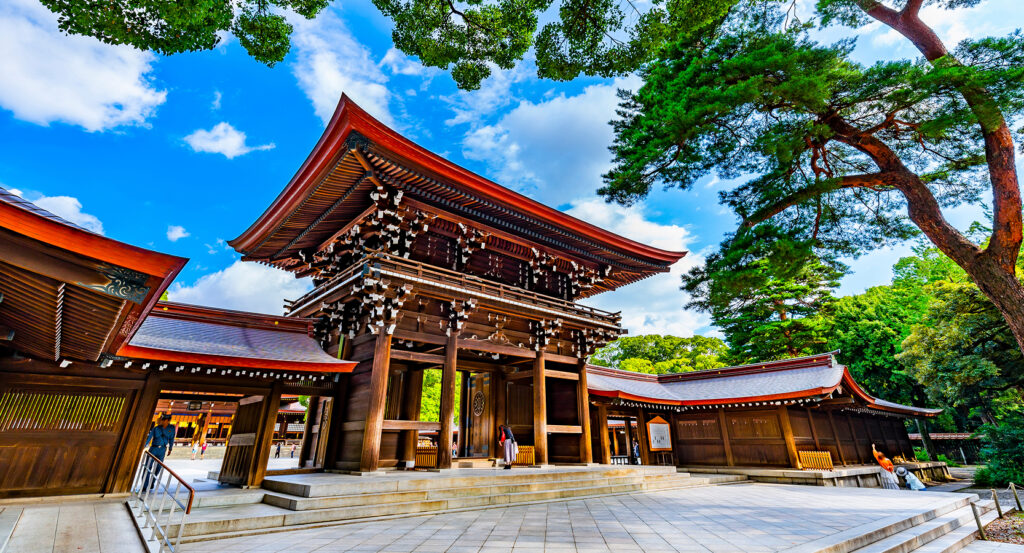
Begin at Meiji Jingu, established on November 1, 1920 in honor of Emperor Meiji and Empress Shoken. The surrounding 70-hectare forest was created as a long-term ecological project from trees donated across Japan, with Seiroku Honda, Takanori Hongo and Keiji Uehara among the forestry specialists who planned a self-renewing woodland dominated over time by evergreen broadleaf species. 100,000 donated trees and labor from 110,000 volunteers produced a forest designed around conditions expected a century or two into the future. Air raids destroyed most of the shrine buildings in 1945, though the forest survived, and the principal structures were rebuilt in 1958. Continue to Japan Folk Crafts Museum, founded by Soetsu Yanagi as the institutional center of the Mingei movement and opened in 1936. Yanagi developed the movement with potters Shoji Hamada and Kanjiro Kawai around the aesthetic significance of utilitarian objects made by anonymous craftspeople, assembling ceramics, textiles, woodwork, lacquer and other objects that shifted critical attention toward forms previously excluded from conventional fine-art hierarchies. The museum building itself adopted elements associated with traditional Japanese domestic architecture, giving the collection a purpose-built setting linked directly to the movement that generated it. Conclude at Yoyogi National Gymnasium, designed by Kenzo Tange for the 1964 Tokyo Olympics and used for swimming, diving and basketball during the Games. Tange worked with structural engineer Yoshikatsu Tsuboi on a suspension system in which immense cables span between principal supports and carry the sweeping roof, producing the building's unmistakable curving profile without filling the arena with internal columns. Its construction connected postwar Japanese engineering with the international architectural ambitions surrounding the Olympics and became one of Tange's decisive works. The progression moves from Honda, Hongo and Uehara's century-scale construction of a sacred forest through Yanagi, Hamada and Kawai's elevation of anonymous craft into Tange and Tsuboi's suspension architecture, developing three influential Japanese responses to nature, making and modernity around Yoyogi.
Where your story begins.
Foresyte Travel reveals places that feel extraordinary long before you arrive.
Enjoy editorial crafted for luxury travelers.
Foresyte may earn a commission when you book.

















































































































