
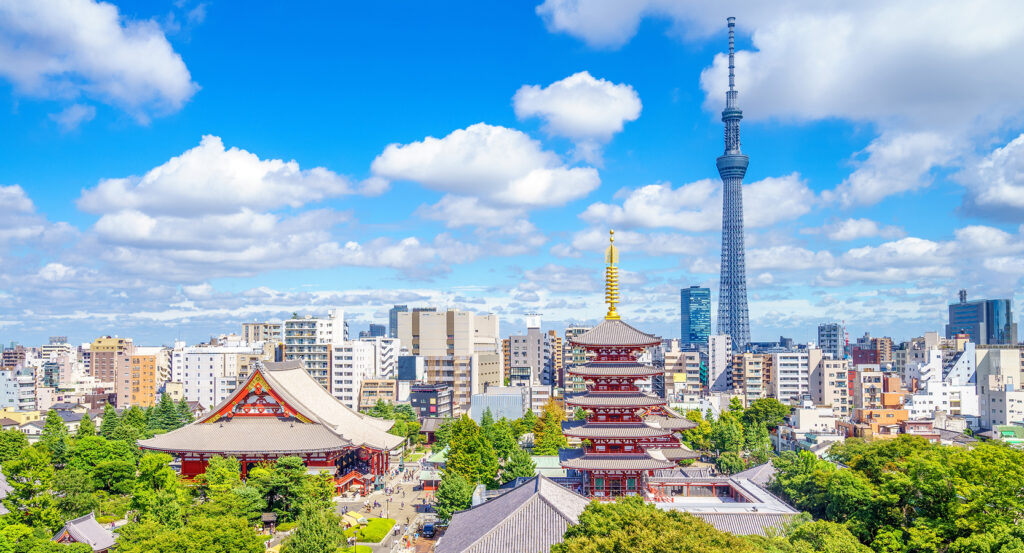
Why Tokyo Skytree matters.
Tokyo Skytree is a soaring broadcasting tower where Oshiage's shitamachi character meets extreme vertical engineering, traditional Japanese form and an aerial encounter with the immense metropolitan scale of Tokyo.
Set along the Kitajikken River near Yotsume-dori and just steps from Oshiage Station, the tower rises from a narrow railway corridor bordered by water, dense residential streets and the interconnected structures of Tokyo Skytree Town. Its steel lattice changes from a triangular footprint into a circular upper profile, generating concave sori and convex mukuri curves that give the immense structure a subtly changing outline as it is viewed from different directions. Tembo Deck places the city beneath three observation levels centered 350 meters above ground, with four high-speed elevators covering the ascent from the entrance level in close to 50 seconds. Tembo Galleria continues upward through a glass-enclosed sloping corridor from Floor 445 toward Sorakara Point at 451.2 meters, turning the upper observatory into a physical ascent around the exterior of the tower. The result is an encounter in which shifting steel geometry, extreme elevation and successive observation levels convert Tokyo's horizontal immensity into an architectural experience organized around ascent.
What defines Tokyo Skytree.
Tokyo Skytree is best known for answering a broadcasting problem created by Tokyo's increasingly tall central skyline through a 634-meter tower developed by Tobu Railway, six major television broadcasters, Nikken Sekkei and Obayashi Corporation. NHK, Nippon Television, TV Asahi, TBS Television, TV Tokyo and Fuji Television formed the New Tower Promotion Project in December 2003 as 200-meter-class buildings raised concerns about reliable terrestrial transmission from existing facilities. Sumida entered the competition for the new tower in 2004, and Tobu Railway joined the effort around its property at Narihirabashi and Oshiage before the district received final selection in March 2006. New Tokyo Tower Co. was created two months later to carry the project, giving the broadcasting initiative a dedicated development organization under the Tobu group. A national naming process produced Tokyo Skytree in June 2008, followed by Obayashi beginning construction on July 14. The planned height initially stood near 610 meters before the project adopted 634 meters in 2009, securing the ambition to create the world's tallest freestanding broadcasting tower and introducing the numerical association 6-3-4 with Musashi, the former province encompassing this part of the Kantō region. Construction required 1,325 days, 58,000 worker-days across the project and close to 37,000 steel components with a combined tower weight near 36,000 tonnes. Tokyo Skytree reached 634 meters at 1:34 p.m. on March 18, 2011, only one week after the Great East Japan Earthquake subjected the unfinished structure to severe shaking. Guinness World Records formally recognized Tokyo Skytree as the world's tallest tower in November 2011, and construction concluded on February 29, 2012. Broadcasting then completed the purpose that had initiated the project: NHK and J-WAVE began FM transmission in April 2012, TOKYO MX completed its transmission move in May 2013, and the six Tokyo television broadcasters began full broadcasting from Tokyo Skytree that same month. The sequence carried a metropolitan transmission problem through site selection, corporate formation, engineering, construction and broadcast activation, giving Tokyo Skytree a technological purpose inseparable from the height that made it globally consequential.
Hirohito Totsune developed a second major strand of Tokyo Skytree's authorship through a lighting program conceived around the cultural character of Edo and the tower's position beside the Sumida River. Totsune and Sirius Lighting Office established Iki and Miyabi as the original two principal compositions in 2009, giving the tower alternating nighttime appearances built around pale blue and Edo purple. Iki concentrates blue light through the central shaft, drawing its water association from the Sumida River and pairing that vertical illumination with restrained points of white light across the steel structure. Miyabi uses Edo purple across three principal legs and introduces gold-toned movement through the tower body, creating a composition with stronger directional emphasis across the lattice. Nobori joined the permanent program in 2017 for Tokyo Skytree's fifth anniversary, adding an orange-centered scheme associated with festival banners and prosperity. A major 2020 intervention expanded the lighting equipment from 2,075 to 2,362 fixtures and revised Iki, Miyabi and Nobori, extending illumination into the gain tower and intermediate sections near 150 and 250 meters. The enlarged system also introduced a high-intensity beam at the summit visible from distances reaching 20 kilometers, expanding the tower's nocturnal presence far beyond Oshiage. Totsune's evolving program turned the same steel structure into three distinct nighttime compositions, giving Tokyo Skytree an authored after-dark character that has continued to change years after its engineering and broadcasting systems entered service.
How Tokyo Skytree fits.
Tokyo Skytree works as the vertical anchor for a daytime progression through three Sumida institutions that carry the surrounding district from early sacred history through Edo literary culture into the artistic legacy of Katsushika Hokusai.
Begin at Ushijima-jinja Shrine, whose foundation tradition reaches the Jōgan era of 859 to 879 and Jikaku Daishi, linking the Sumida riverbank to a religious history more than eleven centuries older than Tokyo Skytree. The sanctuary became the principal guardian shrine of Honjo and moved to its present site in 1932 after reconstruction of Sumida Park; its precinct preserves the Nadeushi devotional ox, komaushi guardian figures and an unusual three-part torii, carrying the shrine's long association with cattle directly into its architecture and ritual objects. Continue to Mimeguri-jinja Shrine, whose medieval origin tradition places a monk from Mii-dera at a neglected sanctuary between 1352 and 1356, where excavation revealed a sacred figure riding a white fox before another fox circled the image three times and disappeared. Edo poet Takarai Kikaku deepened the shrine's cultural importance in 1693 by dedicating a rain-prayer haiku during drought, and the precinct later became closely associated with the Mitsui family, whose commercial dynasty adopted the shrine as a guardian sanctuary and eventually brought a Mitsukoshi lion from the Ikebukuro department store into its grounds. Conclude at The Sumida Hokusai Museum, dedicated to Katsushika Hokusai in the ward of his birth and housed in a sharply faceted building by Kazuyo Sejima. The site once formed part of the Edo residence of the Tsugaru clan of Hirosaki, whose lord commissioned Hokusai to paint a horse on a folding screen, giving the museum ground a direct connection with the artist before the institution arrived there. Sejima, who founded SANAA with Ryue Nishizawa and shared the 2010 Pritzker Prize, translated that historical connection into a four-storey contemporary museum whose collection and exhibition program return Hokusai's international artistic legacy to Sumida. The progression moves from Ushijima-jinja Shrine's ninth-century sacred foundation through Mimeguri-jinja Shrine's medieval legend, Edo poetry and Mitsui patronage into Hokusai's artistic relationship with Honjo, revealing a Sumida whose religious, commercial and creative history extends across centuries beneath Tokyo Skytree.
Where your story begins.
Foresyte Travel reveals places that feel extraordinary long before you arrive.
Enjoy editorial crafted for luxury travelers.
Foresyte may earn a commission when you book.

















































































































