
Why Sumida Park matters.
Sumida Park is a storied riverside landscape where Mukojima's historic waterfront character meets Edo cherry-blossom culture, traces of a Tokugawa garden and broad views across the Sumida River toward modern Tokyo.
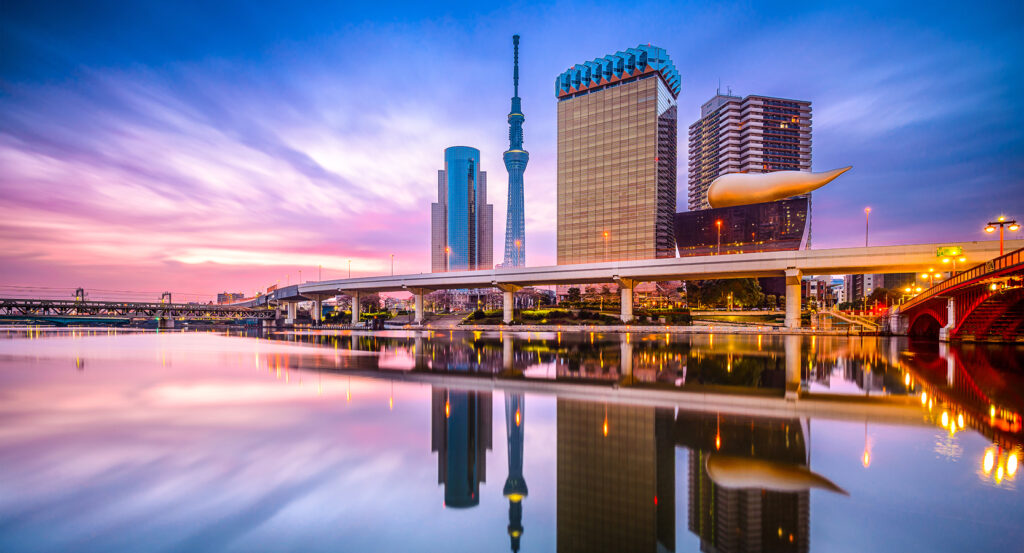
Set along the Sumida River near the mouth of the Kitajikken River and just steps from Sumida River Walk, the park extends northward through Mukojima as a long green corridor opposite Asakusa, opening broad sightlines across the water and toward Tokyo Skytree. Riverside paths run beneath mature trees close to the embankment, then widen into lawns, paved gathering areas and quieter planted sections whose changing widths prevent the landscape from reading as a single formal promenade. The southern reaches preserve a Japanese garden with pond, stonework and carefully composed vegetation, introducing a more enclosed landscape before the park opens again toward the river and surrounding city. Farther north, long rows of cherry trees reinforce the linear geography of the waterfront, with branches extending above the paths as Tokyo Skytree rises behind the lower canopy and boats move through the river beyond it. The result is a park whose length and variety reward slow exploration, shifting between intimate garden spaces, open lawns, historic planting traditions and expansive river views without losing its close relationship with Mukojima.
What defines Sumida Park.
Sumida Park is best known for emerging from Tokyo's reconstruction after the 1923 Great Kanto Earthquake, when the devastated capital used large public parks as part of a broader program joining urban recovery with recreation and disaster preparedness. Fires triggered by the earthquake destroyed 3,465 hectares of Tokyo, and reconstruction subsequently carried land readjustment across just over 3,117 hectares of the burned area. Sumida Park became one of three major disaster-recovery parks created through land acquisition, alongside Hamacho Park and Kinshi Park. Its planning also intersected with a campaign by the Japan Amateur Athletic Association, which petitioned the Imperial Capital Reconstruction Department and Tokyo mayor for athletic parks that would strengthen public health after the disaster. Kinshi opened in 1928 and Hamacho in 1929 before Sumida completed the trio on March 24, 1931. Sumida incorporated athletic fields, tennis courts and a swimming pool equipped with night lighting, facilities that placed organized physical recreation inside the rebuilding of the eastern city. Public radio calisthenics, a sports day for families of municipal employees and a baseball league involving Kabuki actors subsequently used the grounds. A Tokyo City commemorative publication called the park “Downtown Olympia,” capturing an early period when municipal park design was being expanded beyond ornamental landscape into organized recreation for a mass urban population. Sumida Park belongs to the physical legacy of the capital's post-earthquake reconstruction, when devastated ground became an opportunity to build public landscapes capable of supporting leisure, athletics and emergency refuge within the rebuilt city.
Long before the municipal park existed, the eastern riverbank contained the lower residence of the Mito branch of the Tokugawa family, and part of its former strolling garden survives within the Sumida City side of the grounds. The residence occupied a strategically prominent site facing the Sumida River, giving its garden direct visual and physical relationships with the waterway that remain legible in the preserved pond landscape. A separate horticultural lineage developed along the river under the Tokugawa shogunate as cherry planting transformed the banks into one of Edo's great seasonal destinations. Tokugawa Yoshimune, the eighth shogun, ordered cherry trees planted along the Sumida during his 1716 to 1745 rule as part of a broader program that also established public blossom destinations at Asukayama, Goten'yama and Koganei. The riverbank plantings opened spring recreation to common townspeople at a time when the Kyōhō reforms imposed severe fiscal restraint across the shogunate. Cherry viewing subsequently became deeply associated with this stretch of the Sumida, and the tradition survived the political disappearance of Edo, the loss of the Mito residence and the creation of the modern park. The present landscape contains two inherited forms of Tokugawa-era leisure, one originating in the private garden of a major daimyo family and the other in a shogunal program that opened planted riverbanks to the wider population.
How Sumida Park fits.
Sumida Park works as the anchor for a Mukojima route through three nearby sites connecting ancient shrine tradition, Edo literary culture and a temple whose Umewaka legend entered multiple forms of Japanese performance.
Begin at Ushijima-jinja Shrine, whose foundation is associated with Jikaku Daishi during the Jogan era of 859 to 877 and whose historical role developed as the principal guardian shrine of Honjo. Reconstruction of Sumida Park prompted the shrine's relocation to its present site in 1932, where the precinct preserves an unusual three-part torii and the recumbent Nadeushi ox associated with a healing practice in which worshippers touch the part of the figure corresponding to an ailment. Continue to Mimeguri-jinja Shrine, whose name derives from a tradition in which a white fox circled a sacred image three times after it was uncovered. Poet Takarai Kikaku added another layer in 1693 when he composed a rain-prayer haiku during a drought, and later patronage by the Mitsui family left the precinct with distinctive objects tied to one of Edo and Tokyo's great merchant houses. Conclude at Mokuboji Temple, founded by the Tendai priest Chuen in 976 and inseparable from the Umewaka legend, the account of an abducted child whose death beside the Sumida became the basis for works across noh, joruri and nagauta. The temple underwent a complex Meiji-era transition after the separation of Buddhism and Shinto, with the former Umewakadera becoming Umewaka Shrine before priest Koen secured its restoration as a Buddhist institution in 1888; the Umewaka mound and annual memorial continue the tradition. The progression moves from the ancient guardian tradition of Ushijima-jinja Shrine through Mimeguri-jinja Shrine's convergence of poetry and merchant patronage into Mokuboji Temple's millennium-old Umewaka tradition, carrying a walk through Sumida Park deeper into Mukojima's religious and literary history.
Where your story begins.
Foresyte Travel reveals places that feel extraordinary long before you arrive.
Enjoy editorial crafted for luxury travelers.
Foresyte may earn a commission when you book.

















































































































