
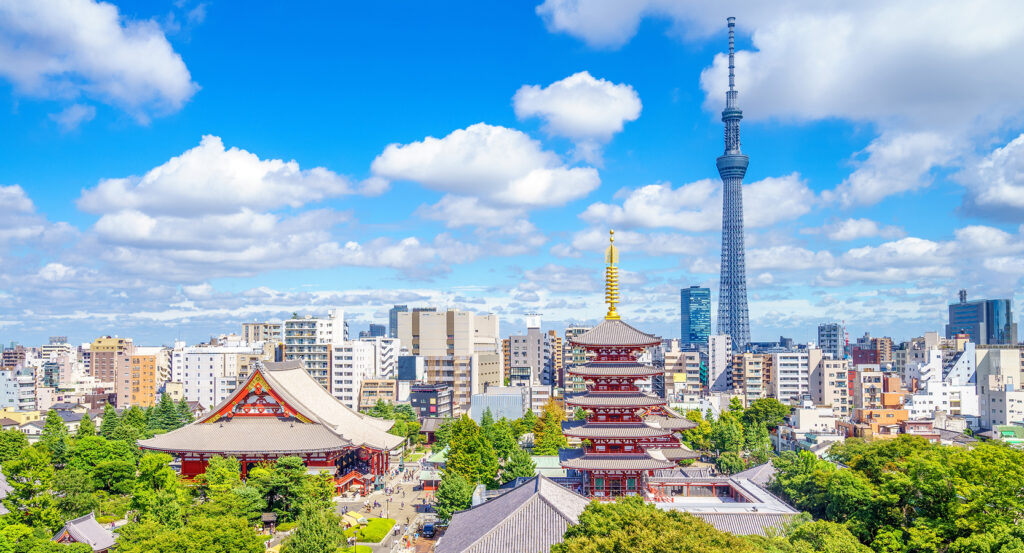
Why Tokyo Skytree Town matters.
Tokyo Skytree Town is a commanding vertical district where Oshiage's shitamachi character meets railway heritage, broadcasting engineering and Tokyo Skytree's 634-meter ascent above eastern Tokyo.
Set along the Kitajikken River near Yotsume-dori and just steps from Oshiage Station, the complex stretches 400 meters between two railway stations across 3.69 hectares shaped by the river and Tobu tracks. Tokyo Skytree rises from a triangular footprint that gradually becomes circular as the steel lattice climbs, producing concave sori and convex mukuri curves associated with Japanese architectural form. Tokyo Solamachi extends around its base through terraces and exterior passages that repeatedly return the tower to view at dramatically changing angles. Tembo Deck at 350 meters and Tembo Galleria at 450 meters shift the encounter upward, opening the metropolitan plain across Sumida, Asakusa, Central Tokyo and the distant mountain horizon. The result is a vast urban composition whose compressed riverfront footprint and immense vertical scale make eastern Tokyo legible from both street and sky.
What defines Tokyo Skytree Town.
Tokyo Skytree Town is best known for converting Tobu Railway's former Narihirabashi freight territory into the base of a new broadcasting system for the Tokyo metropolitan region. Tobu's connection with the site began on April 1, 1902, when the Isesaki Line extended from Kita-Senju to Azumabashi Station, creating a terminal that handled passengers and freight beside waterways used to move cargo through eastern Tokyo. The company transferred its headquarters to the district in 1911, deepening an association that survived the station's renaming as Narihirabashi and the termination of freight operations in March 1993. A new technological purpose emerged after Tokyo's television broadcasters sought a transmission tower in the 600-meter range to overcome interference associated with the concentration of 200-meter-class buildings across the central city. Sumida entered the competition for the tower in November 2004 with Tobu supporting the proposal on land it controlled at Narihirabashi and Oshiage. The site received formal selection in March 2006, linking a century-old railway property to the replacement broadcasting infrastructure demanded by digital television. Construction began in July 2008, and the tower reached its final 634-meter height in March 2011. That number carries a deliberate historical association with Musashi, the former province that encompassed this part of Tokyo, joining an advanced transmission structure to the older geography of the Kantō region. The completed district opened on May 22, 2012, returning a former freight interchange to metropolitan significance through another form of transmission and connection.
Nikken Sekkei confronted the tower's unprecedented structural demands by pairing an outer steel lattice with a reinforced-concrete central column that operates independently through much of the structure. The central column extends 375 meters upward, with its lower section fixed to the steel tower and its upper portion structurally separated so the two masses respond differently during lateral movement. Oil dampers connect the systems between 125 and 375 meters, allowing the central column to counter tower movement through the shinbashira seishin vibration-control system. The engineering concept takes its name from the shinbashira central pillars associated with Japanese five-storey pagodas, translating a historic structural principle into a contemporary damping mechanism at unprecedented height. Beneath the tower, foundation elements descend 50 meters to a bearing stratum and use enlarged nodular forms developed to resist the immense uplift and compressive forces concentrated around the three principal legs. The steelwork introduced another technical challenge as the triangular lower plan transitions through complex three-dimensional curves before reaching a circular form higher in the tower. Nikken Sekkei's combination of central-column damping, deep foundations and changing geometry made the 634-meter structure possible on a narrow site confined between the Tobu railway and Kitajikken River.
How Tokyo Skytree Town fits.
Tokyo Skytree Town works as the anchor for a daytime sequence through three Sumida institutions that connect Oshiage with ancient worship, Edo-period cultural memory and the artistic world of Honjo.
Begin at Ushijima-jinja Shrine, founded in 860 through a tradition associated with the Buddhist priest Jikaku Daishi and established as a guardian shrine for the former Honjo district. Its sacred relationship with cattle survives through stone ox figures and the Nadeushi, an ox sculpture touched in connection with prayers for physical healing, giving the shrine an unusually specific devotional character within Sumida. The present precinct also preserves a rare three-part torii, placing distinctive Shinto architecture beside a cult whose history predates the urbanization of eastern Edo by centuries. Continue to Mimeguri-jinja Shrine, where a fourteenth-century origin tradition centers on a monk from Mii-dera discovering a sacred figure riding a white fox, followed by a white fox circling the image three times and giving the shrine its name. Poet Takarai Kikaku added another cultural layer during the drought of 1693 when he dedicated a rain-prayer haiku at the shrine, an episode commemorated by the surviving verse monument. A Mitsukoshi lion formerly displayed at the Ikebukuro department store later entered the precinct, connecting a medieval sacred tradition with one of modern Japan's major retail institutions. Conclude at The Sumida Hokusai Museum, devoted to Katsushika Hokusai in the ward where he was born in 1760 near Honjo Warigesui and spent most of his ninety-year life. Sumida opened the museum in 2016 in a sharply faceted building by Kazuyo Sejima, giving Hokusai's local biography a permanent institutional home near the territory he repeatedly depicted. Its collection incorporates major groups assembled by Peter Morse and ukiyo-e scholar Muneshige Narazaki, connecting the artist's Sumida origins with generations of international collecting and scholarship devoted to his work. The progression moves from Ushijima-jinja Shrine's ninth-century sacred foundation through Mimeguri-jinja Shrine's medieval origin and Edo literary associations into Hokusai's internationally consequential artistic legacy, revealing a Sumida whose cultural chronology extends more than a millennium beneath the 634-meter tower.
Where your story begins.
Foresyte Travel reveals places that feel extraordinary long before you arrive.
Enjoy editorial crafted for luxury travelers.
Foresyte may earn a commission when you book.

















































































































