
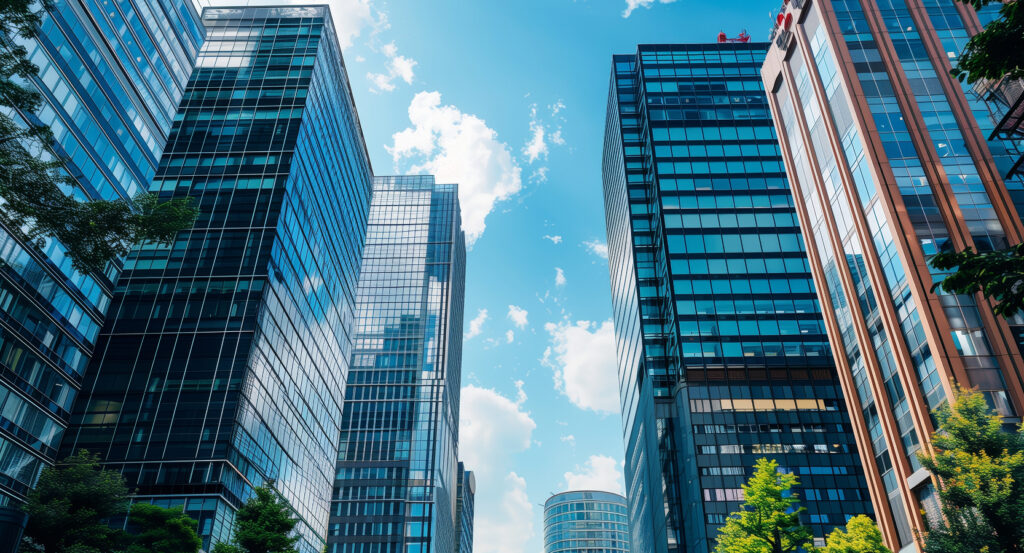
Why Otemachi matters.
Otemachi is a commanding central business district where Otemachi's corporate character meets the former forecourt of Edo Castle, national economic institutions and a dense twenty-first-century skyline built directly against the Imperial Palace.
Set along Hibiya-dori near Eitai-dori and just steps from Ote-mon Gate, the district occupies the broad blocks between the Imperial Palace moat, Tokyo Station and the Nihonbashi River, placing glass-and-steel towers beside fragments of the capital's feudal geography. Wide streets and immense office buildings establish the dominant scale above ground, yet Otemachi Station creates another city beneath them through five subway lines and passages extending between major towers and toward Tokyo Station. The western edge changes the encounter abruptly as office facades terminate against water, stone walls and the wooded grounds of the former Edo Castle, preserving an unusually sharp boundary between contemporary business Tokyo and its shogunal predecessor. Farther north and east, new pedestrian routes and riverside spaces open the district toward the Nihonbashi River, breaking the expansive office blocks into a more permeable sequence of streets, planted corridors and waterfront edges. The result is a district whose exceptional concentration of economic power remains physically tied to the ground from which Edo was governed, allowing successive versions of Japan's administrative and commercial center to remain visible within the same compact quarter.
What defines Otemachi.
Otemachi is best known for evolving from the daimyo quarter outside Edo Castle's principal gate into one of Japan's most concentrated centers of finance, communications and corporate management. Its name derives directly from Ote-mon, the main gate through which feudal lords and their retinues entered Edo Castle, and large daimyo residences occupied the surrounding blocks under the Tokugawa shogunate. The Meiji Restoration fundamentally changed that landholding structure after 1868, and government offices beginning with the Ministry of Finance entered Otemachi in 1869 as the new state appropriated former feudal ground for national administration. Another transformation followed the 1923 Great Kanto Earthquake as ministries increasingly relocated toward Kasumigaseki and major financial and media organizations established headquarters on the vacated sites. Postwar economic growth intensified the office concentration, with buildings such as the Otemachi Building joining a district increasingly dominated by banking, insurance, trading, communications and news organizations. The resulting concentration placed Otemachi at the institutional center of the Japanese economy even as the physical stock inherited from the postwar decades aged. By the early twenty-first century, the problem was no longer establishing a business district but rebuilding one whose largest organizations needed to remain operational inside Otemachi throughout reconstruction. That constraint generated a redevelopment method distinctive to the district, setting up the next major physical chapter without abandoning the concentration of institutions created across the preceding century.
How Otemachi fits.
Otemachi works as the anchor for a compact historical route through three nearby sites that recover the district's name, expose a medieval cult surviving beneath its corporate towers and reconnect the modern business quarter with the waterways that once structured entry into Edo.
Begin at Ote-mon Gate, the former principal entrance to Edo Castle and the structure that gave Otemachi its name. Feudal lords arriving at the political center of Tokugawa Japan passed through this entrance with their retainers, making the gate a point where the shogunate's social hierarchy acquired architectural form. Its defensive plan leads through a rectangular masugata enclosed between gates, creating a controlled space where attackers entering the first opening would have been exposed to defenders positioned around the enclosure. The surviving approach still crosses the Inner Moat, and the Imperial Household Agency now uses Ote-mon as one of three public entrances to the East Gardens, which opened in 1968 across the former Honmaru, Ninomaru and Sannomaru of Edo Castle. Continue to Masakado's Tomb, where the corporate district preserves a memorial tradition attached to Taira no Masakado, the tenth-century warrior whose rebellion challenged imperial authority across the Kanto region. Masakado was killed in Shimofusa after declaring himself a new emperor, and his severed head was exposed at Shichijo-gawara in Heian-kyo. A later legend held that the head flew east and came to rest on this ground, producing a cult of commemoration that survived dramatic changes around the site. During the Edo period the location lay within the upper residence of Sakai Utanokami, then entered the government quarter after the Meiji Restoration. Reconstruction of the Ministry of Finance following the Great Kanto Earthquake removed the old mound, yet the memorial endured, leaving a medieval warrior tradition embedded among some of modern Japan's largest corporate institutions. Conclude at Wadakura Bridge, where the western edge of the business district reveals how profoundly reclamation altered the geography surrounding Edo Castle. Before Tokugawa Ieyasu's rise, this ground faced the Hibiya inlet, placing water much closer to the castle than the present streets suggest. Edo-period reclamation converted the shoreline into land used for warehouses and water transport, and a masugata was constructed at Wadakura in 1620 as part of the castle's fortified perimeter. Stonework from that defensive system survives beside the present concrete bridge, whose form retains traces of its wooden predecessor across the Inner Moat. The site reconnects Otemachi's office landscape with a period when castle defenses, wharves and maritime access organized the same edge of the city. The progression moves from Ote-mon Gate's control of daimyo entry into Edo Castle through Masakado's Tomb's survival of medieval commemoration beneath the modern business district into Wadakura Bridge's evidence of a vanished waterfront, revealing the political, sacred and geographic foundations beneath contemporary Otemachi.
Where your story begins.
Foresyte Travel reveals places that feel extraordinary long before you arrive.
Enjoy editorial crafted for luxury travelers.

















































































































