
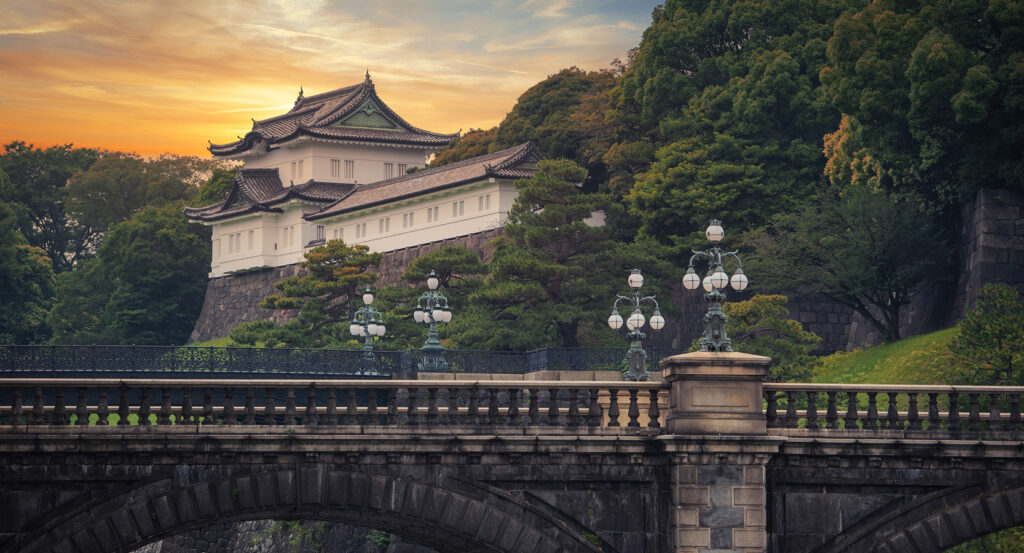
Why Imperial Palace matters.
Imperial Palace is a vast sovereign precinct where Marunouchi's metropolitan core meets fortified landscapes, ceremonial architecture and the enduring physical inheritance of Edo Castle.
Set within Chiyoda near Uchibori-dori and just steps from the Marunouchi business district, the palace occupies an immense green enclosure of moats, stone ramparts, gates and wooded grounds at the geographic center of Tokyo. Nijubashi and the adjoining approaches compress the surrounding city into carefully framed views of water, masonry, pines and surviving defensive structures, giving the palace perimeter an unmistakable visual separation from the towers beyond it. Public routes through the grounds move between broad gravel approaches and heavily fortified gateways before opening onto quieter interior landscapes whose scale becomes apparent only after passing the outer defenses. The East Gardens deepen that encounter through lawns, ponds, stone walls, guardhouses and the massive base of the former Edo Castle keep, allowing the vanished castle to remain physically legible through surviving terrain and masonry. The result is a sovereign landscape where fortification, garden design and controlled architectural views preserve the extraordinary spatial scale of the political center from which Edo became Tokyo.
What defines Imperial Palace.
Imperial Palace is best known for occupying the principal grounds of Edo Castle, the political center from which Tokugawa Ieyasu and his successors governed Japan for more than 260 years before the imperial court transferred its residence from Kyoto to Tokyo in 1868. The castle itself originated in the mid-fifteenth century before Ieyasu, founder of the Tokugawa shogunate, undertook its enormous expansion around the beginning of the seventeenth century and made the complex the seat of shogunal government. Kyoto remained the imperial capital during Tokugawa rule, yet successive shoguns exercised national political authority from Edo Castle, making its compounds, gates and defensive works inseparable from the administrative rise of Edo. The Meiji Restoration overturned that political geography in 1868 when the former shogunal castle became the residence of Emperor Meiji, bringing the imperial household into the same fortified precinct that had embodied Tokugawa power. Fire destroyed the Nishinomaru Palace in 1873, requiring the imperial household to use the Akasaka Detached Palace during a fifteen-year interval before a new palace complex was completed in 1888. That reconstruction accompanied another institutional change when the precinct formally received the name Kyujo, or Palace Castle, which remained in use until 1948. Air raids in May 1945 destroyed the Meiji palace buildings during the final months of World War II, leaving the imperial household to confront a second major architectural rupture within less than a century. The postwar designation Kokyo, or Imperial Palace, replaced Kyujo in 1948 as reconstruction of the sovereign precinct entered a new political era. Emperor Meiji's 1868 arrival, the 1888 reconstruction, wartime destruction and postwar renaming transformed the former seat of the Tokugawa shoguns into the continuing residence and working center of Japan's emperors without erasing the castle landscape that preceded imperial occupation.
The postwar palace complex developed from a 1959 Imperial Palace Construction Council recommendation that paired a new ceremonial palace and imperial residence in the western grounds with a public garden across the former eastern castle compounds. A Cabinet decision on January 29, 1960 advanced that program, and work on the East Gardens began in 1961 across 210,000 square meters of the former Honmaru, Ninomaru and Sannomaru. Toukagakudo entered the eastern precinct in February 1966 as a concert hall created to commemorate Empress Kojun's sixtieth birthday, adding a new imperial cultural building within the former Honmaru. Reconstruction of Ote-mon's larger gate followed in 1967 before the East Gardens reached completion in September 1968 and opened to the public on October 1. The new Imperial Palace was completed in October of the same year and entered use in April 1969 as a steel-reinforced-concrete complex organized around Seiden and six wings beneath long projecting eaves. Its 24,175 square meters accommodated the principal ceremonial and official functions of the imperial household within an architectural program combining modern construction with traditional Japanese roof, pillar and beam forms. Emperor Showa later initiated the creation of Ninomaru Grove between 1983 and 1985, introducing a woodland composed from native Japanese trees into the reconstructed garden. The 1960 Cabinet decision produced two complementary postwar interventions across the former castle: a new ceremonial palace for imperial functions and a 210,000-square-meter eastern garden that reopened Honmaru, Ninomaru and Sannomaru terrain to public access.
How Imperial Palace fits.
Imperial Palace works as the anchor for a daytime route through three institutions around Kitanomaru and Takebashi that connect postwar art collecting, government archives and Japan's national investment in public scientific education.
Begin at The National Museum of Modern Art, Tokyo, founded in Kyobashi in 1952 as Japan's first national art museum before moving to Takebashi in 1969. Architect Taniguchi Yoshiro designed the new building, donated by Bridgestone Tire chairman Ishibashi Shojiro, and conceived its position between the former Edo Castle moat and Marunouchi as an interface between historical Japan and the modern capital. The museum now holds more than 14,000 works spanning Japanese and international art from the late nineteenth century onward, extending its founding mission across one of the country's largest modern-art collections. Continue to National Archives of Japan, established under the Prime Minister's Office on July 1, 1971 after the Science Council of Japan urged the government in 1959 to prevent the dispersal and loss of official documents and provide public access to them. Japanese ministries had preserved their own administrative papers independently since the Meiji period, making the new institution a postwar response to the absence of a centralized national archival system; its Kitanomaru headquarters subsequently became the permanent repository for historically significant government documents transferred from ministries and agencies. Conclude at Science Museum, where the Japan Science Foundation created a public institution in Kitanomaru Park devoted to direct engagement with science and industrial technology. Its interactive exhibits and experimental programs place mechanical principles, electricity, computing and industrial systems within a hands-on educational environment, connecting the former military and governmental landscape north of the palace with postwar Japan's expanding scientific culture. Nobel Prize-winning chemist Noyori Ryoji now serves as director, linking the institution's public educational mission with one of Japan's most internationally recognized scientific careers. The progression moves from Taniguchi Yoshiro and Ishibashi Shojiro's postwar national art museum through the 1959 campaign that produced National Archives of Japan into Science Museum's public engagement with industrial technology, revealing how the northern edge of Imperial Palace became a concentrated landscape of national cultural and educational institutions.
Where your story begins.
Foresyte Travel reveals places that feel extraordinary long before you arrive.
Enjoy editorial crafted for luxury travelers.
Foresyte may earn a commission when you book.

















































































































