
Why you should experience Holiday Inn Paris Montmartre in Paris, France.
Holiday Inn Paris Montmartre is an unassuming four-star hotel where Montmartre's artistic independence, village intimacy, cabaret inheritance and stubbornly local character settle into the quieter northern slope of the Butte.
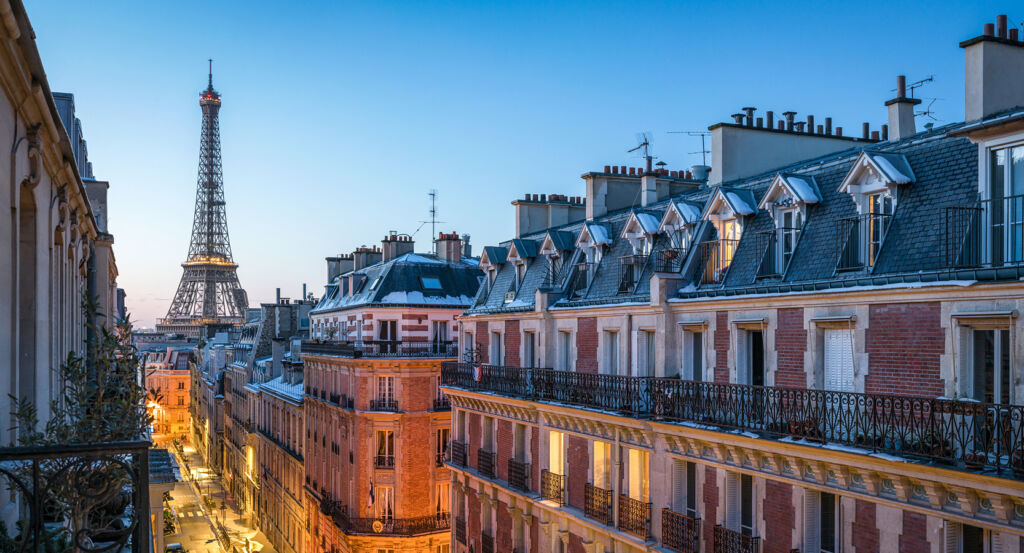
Set along Rue Damrémont near Rue Caulaincourt and just steps from the winding streets above Cimetière de Montmartre, the 54-room hotel occupies a seven-floor address removed from the denser performance of Pigalle and the summit. IHG's current accommodation program ranges from Standard rooms through 24-square-meter Premium rooms to a 41-square-meter Two Bedroom Suite, while upper-floor rooms open toward the layered rooftops that make the northern slope feel markedly more residential. A private courtyard with a planted green wall creates another pocket of separation from the street, complemented inside by an Open Lobby and Honesty Bar designed around informal gathering. The result is a hotel where Montmartre's quieter domestic rhythm becomes the defining luxury, placing the Butte's creative mythology within a neighborhood that still functions convincingly as home.
What you should know about Holiday Inn Paris Montmartre.
Holiday Inn Paris Montmartre is best known for operating as a 54-room, seven-floor IHG property at 23 Rue Damrémont, with an accommodation program extending from Standard rooms to 24-square-meter Premium rooms and a 41-square-meter Two Bedroom Suite combining one queen bed with two singles. The property opened in 1994 and underwent a renovation in 2019, while its current room inventory incorporates connecting configurations and family accommodation within a relatively compact Montmartre footprint. The Francoeur meeting room introduces a separate professional dimension on the ground floor, accommodating 19 people in a garden-facing space equipped with an electronic presentation board, conference telephone and dedicated business facilities. A private terrace, planted green wall, Open Lobby and Honesty Bar develop the communal program around the courtyard, giving the internationally standardized Holiday Inn model an unusually inward-facing physical arrangement at this Paris address.
Rue Damrémont gives the hotel a deeper relationship with the transformation of Montmartre itself, since the 1,130-meter street incorporates a section inherited from the former commune of Montmartre before its incorporation into the Paris road network in 1863. Charles-Marie Denys de Damrémont, the lieutenant-general killed during the 1837 siege of Constantine, supplied the street's name, while the present route was formally created on August 11, 1867 and eventually connected Rue Joseph-de-Maistre with Rue Belliard across the northern slope. Catherine Bernis introduces a contemporary artistic layer inside the property through La Vigne de Montmartre, a triptych displayed in the hotel and explicitly connected through its title with the viticultural character still surviving on the Butte. Together, Rue Damrémont, Charles-Marie Denys de Damrémont, Catherine Bernis and La Vigne de Montmartre give Holiday Inn Paris Montmartre a more specific sense of place than its international flag initially suggests, connecting the hotel with the northern slope's municipal evolution, nineteenth-century street character and continuing artistic imagination.
How to fold Holiday Inn Paris Montmartre into your trip.
Holiday Inn Paris Montmartre works as the anchor for an afternoon tracing the artists, cabaret culture and rebellious experimentation that turned the northern slope of the Butte into one of modern Paris's great creative territories.
Begin at Musée de Montmartre, created in 1960 inside seventeenth-century buildings at 12 Rue Cortot, where Renoir kept a studio, Suzanne Valadon later lived with Maurice Utrillo and André Utter, and collections spanning Toulouse-Lautrec, Modigliani, Kupka and Steinlen reconstruct the artistic and cabaret culture of the Butte. Continue to Clos Montmartre, the surviving vineyard immediately below the museum gardens, whose vines preserve the agricultural memory of a hill once covered with vineyards and give Montmartre's annual wine tradition a physical foothold within modern Paris. Conclude at Au Lapin Agile, where André Gill's 1879 rabbit sign generated the cabaret's enduring name, Aristide Bruant later purchased the building to protect it, Frédé fostered a community encompassing Picasso, Utrillo, Modigliani and Apollinaire, and Roland Dorgelès famously passed off a painting made with the donkey Lolo's tail as the work of “Boronali.”  The progression moves from the studios where Montmartre's art was physically made through the vineyard preserving the Butte's pre-metropolitan landscape into a cabaret where Picasso, poets, musicians and even Frédé's donkey turned artistic seriousness into provocation, recovering the creative independence that still gives Holiday Inn Paris Montmartre its cultural context.
Where your story begins.
Foresyte Travel reveals places that feel extraordinary long before you arrive.
Experience premium editorial crafted for luxury travelers.














































































































