
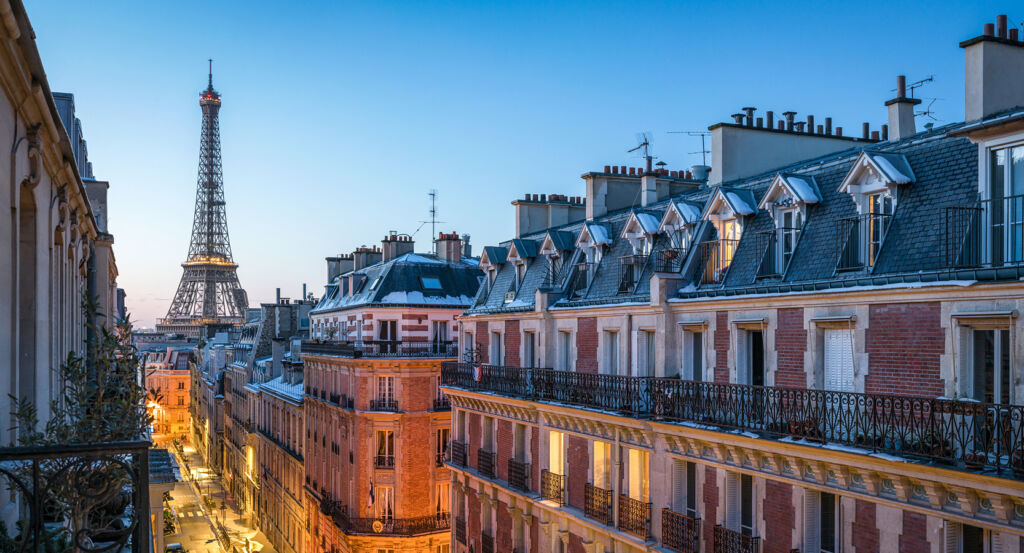
Why you should experience Hotel Auteuil Eiffel Tower in Paris, France.
Hotel Auteuil Eiffel Tower is a contemplative four-star hotel where Auteuil's architectural experimentation, residential seclusion, creative independence and relationship with the Seine converge within a quietly contemporary retreat removed from Central Parisian performance.
Set along Rue Félicien David near Rue Gros and just steps from the Seine, the 102-room hotel occupies an eight-floor property opened in the mid-1990s and comprehensively renovated in 2018, placing generous contemporary accommodation within the villa-lined western reaches of the sixteenth Arrondissement. Pale woods, restrained geometry and muted natural tones establish an intentionally calming interior vocabulary, while several room categories extend beyond the compact proportions commonly associated with Central Paris. A sauna, fitness center, lounge bar and sheltered garden deepen the sense of retreat, creating a hospitality rhythm that fits an Auteuil historically receptive to private houses, gardens and experiments in domestic architecture. The result is a hotel where contemporary restraint and unusually generous breathing room translate Auteuil's introspective character into a stay built around quiet, privacy and decompression.
What you should know about Hotel Auteuil Eiffel Tower.
Hotel Auteuil Eiffel Tower is best known for emerging from a comprehensive twelve-month renovation completed in 2018 that reworked a 102-room, eight-floor property at 8-10 Rue Félicien David while retaining an accommodation scale unusually substantial for this residential pocket of western Paris. The room program centers on 20-square-meter standard accommodations and extends through larger configurations, while the renovation incorporated a fitness center, sauna, lounge bar, business facilities and renewed hospitality spaces within the same building. The property's position also gives its name unusual geographical precision: Auteuil identifies the historically independent village incorporated into Paris in 1860, while the Eiffel reference points toward the tower visible across the Seine from portions of the surrounding sixteenth Arrondissement. Rue Félicien David carries another distinctly local cultural connection through Félicien David, the nineteenth-century French composer whose 1844 symphonic ode Le Désert became a major expression of musical Orientalism and helped establish his reputation in Paris.
Félicien David gives the hotel's address a deeper musical lineage through a career shaped by the Saint-Simonian movement, which he joined after arriving in Paris and followed into exile when the organization was suppressed under Prosper Enfantin. David subsequently traveled through Egypt and the eastern Mediterranean, experiences that informed Le Désert, premiered at the Conservatoire de Paris in December 1844 and constructed for reciter, tenor, male chorus and orchestra around an imagined desert journey. The Académie des Beaux-Arts elected Félicien David to succeed Hector Berlioz in 1869, placing the composer commemorated by the hotel's street within the institutional lineage of nineteenth-century French music. Together, Hotel Auteuil Eiffel Tower, Rue Félicien David, Le Désert and the Académie des Beaux-Arts give an otherwise understated address an unexpected connection with the musical experimentation and cultural institutions of nineteenth-century Paris.
How to fold Hotel Auteuil Eiffel Tower into your trip.
Hotel Auteuil Eiffel Tower works as the anchor for an afternoon tracing Auteuil and Passy through private literary life, twentieth-century broadcasting and the extraordinary accumulation of Impressionist painting inside a former collector's home.
Begin at Maison de Balzac, the surviving Passy residence where Honoré de Balzac lived under the pseudonym Monsieur de Breugnol from 1840 to 1847, corrected La Comédie humaine, received visitors including Théophile Gautier and escaped creditors through a second entrance opening toward Rue Berton. Continue to Maison de la Radio et de la Musique, Henry Bernard's vast circular broadcasting complex constructed between 1952 and 1963, conceived for French public radio and television and subsequently transformed through new studios, performance spaces and the Auditorium while remaining the headquarters of Radio France. Conclude at Musée Marmottan Monet, where Paul Marmottan's Empire collection entered the Académie des Beaux-Arts in 1932, the museum opened in 1934 and Michel Monet's 1966 bequest brought more than 100 works by his father, including grand Nymphéas, into what became the world's foremost Claude Monet collection. The progression moves from Balzac constructing a literary universe in private through Henry Bernard giving mass communication architectural form and finally to the Marmottan and Monet families preserving creative legacies for posterity, revealing the unusually cerebral cultural world surrounding Hotel Auteuil Eiffel Tower.
Where your story begins.
Foresyte Travel reveals places that feel extraordinary long before you arrive.
Experience premium editorial crafted for luxury travelers.














































































































