
Why Hôtel Barrière Le Fouquet's matters.
Hôtel Barrière Le Fouquet's is a cinematic hotel where the Champs-Élysées Quarter's grand-boulevard character meets a Belle Époque brasserie, more than a century of French film culture and an audacious architectural intervention across a historic Golden Triangle block.
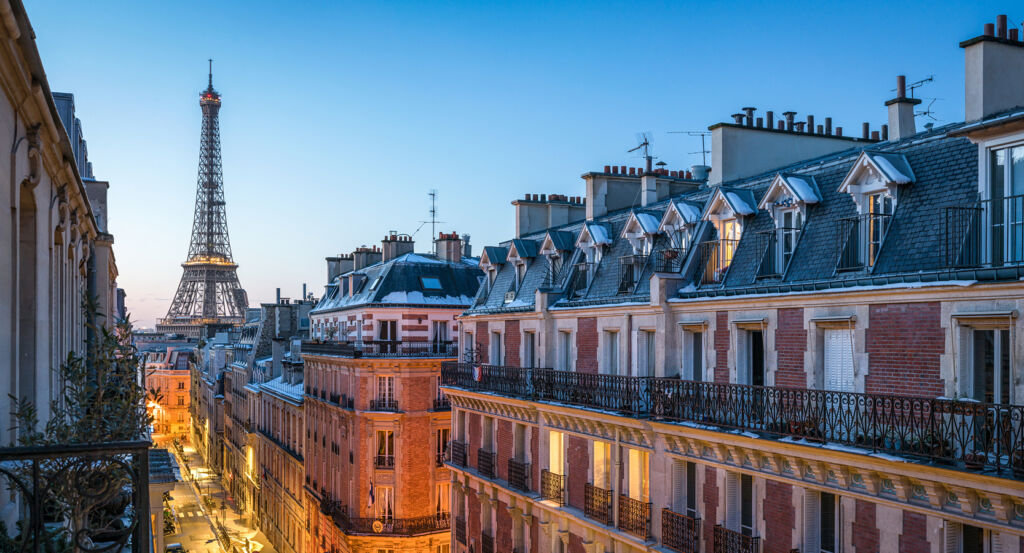
Set along Avenue George V near Avenue des Champs-Élysées and just steps from Rue Vernet, the hotel occupies a prominent Golden Triangle corner where nineteenth-century Parisian façades converge with the expansive commercial axis extending west toward the Arc de Triomphe. Seven previously disparate buildings form the property, combining authentic Haussmannian structures, later pastiches and twentieth-century construction within a single urban block. Édouard François unified those elevations through his moulé-troué treatment, casting a neighboring Haussmannian façade in concrete before piercing the reproduction with large windows independent of its classical ornament. Thousands of vertical aluminum branches transform the internal courtyard into an architectural installation, extending François's intervention from the street elevations into the center of the complex. The result is a hotel whose deliberately manipulated Haussmannian exterior connects a twenty-first-century architectural project with one of the Champs-Élysées' oldest hospitality institutions.
What defines Hôtel Barrière Le Fouquet's.
Hôtel Barrière Le Fouquet's is best known for transforming the historic Fouquet's brasserie and its surrounding buildings into Barrière's first Paris hotel through one of the Champs-Élysées' most architecturally ambitious hospitality developments. Louis Fouquet established the brasserie at 99 Avenue des Champs-Élysées in 1899, beginning an institution whose corner position at Avenue George V preceded the hotel by more than a century. Barrière acquired Fouquet's in 1998 after the restaurant entered judicial restructuring, giving the French hospitality group the property from which it would establish a permanent Paris presence. The brasserie reopened in 2000 after extensive work as plans advanced for a hotel encompassing the surrounding block. Seven buildings had to be reconciled across the site, including three nineteenth-century Haussmannian structures, two later historicist buildings and a 1970s bank with a curtain-wall façade. Dominique Desseigne entrusted Édouard François with the architectural problem, and François developed the moulé-troué system by reproducing an authentic façade from 93-95 Avenue des Champs-Élysées in prefabricated gray concrete panels. Large openings cut independently through that classical pattern allowed the new elevations to satisfy the internal geometry of the hotel as cornices, balconies, floral ornaments, heads and lions preserved the visual cadence of the neighboring streetscape. Jacques Garcia directed the interiors, establishing a separate decorative program within François's architectural shell. The project required €60 million and culminated in the hotel's 2006 inauguration, giving Barrière a Paris flagship physically integrated with the brasserie that had initiated its presence on the block. Another major chapter began in January 2017 when the hotel closed for six months and Garcia returned to renew the interiors, followed by an expansion into space above the historic restaurant. The completed sequence joined a Belle Époque brasserie, multiple generations of Parisian construction and a contemporary architectural intervention within a property whose development depended on preserving the irregular history of an entire city block.
Fouquet's entered French cinema history long before the hotel surrounded it, giving the later property a cultural inheritance rooted in filmmakers, performers and the institutional life of the national film industry. Josephine Baker and Marlene Dietrich belonged to the entertainment figures associated with the brasserie during the interwar decades, followed after the Second World War by filmmakers whose careers helped redefine French cinema. Jean-Luc Godard and François Truffaut became part of its mid-century clientele as the Nouvelle Vague altered international filmmaking through Breathless, The 400 Blows and the broader movement centered on younger French directors. The Académie des Arts et Techniques du Cinéma subsequently bound Fouquet's to the César Awards through its traditional post-ceremony dinner, turning the restaurant into an annual gathering place for the French film industry. Black-and-white portraits of actors and filmmakers became part of the historic dining room's decorative fabric, converting those associations into a permanent visual record inside the property. Historic Monument protection granted in 1990 covered the brasserie's principal dining room, mahogany bar and associated decorative elements, placing legal preservation around the physical setting of that cinematic history. Jacques Garcia incorporated the same cultural inheritance into the hotel created around the restaurant, then returned during the 2017 reconstruction to renew his original interiors through velvet, mahogany, metallic detailing and retained quilted-leather headboards. Pierre Gagnaire simultaneously took responsibility for Fouquet's culinary direction during the reopening, joining one of France's most consequential chefs to the institution's next chapter. The Académie des César continued using Fouquet's for its nominated-artists dinner into 2025, preserving the relationship between the Champs-Élysées property and French cinema more than a century after Louis Fouquet established the original brasserie.
How Hôtel Barrière Le Fouquet's fits.
Hôtel Barrière Le Fouquet's works as an anchor for an outing connecting a philanthropic palace whose metal structure came from Gustave Eiffel's workshops, the historic couture headquarters where Yves Saint Laurent worked for nearly three decades and a reinforced-concrete theater inseparable from one of modern music's most consequential premieres.
Begin at Palais Galliera, commissioned by Marie Brignole-Sale, Duchess of Galliera, to house her art collection and designed by Paul-René-Léon Ginain after construction began in 1879. A metal skeleton fabricated by Gustave Eiffel's enterprise supports the dressed-stone building, whose mosaic floors and painted ceilings involved Giandomenico Facchina. The duchess redirected her collection to Genoa after a legal error frustrated her intended donation, leaving Paris a purpose-built museum. Completed in 1894 and inaugurated the following year, the palace passed through several cultural functions before becoming the city's fashion museum in 1977. Continue to Musée Yves Saint Laurent Paris, occupying the Second Empire hôtel particulier at 5 Avenue Marceau where the couturier transferred his haute couture house in 1974. Yves Saint Laurent worked there for nearly three decades with six or seven studio collaborators, supported by ateliers employing close to 200 tailors and seamstresses who executed the collections presented downstairs. Saint Laurent announced the end of his couture career in January 2002, closing the house that year. The Fondation Pierre Bergé, Yves Saint Laurent opened there after extensive reconstruction in 2004, followed in October 2017 by the museum preserving the historic studio, couture heritage and institutional collection at the address where the work was created. Conclude at Théâtre des Champs-Élysées, initiated by impresario Gabriel Astruc and patron Gabriel Thomas as a new Parisian palace for music and dance. Henry Van de Velde entered the project in 1910 before Auguste and Gustave Perret brought their reinforced-concrete expertise to the structure, making the completed 1913 building Paris's first theater constructed entirely in that material. Antoine Bourdelle developed its sculptural façade program, with Maurice Denis, Édouard Vuillard and Jacqueline Marval contributing to the larger decorative project. Weeks after the opening, Igor Stravinsky's The Rite of Spring, choreographed by Vaslav Nijinsky, produced the premiere that permanently connected the theater with the rupture of twentieth-century modernism. The progression moves from a nineteenth-century philanthropic commission transformed into Paris's fashion museum through the working headquarters of a couturier who reshaped twentieth-century dress and culminates in an architectural and musical project that placed reinforced concrete, modern sculpture and dramatic performance inside a single Paris institution.
Where your story begins.
Foresyte Travel reveals places that feel extraordinary long before you arrive.
Enjoy editorial crafted for luxury travelers.
Foresyte may earn a commission when you book.














































































































