
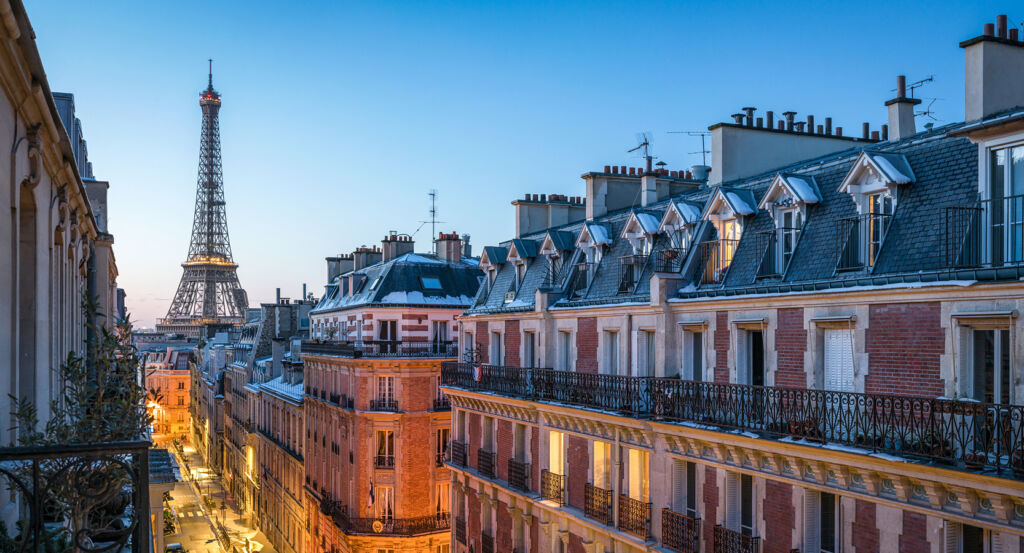
Why you should experience Hôtel Bourgogne & Montana in Paris, France.
Hôtel Bourgogne & Montana is a discreet four-star hotel where Invalides's aristocratic composure, Left Bank artistic culture, architectural inheritance and instinct for cultivated privacy converge within an eighteenth-century house shaped around the quieter codes of Parisian luxury.
Set along Rue de Bourgogne near Rue de l'Université and just steps from the Seine, the 31-room property occupies a private mansion dating to 1791, preserving the intimate proportions and differentiated floor heights inherited from its original domestic architecture. Interior architect Denis Doistau reworked the house in 2014 while retaining its low entresol levels, taller noble floors, moldings, fireplaces and traditionally proportioned wooden windows, allowing the building's original hierarchy to remain legible within the contemporary hotel. Doistau introduced a more graphic counterpoint through black-and-white surfaces, velvet, satin, Piero Fornasetti textiles and an octagonal central courtyard capped by a custom glass roof that draws daylight into the heart of the building. The result is a hotel where eighteenth-century spatial character and Denis Doistau's controlled modernity give Invalides's polished restraint the intimacy of a private Parisian residence.
What you should know about Hôtel Bourgogne & Montana.
Hôtel Bourgogne & Montana is best known for occupying a private mansion built in 1791 whose 31 guestrooms preserve an unusually legible hierarchy between low-ceilinged entresol levels originally associated with service functions and taller noble floors conceived for the principal rooms of the house. Interior architect Denis Doistau retained that vertical organization during the hotel's 2014 renovation, restoring wooden windows according to their original forms while working around surviving moldings, cornices, fireplaces and differing ceiling heights instead of flattening the building into standardized accommodation. The six-floor room program developed four distinct categories around plum, midnight blue, gold and pearl-grey tones, with Piero Fornasetti textiles, parquet, velvet bedcovers and patterned surfaces introducing contemporary decorative tension against the eighteenth-century envelope. At the center of the property, Doistau reopened the architectural importance of an octagonal courtyard that had previously been covered by a concrete slab, replacing it with a custom glass canopy produced by a French workshop and turning the void into the principal source of daylight for the hotel's circulation spaces.
Denis Doistau developed the entresol rooms around their compressed proportions by wrapping walls in cloud-patterned fabric, converting a structural constraint into one of Hôtel Bourgogne & Montana's most specific interior signatures. Piero Fornasetti contributes another layer of visual authorship through celestial fabrics used among the guestrooms, connecting Doistau's restrained architectural structure with the Milanese designer's surreal graphic vocabulary. Eugène Atget enters the composition through photographic prints recalling the private houses of older Paris, while velvet and satin soften the sharper black-and-white geometry repeated between the entrance hall and bathrooms. Together, Denis Doistau, Piero Fornasetti and Eugène Atget create a continuous decorative argument across Hôtel Bourgogne & Montana, moving from preserved eighteenth-century proportions through twentieth-century image-making into a contemporary interior whose personality depends on the tension between historical fabric and graphic invention.
How to fold Hôtel Bourgogne & Montana into your trip.
Hôtel Bourgogne & Montana works as the anchor for an afternoon moving from Belle Époque artistic ambition through the ceremonial culture of French honors into the private-house diplomacy that gives this pocket of the Left Bank its unusual institutional refinement.
Begin at Musée d'Orsay, where Victor Laloux's terminus for the Compagnie d'Orléans opened for the 1900 Exposition Universelle with sixteen underground tracks and a 138-meter-long, 32-meter-high hall before ACT Architecture and Gae Aulenti recast the former station for the museum inaugurated by François Mitterrand in 1986. Continue to Musée de la Légion d'honneur, where General Augustin Dubail drove the creation of a museum inside Hôtel de Salm after earlier exhibitions in 1889 and 1911, opening five galleries in 1925 around royal orders, the Légion d'honneur, international decorations and Maurice Bucquet's collection. Conclude at Maison de l'Amérique latine, founded in 1946 to deepen relations between France and Latin America and housed within Hôtel de Varengeville, designed by Jacques Gabriel in 1704, and Hôtel Amelot de Gournay, created by Germain Boffrand in 1712, with former Hôtel de Varengeville resident Jean-Martin Charcot adding another layer to its intellectual history. The progression moves from Laloux's marriage of engineering and Beaux-Arts performance through France's culture of ceremonial distinction into Gabriel and Boffrand's aristocratic architecture repurposed for international exchange, revealing the artistic, institutional and diplomatic character surrounding Hôtel Bourgogne & Montana.
Where your story begins.
Foresyte Travel reveals places that feel extraordinary long before you arrive.
Experience premium editorial crafted for luxury travelers.














































































































