
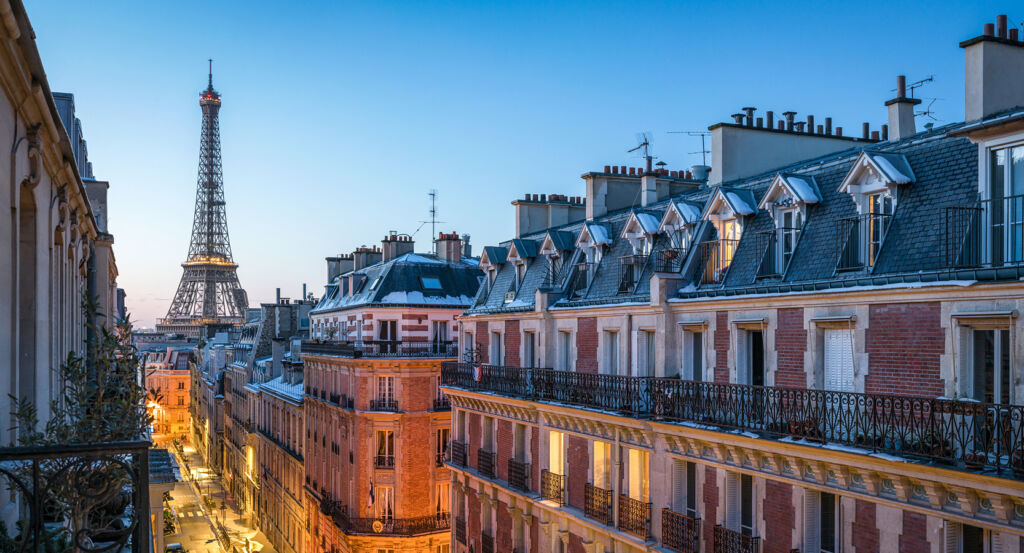
Why you should experience Hotel Brittany 4 étoiles in Paris, France.
Hotel Brittany 4 étoiles is a characterful boutique hotel where Nouvelle Athènes's Romantic imagination, literary sociability, theatrical heritage and nineteenth-century fascination with Britain converge within a lively Parisian interpretation of the Anglo-French country house.
Set along Rue Saint-Lazare near Rue Notre-Dame-de-Lorette and just steps from Église Notre-Dame-de-Lorette, the hotel sits within Nouvelle Athènes, the artistic quarter named by journalist Adolphe Dureau de la Malle in 1823 as painters, writers, musicians and performers gathered around its newly built villas and studios. Scottish tartans, Chesterfield forms, patterned wallpapers, dark woods and references to the British Isles shape the interiors, translating the Brittany name through an intentionally eclectic decorative vocabulary. Guestrooms move between compact contemporary spaces and more elaborate compositions carrying British references, allowing color, pattern and collected objects to establish the house's deliberately individual personality. The result is a hotel where Anglo-French eccentricity feels unexpectedly natural within Nouvelle Athènes, a neighborhood already shaped by George Sand, Frédéric Chopin, Eugène Delacroix and generations of artists who made private interiors central to Parisian creative life.
What you should know about Hotel Brittany 4 étoiles.
Hotel Brittany 4 étoiles is best known for building its character around an Anglo-French decorative dialogue, combining Scottish tartans, Chesterfield-inspired furniture, patterned textiles and British references within a Rue Saint-Lazare address embedded in Nouvelle Athènes, the artistic quarter formally named in 1823 by journalist Adolphe Dureau de la Malle. Nouvelle Athènes developed rapidly from the 1820s as orchards and market gardens gave way to private houses, income properties and artists' studios, with Rue Chaptal opened in 1825 after Alexandre Delessert and Louis Nicolas Hubert Lavocat received royal authorization to connect Rue Blanche with Rue Pigalle. Painter Ary Scheffer settled nearby in 1830 after becoming drawing instructor to the Orléans children in 1822, establishing two north-facing studios where Frédéric Chopin, Franz Liszt, George Sand, Pauline Viardot, Charles Gounod, Gioachino Rossini and Charles Dickens later participated in the celebrated Friday gatherings of Rue Chaptal. The hotel occupies a remarkably coherent cultural setting for its deliberately domestic interiors, with its tartans, upholstered furniture and collected-room atmosphere echoing a district where nineteenth-century artistic exchange frequently unfolded inside private houses and salons.
Église Notre-Dame-de-Lorette provides the strongest architectural expression of the same creative milieu, with Louis-Hippolyte Lebas constructing the neoclassical church between 1823 and 1836 as Nouvelle Athènes expanded around the hotel's immediate surroundings. Pierre-Claude Delorme painted the choir cupola's Translation de la Sainte Maison de Lorette in 1836, while François-Joseph Heim, Michel-Martin Drolling, François-Édouard Picot and Jacques-Victor Orsel contributed major painted programs that turned the interior into a concentrated expression of Restoration and July Monarchy religious art. Georges Bizet was baptized there in 1840 and Claude Monet followed in 1841, connecting Lebas's church with two creative careers that would later reshape French music and painting far beyond the district. Together, Louis-Hippolyte Lebas, Pierre-Claude Delorme, Georges Bizet and Claude Monet deepen Hotel Brittany 4 étoiles's Nouvelle Athènes context, placing its British-inflected interiors within streets whose nineteenth-century character was constructed through architecture, painting, music and unusually concentrated artistic sociability.
How to fold Hotel Brittany 4 étoiles into your trip.
Hotel Brittany 4 étoiles works as the anchor for an afternoon tracing Romantic sociability, artist-house culture and architectural patronage through the unusually intimate creative geography of Nouvelle Athènes.
Begin at Musée de la Vie Romantique, where entrepreneur Wormser built Ary Scheffer's Italianate house in 1830, Scheffer added two north-facing studios for painting and reception, and Friday salons subsequently brought Delacroix, Chopin, Liszt, George Sand, Pauline Viardot, Rossini and Dickens into the property before it became Musée de la Vie Romantique in 1987 and underwent a €3.8 million renovation completed in 2026. Continue to Église Notre-Dame-de-Lorette, where Louis-Hippolyte Lebas constructed a Roman-basilica-inspired church between 1823 and 1836 and assembled an interior enriched by Pierre-Claude Delorme, François-Joseph Heim, Michel-Martin Drolling, François-Édouard Picot and Jacques-Victor Orsel before Georges Bizet and Claude Monet were baptized there in 1840 and 1841. Conclude at Musée Gustave Moreau, the painter's former family home and studio, where Moreau conceived the preservation of his own artistic legacy before his 1898 death, leaving thousands of paintings, watercolors and drawings within the residence and vast upper studios subsequently opened as a museum in 1903. The progression moves from Scheffer's salon culture through Lebas's synthesis of architecture and painting into Moreau's self-fashioned artistic universe, revealing why private houses, creative personalities and intensely authored interiors remain so fundamental to the atmosphere surrounding Hotel Brittany 4 étoiles.
Where your story begins.
Foresyte Travel reveals places that feel extraordinary long before you arrive.
Experience premium editorial crafted for luxury travelers.














































































































