
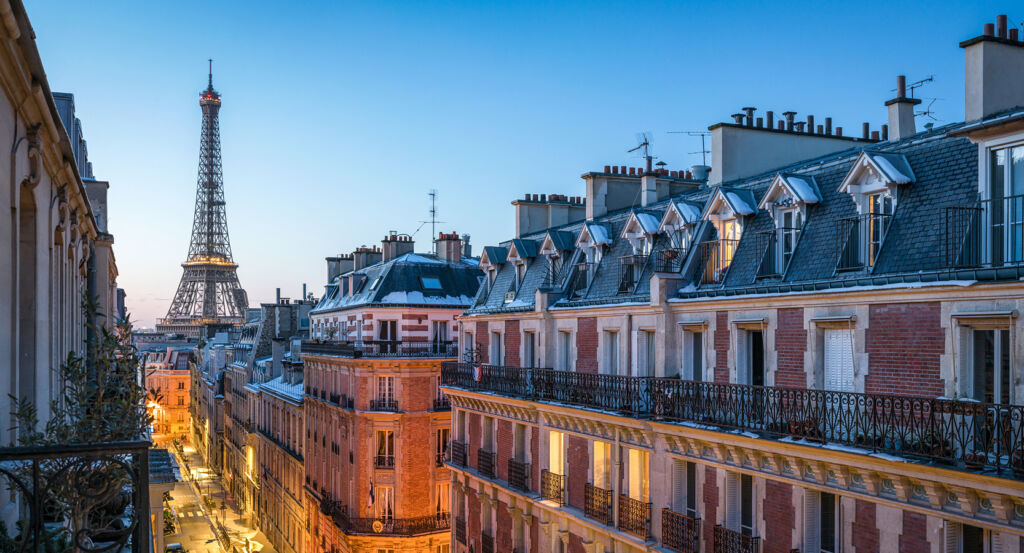
Why you should experience Hôtel de JoBo in Paris, France.
Hôtel de JoBo is an exuberant four-star hotel where Saint-Paul's aristocratic heritage, Napoleonic mythology, decorative audacity and enduring taste for private salons converge inside a fantasy inspired by Joséphine Bonaparte.
Set along Rue d'Ormesson near Rue de Turenne and just steps from Place du Marché Sainte-Catherine, the hotel occupies an intimate Marais address transformed by decorator Bambi Sloan into an imaginary residence for Joséphine, whose nickname supplies the lively “JoBo” identity. Leopard print, rose motifs, saturated reds, velvet, tassels and Directoire references build a deliberately maximalist interior language around the empress's documented passions for fashion, decoration and roses, carrying the concept through guestrooms, salons and the cocktail bar. Sloan approached the project as narrative decoration, allowing historical references to Joséphine's world to coexist with contemporary wit instead of reproducing an Empire-period interior literally. The result is a hotel where Bambi Sloan's theatrical imagination turns Saint-Paul's culture of hôtels particuliers and hidden courtyards into an unusually convincing exercise in historical fantasy.
What you should know about Hôtel de JoBo.
Hôtel de JoBo is best known for opening in 2016 after French decorator Bambi Sloan transformed the property into a 24-room homage to Joséphine de Beauharnais, building its character around the empress's private tastes. Sloan divided the interiors into four decorative worlds inspired by Joséphine, using leopard motifs to evoke the exoticism associated with her circle, rose patterns recalling her celebrated botanical collection at Château de Malmaison, Directoire references connected with the period preceding the Empire and saturated reds that give the house its theatrical intensity. Pierre Frey fabrics contribute to the layered textile program alongside velvet, patterned carpets and custom decorative details, while individually composed guestrooms extend the concept through canopy-like forms, tassels, mirrors and historically inflected furniture. Joséphine's association with roses gives the decorative premise unusual historical substance, since the gardens at Malmaison became one of Europe's important centers of botanical collecting under her patronage and supplied Pierre-Joseph Redouté with specimens for the celebrated botanical plates published in Les Roses between 1817 and 1824.
Bambi Sloan carried the Joséphine narrative beyond the guestrooms into Le Bar de JoBo, conceiving its velvet seating, leopard patterning and intimate scale as another room within the empress's imagined contemporary residence. Pierre Frey reinforces the continuity between sleeping and social spaces through textiles whose dense pattern and color support Sloan's rejection of anonymous hotel minimalism, making fabric one of the principal architectural devices throughout the property. Joséphine de Beauharnais supplies another layer through the recurring bee, rose and feline imagery associated with the decorative vocabulary, allowing historical references to survive as symbols embedded within Sloan's contemporary composition. Together, Bambi Sloan, Pierre Frey, Joséphine de Beauharnais and Pierre-Joseph Redouté give Hôtel de JoBo a coherent chain of authorship linking contemporary Parisian decoration with the collecting, botanical patronage and cultivated theatricality surrounding its namesake.
How to fold Hôtel de JoBo into your trip.
Hôtel de JoBo works as the anchor for an afternoon tracing aristocratic domesticity, literary self-invention and eighteenth-century collecting through the private mansions that make the Marais such a natural setting for JoBo's historical fantasy.
Begin at Musée Carnavalet, Paris's oldest municipal museum, opened on February 25, 1880 inside Hôtel Carnavalet, a mansion substantially remodeled by François Mansart in the seventeenth century and inhabited from 1677 to 1696 by letter writer Madame de Sévigné, before the institution expanded into Hôtel Le Peletier de Saint-Fargeau in 1989 and developed collections spanning Paris from prehistory to the present. Continue to Maison de Victor Hugo, where the writer occupied an apartment in Hôtel de Rohan-Guéménée from 1832 to 1848 before his friend Paul Meurice proposed a memorial museum for Hugo's 1902 centenary, donated his own collection, acquired Juliette Drouet's collection from Louis Koch and helped create the institution that opened on June 30, 1903. Conclude at Musée Cognacq-Jay, where La Samaritaine founders Ernest Cognacq and Marie-Louise Jay's passion for eighteenth-century art evolved from exhibitions at Samaritaine de Luxe beginning in 1925 into a museum inaugurated in 1929, before their collection moved in 1990 to Hôtel Donon, the sixteenth-century residence built after Médéric de Donon acquired the site in 1575. The progression moves from Madame de Sévigné's aristocratic household through Hugo and Meurice's construction of literary memory into Cognacq and Jay's recreation of eighteenth-century collecting culture, revealing the private houses, cultivated personalities and decorative histories that make Hôtel de JoBo's imagined residence feel so completely at home in Saint-Paul.
Where your story begins.
Foresyte Travel reveals places that feel extraordinary long before you arrive.
Experience premium editorial crafted for luxury travelers.














































































































