
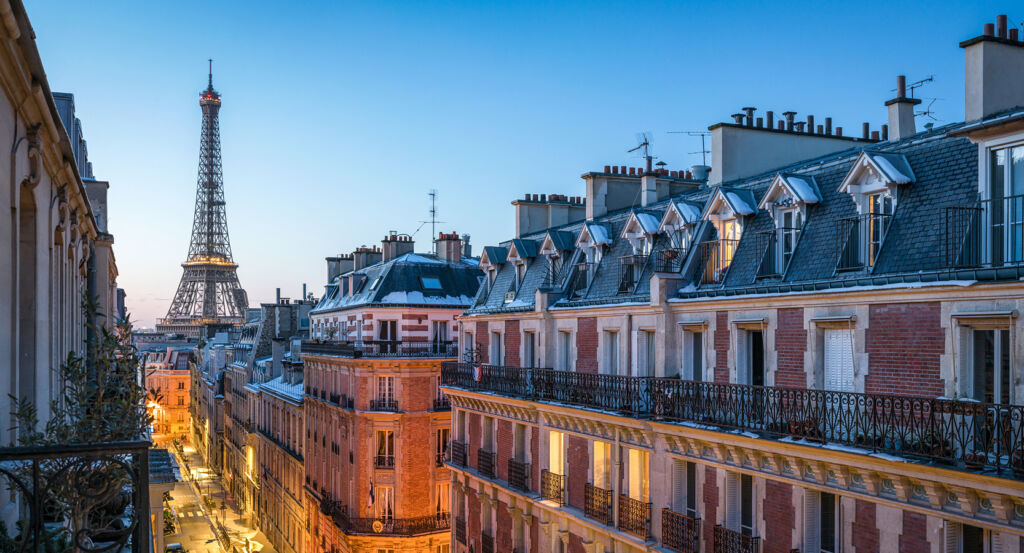
Why you should experience Hôtel de l'Abbaye Saint-Germain in Paris, France.
Hôtel de l'Abbaye Saint-Germain is a contemplative four-star hotel where Saint-Germain-des-Prés's monastic inheritance, Left Bank refinement, private-garden culture and instinct for cultivated domesticity converge within a former Benedictine refuge concealed behind Rue Cassette.
Set along Rue Cassette near Rue de Rennes and just steps from Église Saint-Sulpice, the hotel occupies part of a religious complex established after Benedictine sisters fleeing the wars in Lorraine reached Paris and settled here in 1659 under the protection of Anne of Austria, mother of Louis XIV. The Monastery of Perpetual Adoration of the Blessed Sacrament once extended toward Rue du Cherche-Midi and Rue de Vaugirard, leaving the present hotel with old stonework and an enclosed garden whose wrought-iron furniture, glass-roofed salon and fireplace preserve the intimacy of a private Left Bank house. French decorator Michel Boyer later transformed that inherited fabric through layered prints, colorful patterns and classical furnishings, creating rooms that feel accumulated across generations instead of conceived as a uniform hospitality scheme. The result is a hotel where Benedictine seclusion, Michel Boyer's decorative confidence and a hidden garden give Saint-Germain-des-Prés's cultivated character the rare sensation of having evolved naturally behind the same walls for centuries.
What you should know about Hôtel de l'Abbaye Saint-Germain.
Hôtel de l'Abbaye Saint-Germain is best known for occupying part of the former Monastery of Perpetual Adoration of the Blessed Sacrament, established on Rue Cassette in 1659 when Benedictine sisters displaced by warfare in Lorraine moved from Rue Férou under the protection of Anne of Austria, whose son Louis XIV was then eleven years old. The religious property extended from Rue Cassette toward Rue du Cherche-Midi and Rue de Vaugirard, while surviving stonework and the enclosed garden eventually became the architectural foundation for a hotel that opened in 1973 and today contains 43 rooms and suites. Gisèle and Pierre-Antoine Lafortune, the property's original owners, subsequently commissioned French decorator Michel Boyer during the 1990s to reinterpret the preserved complex, combining prints, colorful patterns and classical French decoration with its old masonry and garden. Boyer's intervention extended through guestrooms and shared interiors toward the glass-roofed Salon, fireplace and planted courtyard, establishing the domestic style that has remained substantially intact since the 1990s renovations.
The Kampf family opened another chapter in Hôtel de l'Abbaye Saint-Germain's history after becoming the property's new owner in 2020, connecting the long-independent Rue Cassette house with a hospitality family already associated with Coeur de Megève. Compagnie Hôtelière de Bagatelle subsequently incorporated Hôtel de l'Abbaye Saint-Germain into a six-property collection that also encompasses Le Roch Hotel & Spa, The Chess Hotel, Platine Hotel, Les Plumes Hotel and Hôtel La Pérouse, while preserving the Abbaye's individual character within the group. SOFIBIM BAGATEL now stands behind that collection, with Hôtel de l'Abbaye Saint-Germain retaining its four-star positioning and the historical Michel Boyer interiors that distinguish the property from Bagatelle's other Parisian houses. Together, the Kampf family, Compagnie Hôtelière de Bagatelle, SOFIBIM BAGATEL and Michel Boyer connect Hôtel de l'Abbaye Saint-Germain's contemporary stewardship with a decorative character created for Gisèle and Pierre-Antoine Lafortune decades earlier, preserving continuity across successive generations of ownership.
How to fold Hôtel de l'Abbaye Saint-Germain into your trip.
Hôtel de l'Abbaye Saint-Germain works as the anchor for an afternoon tracing artistic patronage, institutional collecting and private creative life through the gardens and ateliers surrounding Luxembourg.
Begin at Musée du Luxembourg, whose institutional ancestry reaches 1750, when the Palais du Luxembourg became France's first public museum of antique art and displayed Marie de' Medici's Rubens cycle, before Louis XVIII created a museum for living artists there in 1818 and the Senate financed the present museum building after requisitioning the palace in 1879. Continue to Musée Zadkine, where Ossip Zadkine and painter Valentine Prax settled into the Rue d'Assas house and garden in 1928, before Prax secured the sculptor's legacy through a major 1978 donation, a 1980 bequest of her possessions to the City of Paris and the museum's April 19, 1982 inauguration by Mayor Jacques Chirac. Conclude at Église Saint-Sulpice, where construction begun in the seventeenth century ultimately produced one of Paris's largest churches, with Giovanni Niccolò Servandoni shaping its grand eighteenth-century façade, Jean-Baptiste Languet de Gergy commissioning the astronomical gnomon and Eugène Delacroix completing the Chapel of the Holy Angels paintings during the nineteenth century. The progression moves from royal collections becoming public culture through Zadkine and Prax's private atelier becoming a museum into Saint-Sulpice's centuries of architectural, scientific and artistic patronage, revealing the continuum between contemplation, collecting and creative life surrounding Hôtel de l'Abbaye Saint-Germain.
Where your story begins.
Foresyte Travel reveals places that feel extraordinary long before you arrive.
Experience premium editorial crafted for luxury travelers.














































































































