
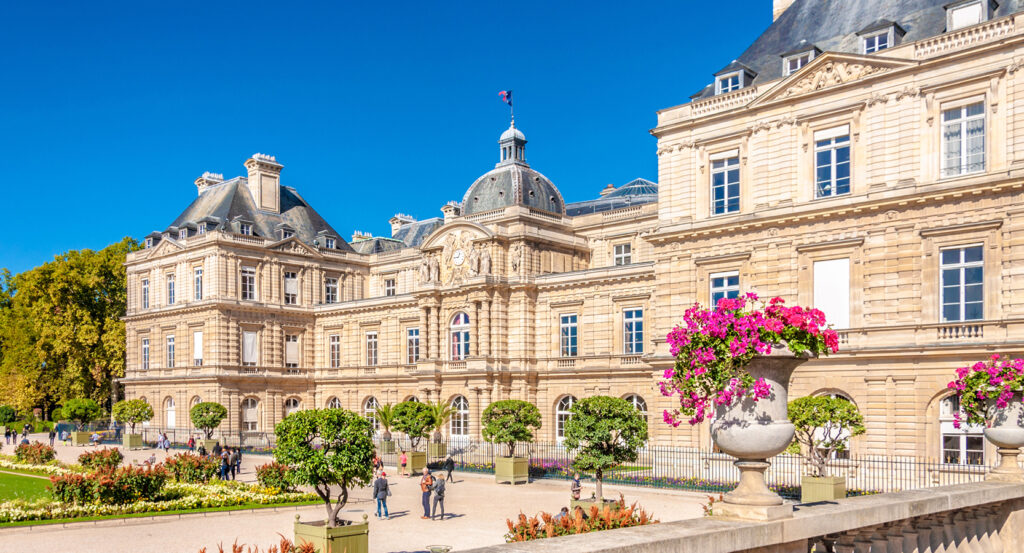
Why Musée du Luxembourg matters.
Musée du Luxembourg is a cultivated exhibition museum where Odéon's literary character meets France's earliest public museum tradition, the Luxembourg Garden and an institution that helped define official recognition for generations of living artists.
Set along Rue de Vaugirard near Rue Férou and just steps from Jardin du Luxembourg, the museum occupies a low garden-edge building where stone facades, chestnut trees, iron gates and the adjoining Senate precinct create a measured transition between Saint-Sulpice's narrow streets and the expansive grounds surrounding Palais du Luxembourg. The long horizontal elevation remains deliberately subordinate to the palace and garden, with its restrained scale preserving views across one of the Left Bank's most architecturally controlled public landscapes. Rue de Vaugirard places the museum against the dense northern edge of the garden as nearby Rue Férou leads toward Place Saint-Sulpice through blocks of historic residences and religious institutions. The entrance opens directly beside the garden, making the building feel physically connected to the palace grounds despite its independent exhibition spaces. The result is a compact museum whose setting binds temporary exhibitions to the palace, garden and Left Bank streets that shaped more than two centuries of its institutional history.
What defines Musée du Luxembourg.
Musée du Luxembourg is best known for descending from the first French museum opened to the public, established inside Palais du Luxembourg in 1750 with royal paintings and Marie de Médicis's celebrated cycle by Peter Paul Rubens. The eastern gallery displayed 110 paintings from the Cabinet du Roi, bringing Leonardo da Vinci, Raphael, Titian, Veronese, Poussin and Rembrandt into a public collection as the western gallery held Rubens's twenty-four canvases devoted to the life of Marie de Médicis. Comte de Provence, the future Louis XVIII, closed the museum in 1780 after taking possession of the palace, ending its first public phase after three decades. The Sénat conservateur revived the institution in 1803 after Joseph-Marie Vien proposed restoring a gallery of painting, and Jean Naigeon became its curator as works by Jacob Jordaens, Eustache Le Sueur and Joseph Vernet entered the renewed display. The political settlement following the Napoleonic Wars altered the museum again when artworks returned to European states and the Louvre reclaimed paintings held at Luxembourg. Louis XVIII approved a new purpose in 1818 by creating a museum devoted to living artists, establishing an official venue where contemporary French production entered state collections. Jacques-Louis David, Anne-Louis Girodet, Pierre-Paul Prud'hon, Jean-Auguste-Dominique Ingres and Eugène Delacroix belonged to the generations represented during this period. Works selected for lasting distinction transferred to the Louvre after their creators died, turning Luxembourg into a first institutional stage within a state museum system that separated living production from established masters. The museum consequently changed from a royal picture gallery into a mechanism for recognizing contemporary art, establishing two precedents that shaped French museum culture across the eighteenth and nineteenth centuries.
The institution entered another decisive phase after the Sénat assumed responsibility for Palais du Luxembourg and its garden in 1879 and pursued a separate building for the growing contemporary collection. Étienne Arago championed the project, and a Sénat report authorized use of available 1884 funds to create a Musée des arts contemporains beside the Orangerie Férou. The new building on Rue de Vaugirard opened on April 1, 1886, freeing the collection from rooms inside the palace and establishing the site occupied by the present museum. Gustave Caillebotte then altered the institution's artistic significance through his bequest of an Impressionist collection to the French state. Acceptance brought works by artists including Camille Pissarro, Édouard Manet, Paul Cézanne, Alfred Sisley, Claude Monet and Pierre-Auguste Renoir into Luxembourg in 1895, marking the first admission of Impressionist painting into a French national museum. The building soon proved too small for an expanding collection whose role had moved far beyond the academic system that governed its earlier decades. Creation of the Musée national d'art moderne at Palais de Tokyo for the 1937 Exposition Internationale ended this chapter, and the Luxembourg collections transferred there. Exhibition activity returned to the Rue de Vaugirard building in 1979, restoring an artistic function to the site more than four decades after the modern collection departed. The Sénat resumed management in 2000, reconnecting the building with the institution responsible for its nineteenth-century construction and extending a museum lineage that had repeatedly changed form without abandoning Luxembourg as its geographic anchor.
How Musée du Luxembourg fits.
Musée du Luxembourg works as the anchor for a daytime exploration through the southern Left Bank using three nearby sites that move from Marie de Médicis's seventeenth-century garden architecture through a major Counter-Reformation church into the preserved home and studio of an École de Paris sculptor.
Begin at Fontaine Médicis, the surviving component of the grottos, fountains and water architecture Marie de Médicis commissioned after establishing her new Parisian residence following Henri IV's death in 1610. Salomon de Brosse designed the palace as Tommaso Francini and Jacques Boyceau de la Barauderie developed the garden's terraces and waterworks with references to the Florentine world of the queen's childhood. Haussmann's creation of Rue de Médicis threatened the grotto during the 1860s, prompting Alphonse de Gisors to dismantle it stone by stone in 1862 and rebuild it thirty meters closer to the palace with a long basin extending between rows of plane trees. Continue to Église Saint-Sulpice, whose present structure rose above a medieval sanctuary through campaigns involving Christophe Gamard, Daniel Gittard, Gilles-Marie Oppenord and Jean-Nicolas Servandoni. Servandoni developed the great western facade, and Jean-François Chalgrin subsequently reshaped its northern tower and Baptismal Chapel. Eugène Delacroix received the commission for the Chapelle des Saints-Anges in 1849 and spent more than a decade developing Jacob Wrestling with the Angel, Heliodorus Driven from the Temple and Saint Michael Defeating the Devil before the chapel opened in 1861. Conclude at Musée Zadkine, where Ossip Zadkine and painter Valentine Prax settled in a house and studio on Rue d'Assas in 1928. Zadkine's years there accompanied exhibitions in London, Venice, Brussels and New York and a shift toward works modeled for bronze alongside his continuing practice of direct carving. After Zadkine's death in 1967, Prax safeguarded his work and bequeathed their property and collections to the City of Paris in 1978; the museum opened on April 19, 1982, preserving sculpture, drawings, photographs and Prax's work within the garden and studios where the couple created them. The progression moves from Marie de Médicis's surviving garden architecture through Saint-Sulpice's centuries of architectural and artistic commissions into Zadkine and Prax's preserved working environment, carrying the surrounding district from royal patronage through ecclesiastical art to twentieth-century studio culture.
Where your story begins.
Foresyte Travel reveals places that feel extraordinary long before you arrive.
Experience premium editorial crafted for luxury travelers.
Foresyte Travel may earn a commission when you book through the link on this page.














































































































