
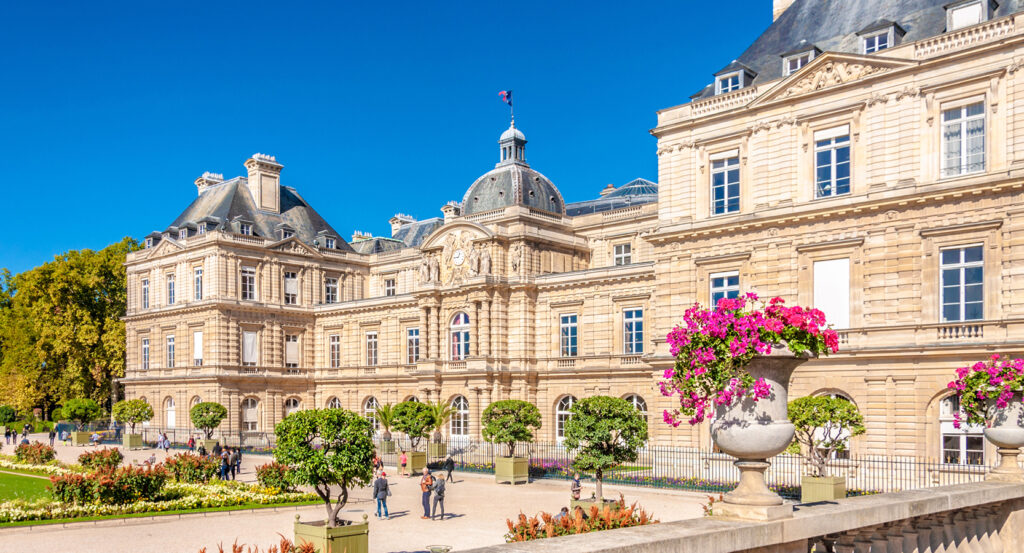
Why Luxembourg Palace matters.
Luxembourg Palace is a regal political palace where the Latin Quarter's scholarly character meets Marie de Médicis's royal ambitions, seventeenth-century French architecture and four centuries of adaptation from princely residence to parliamentary seat.
Set along Rue de Vaugirard near Rue de Médicis and just steps from Rue de Tournon, the palace occupies the northern edge of the Luxembourg Garden where its rusticated stone elevations, projecting pavilions and enclosed cour d'honneur form an imposing architectural boundary between Saint-Germain-des-Prés and the greener avenues descending toward the Observatoire. The main corps de logis rises behind a deep forecourt framed by symmetrical wings, creating a ceremonial composition distinct from the closely packed residential streets immediately north. The garden facade opens toward broad terraces, clipped planting and long tree-lined perspectives that extend the building's presence deep into the southern Left Bank. Petit Luxembourg and its enclosed garden continue the complex westward along Rue de Vaugirard as the eastern side approaches the streets surrounding the Odéon and Rue de Médicis. The result is a palace whose architectural authority comes from the sustained relationship between royal residence, formal garden and the dense intellectual quarter that developed around them.
What defines Luxembourg Palace.
Luxembourg Palace is best known for the residence Marie de Médicis commissioned from Salomon de Brosse after the death of Henri IV, creating a royal retreat whose political history soon overtook the queen who built it. Marie purchased François de Luxembourg's neighboring property on April 2, 1612 for 93,000 livres and assembled additional parcels before entrusting construction of the new palace to de Brosse in 1615. Work continued for more than fifteen years, with the queen occupying the western apartments from 1625 even before the entire complex was finished. Peter Paul Rubens received one of its most consequential artistic commissions, producing twenty-four canvases devoted to Marie's life and regency for the western gallery. A corresponding cycle celebrating Henri IV was planned for the eastern gallery but collapsed amid disagreements between Rubens and the queen, leaving only preparatory work from the unrealized commission. Political conflict reached the palace itself during the Journée des Dupes in November 1630, when Marie attempted to force Louis XIII to dismiss Cardinal Richelieu and instead lost her struggle for influence over the king. Exile followed in 1631, the same year the palace approached completion, and Marie never returned to the residence she had spent nearly two decades creating. Gaston d'Orléans inherited it after her death in 1642, followed by his widow and daughters, including Anne Marie Louise d'Orléans, the Grande Mademoiselle. The Duchess of Guise gave the property to Louis XIV in 1694, moving a residence born from Marie's personal court into the royal domain. Luxembourg Palace emerged from that sequence as both an architectural project of Bourbon queenship and the setting for the political defeat that ended its patron's life in France.
The French Revolution initiated the institutional transformations that converted the former royal residence into a legislative palace. Declared national property in 1791, Luxembourg became a prison during the Terror and held prisoners including Camille Desmoulins, Georges Danton and André Chénier before assignment to the Directoire in 1795. The Constitution of Year VIII transferred the complex to the Sénat conservateur at the end of 1799, forcing Jean-François-Thérèse Chalgrin to adapt royal apartments for a political assembly. Chalgrin removed Salomon de Brosse's principal staircase, constructed a columned vestibule and created a new grand stair in the western wing, sacrificing the former Rubens gallery as parliamentary circulation replaced the palace's original residential organization. Growth of the Chamber of Peers prompted another decisive intervention under Alphonse de Gisors beginning in 1836, when the southern facade was advanced thirty meters into the garden to accommodate a larger chamber and library. Eugène Delacroix spent six years decorating the library cupola and apse, completing the commission in 1846 within Gisors's 52-meter gallery. The Third Republic assigned the palace to the Senate in 1879, establishing the parliamentary role that continued through successive republican institutions apart from wartime interruption. Luftwaffe-West occupied the complex during the German occupation before liberation on August 25, 1944, after which it housed the Provisional Consultative Assembly, High Court of Justice and 1946 Paris Peace Conference. The Senate of the Fifth Republic has occupied Luxembourg Palace since 1958, completing a transformation in which revolutionary confiscation, Chalgrin's reconstruction and Gisors's enlargement converted Marie de Médicis's residence into one of France's principal parliamentary buildings.
How the Luxembourg Palace fits.
Luxembourg Palace works as the anchor for a daytime exploration across the southern Left Bank using three nearby sites that move from Counter-Reformation church building through Enlightenment architecture recast by revolutionary commemoration into a scientific institution organized around the measurement of the heavens.
Begin at Saint-Sulpice, where a medieval parish church proved inadequate for the growing Faubourg Saint-Germain and a replacement received its first stone from Anne of Austria on February 20, 1646. Christophe Gamard began the new structure before Louis Le Vau and Daniel Gittard entered the project, with Gittard establishing the principal plan that guided much of the subsequent campaign. Jean-Nicolas Servandoni won the 1733 competition for the western facade, introducing the two superimposed colonnades that gave the church a markedly different architectural character from its seventeenth-century body. Later artistic commissions extended the building's chronology through Eugène Delacroix's paintings in the Chapel of the Holy Angels and Aristide Cavaillé-Coll's nineteenth-century organ, an instrument closely associated with Charles-Marie Widor and Marcel Dupré. Continue to the Panthéon, conceived by Jacques-Germain Soufflot as the new church of Sainte-Geneviève under Louis XV and developed around a Greek-cross plan surmounted by a triple dome. Soufflot sought an architectural achievement capable of standing beside St. Peter's in Rome and St. Paul's in London, but died before completion, leaving Maximilien Brébion and Jean-Baptiste Rondelet to finish the project in 1790. Revolutionaries converted the church into a national memorial in 1791, beginning a century in which religious and secular functions changed repeatedly with successive regimes. Victor Hugo's interment in 1885 consolidated its modern commemorative role, and the crypt subsequently received figures including Voltaire, Rousseau, Émile Zola, Pierre and Marie Curie and Simone Veil. Conclude at Observatoire de Paris, founded under Louis XIV and Colbert in 1667 and constructed by Claude Perrault between 1667 and 1672. Astronomers fixed the property's north-south orientation before architectural work advanced, forcing Perrault to make that scientific line the building's axis of symmetry and establishing the Paris meridian through the institution. The rectangular structure, octagonal towers and cardinally aligned elevations translated astronomical measurement directly into architecture, and later scientific buildings expanded through the grounds as new instruments arrived. The progression moves from Gittard and Servandoni's centuries-long construction of Saint-Sulpice through Soufflot's royal church transformed into a national memorial into Perrault's building physically aligned with the Paris meridian, developing three institutions through religion, public commemoration and empirical science across the southern Left Bank.
Where your story begins.
Foresyte Travel reveals places that feel extraordinary long before you arrive.
Enjoy editorial crafted for luxury travelers.
Foresyte may earn a commission when you book.














































































































